Back

Haptic Intelligence Members Publications

Novel Designs and Rendering Algorithms for Fingertip Haptic Devices
Fuppeteer white bg
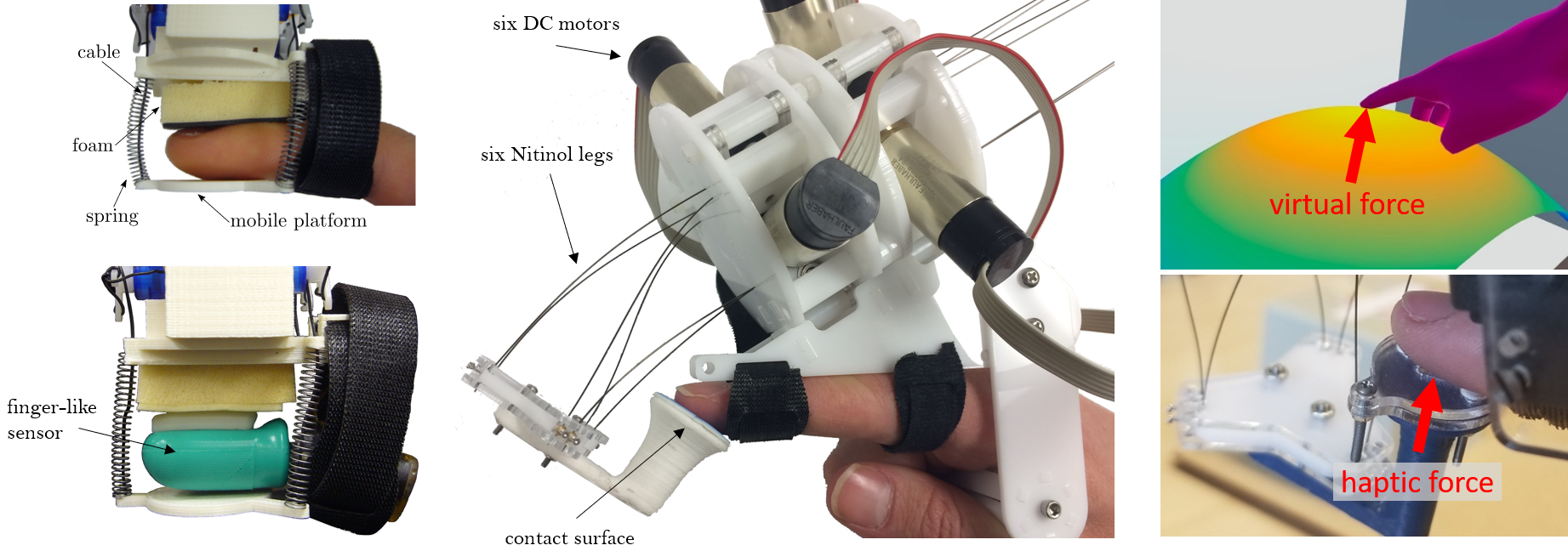
This project introduces a wide assortment of fingertip haptic devices and their rendering algorithms. Left: a three-degree-of-freedom (3-DOF) device that can render haptic sensations to a human finger (top) or a finger-like sensor for data collection (bottom). Middle: our 6-DOF fingertip haptic device that renders rich contact sensations by controlling the lengths of six elastic legs. Right: an example of a virtual interaction rendered by this 6-DOF device.

Members

Thumb ticker sm mpi website
Haptic Intelligence
Thumb ticker sm picture david
Haptic Intelligence
  • Research Scientist
Thumb ticker sm thumb ticker kjk 2024
Haptic Intelligence
Director

Publications

Haptic Intelligence Conference Paper Ungrounded Vari-Dimensional Tactile Fingertip Feedback for Virtual Object Interaction Young, E. M., Kuchenbecker, K. J. In Proceedings of the CHI Conference on Human Factors in Computing Systems, (217)1-14, ACM, Yokohama, Japan, May 2021 (Published)
Compared to grounded force feedback, providing tactile feedback via a wearable device can free the user and broaden the potential applications of simulated physical interactions. However, neither the limitations nor the full potential of tactile-only feedback have been precisely examined. Here we investigate how the dimensionality of cutaneous fingertip feedback affects user movements and virtual object recognition. We combine a recently invented 6-DOF fingertip device with motion tracking, a head-mounted display, and novel contact-rendering algorithms to enable a user to tactilely explore immersive virtual environments. We evaluate rudimentary 1-DOF, moderate 3-DOF, and complex 6-DOF tactile feedback during shape discrimination and mass discrimination, also comparing to interactions with real objects. Results from 20 naive study participants show that higher-dimensional tactile feedback may indeed allow completion of a wider range of virtual tasks, but that feedback dimensionality surprisingly does not greatly affect the exploratory techniques employed by the user.
DOI BibTeX

Haptic Intelligence Ph.D. Thesis Delivering Expressive and Personalized Fingertip Tactile Cues Young, E. M. University of Pennsylvania, Philadelphia, PA, December 2020, Department of Mechanical Engineering and Applied Mechanics (Published)
Wearable haptic devices have seen growing interest in recent years, but providing realistic tactile feedback is not a challenge that is soon to be solved. Daily interac- tions with physical objects elicit complex sensations at the fingertips. Furthermore, human fingertips exhibit a broad range of physical dimensions and perceptive abilities, adding increased complexity to the task of simulating haptic interactions in a compelling manner. However, as the applications of wearable haptic feedback grow, concerns of wearability and generalizability often persuade tactile device designers to simplify the complexities associated with rendering realistic haptic sensations. As such, wearable devices tend to be optimized for particular uses and average users, rendering only the most salient dimensions of tactile feedback for a given task and assuming all users interpret the feedback in a similar fashion. We propose that providing more realistic haptic feedback will require in-depth examinations of higher-dimensional tactile cues and personalization of these cues for individual users. In this thesis, we aim to provide hardware and software-based solutions for rendering more expressive and personalized tactile cues to the fingertip. We first explore the idea of rendering six-degree-of-freedom (6-DOF) tactile fingertip feedback via a wearable device, such that any possible fingertip interaction with a flat surface can be simulated. We highlight the potential of parallel continuum manipulators (PCMs) to meet the requirements of such a device, and we refine the design of a PCM for providing fingertip tactile cues. We construct a manually actuated prototype to validate the concept, and then continue to develop a motorized version, named the Fingertip Puppeteer, or Fuppeteer for short. Various error reduction techniques are presented, and the resulting device is evaluated by analyzing system responses to step inputs, measuring forces rendered to a biomimetic finger sensor, and comparing intended sensations to perceived sensations of twenty-four participants in a human-subject study. Once the functionality of the Fuppeteer is validated, we begin to explore how the device can be used to broaden our understanding of higher-dimensional tactile feedback. One such application is using the 6-DOF device to simulate different lower-dimensional devices. We evaluate 1-, 3-, and 6-DOF tactile feedback during shape discrimination and mass discrimination in a virtual environment, also comparing to interactions with real objects. Results from 20 naive study participants show that higher-dimensional tactile feedback may indeed allow completion of a wider range of virtual tasks, but that feedback dimensionality surprisingly does not greatly affect the exploratory techniques employed by the user. To address alternative approaches to improving tactile rendering in scenarios where low-dimensional tactile feedback is appropriate, we then explore the idea of personalizing feedback for a particular user. We present two software-based approaches to personalize an existing data-driven haptic rendering algorithm for fingertips of different sizes. We evaluate our algorithms in the rendering of pre-recorded tactile sensations onto rubber casts of six different fingertips as well as onto the real fingertips of 13 human participants, all via a 3-DOF wearable device. Results show that both personalization approaches significantly reduced force error magnitudes and improved realism ratings.
BibTeX

Haptic Intelligence Article Compensating for Fingertip Size to Render Tactile Cues More Accurately Young, E. M., Gueorguiev, D., Kuchenbecker, K. J., Pacchierotti, C. IEEE Transactions on Haptics, 13(1):144-151, January 2020, Katherine J. Kuchenbecker and Claudio Pacchierotti contributed equally to this publication. Presented at the IEEE World Haptics Conference (WHC) (Published)
Fingertip haptic feedback offers advantages in many applications, including robotic teleoperation, gaming, and training. However, fingertip size and shape vary significantly across humans, making it difficult to design fingertip interfaces and rendering techniques suitable for everyone. This article starts with an existing data-driven haptic rendering algorithm that ignores fingertip size, and it then develops two software-based approaches to personalize this algorithm for fingertips of different sizes using either additional data or geometry. We evaluate our algorithms in the rendering of pre-recorded tactile sensations onto rubber casts of six different fingertips as well as onto the real fingertips of 13 human participants. Results on the casts show that both approaches significantly improve performance, reducing force error magnitudes by an average of 78% with respect to the standard non-personalized rendering technique. Congruent results were obtained for real fingertips, with subjects rating each of the two personalized rendering techniques significantly better than the standard non-personalized method.
DOI BibTeX

Haptic Intelligence Article Implementation of a 6-DOF Parallel Continuum Manipulator for Delivering Fingertip Tactile Cues Young, E. M., Kuchenbecker, K. J. IEEE Transactions on Haptics, 12(3):295-306, June 2019 (Published)
Existing fingertip haptic devices can deliver different subsets of tactile cues in a compact package, but we have not yet seen a wearable six-degree-of-freedom (6-DOF) display. This paper presents the Fuppeteer (short for Fingertip Puppeteer), a device that is capable of controlling the position and orientation of a flat platform, such that any combination of normal and shear force can be delivered at any location on any human fingertip. We build on our previous work of designing a parallel continuum manipulator for fingertip haptics by presenting a motorized version in which six flexible Nitinol wires are actuated via independent roller mechanisms and proportional-derivative controllers. We evaluate the settling time and end-effector vibrations observed during system responses to step inputs. After creating a six-dimensional lookup table and adjusting simulated inputs using measured Jacobians, we show that the device can make contact with all parts of the fingertip with a mean error of 1.42 mm. Finally, we present results from a human-subject study. A total of 24 users discerned 9 evenly distributed contact locations with an average accuracy of 80.5%. Translational and rotational shear cues were identified reasonably well near the center of the fingertip and more poorly around the edges.
DOI BibTeX

Haptic Intelligence Article Task-Driven PCA-Based Design Optimization of Wearable Cutaneous Devices Pacchierotti, C., Young, E. M., Kuchenbecker, K. J. IEEE Robotics and Automation Letters, 3(3):2214-2221, July 2018, Presented at ICRA 2018 (Published)
Small size and low weight are critical requirements for wearable and portable haptic interfaces, making it essential to work toward the optimization of their sensing and actuation systems. This paper presents a new approach for task-driven design optimization of fingertip cutaneous haptic devices. Given one (or more) target tactile interactions to render and a cutaneous device to optimize, we evaluate the minimum number and best configuration of the device’s actuators to minimize the estimated haptic rendering error. First, we calculate the motion needed for the original cutaneous device to render the considered target interaction. Then, we run a principal component analysis (PCA) to search for possible couplings between the original motor inputs, looking also for the best way to reconfigure them. If some couplings exist, we can re-design our cutaneous device with fewer motors, optimally configured to render the target tactile sensation. The proposed approach is quite general and can be applied to different tactile sensors and cutaneous devices. We validated it using a BioTac tactile sensor and custom plate-based 3-DoF and 6-DoF fingertip cutaneous devices, considering six representative target tactile interactions. The algorithm was able to find couplings between each device’s motor inputs, proving it to be a viable approach to optimize the design of wearable and portable cutaneous devices. Finally, we present two examples of optimized designs for our 3-DoF fingertip cutaneous device.
DOI BibTeX

Haptic Intelligence Conference Paper Design of a Parallel Continuum Manipulator for 6-DOF Fingertip Haptic Display Young, E. M., Kuchenbecker, K. J. In Proceedings of the IEEE World Haptics Conference (WHC), 599-604, Munich, Germany, June 2017, Finalist for best poster paper (Published)
Despite rapid advancements in the field of fingertip haptics, rendering tactile cues with six degrees of freedom (6 DOF) remains an elusive challenge. In this paper, we investigate the potential of displaying fingertip haptic sensations with a 6-DOF parallel continuum manipulator (PCM) that mounts to the user's index finger and moves a contact platform around the fingertip. Compared to traditional mechanisms composed of rigid links and discrete joints, PCMs have the potential to be strong, dexterous, and compact, but they are also more complicated to design. We define the design space of 6-DOF parallel continuum manipulators and outline a process for refining such a device for fingertip haptic applications. Following extensive simulation, we obtain 12 designs that meet our specifications, construct a manually actuated prototype of one such design, and evaluate the simulation's ability to accurately predict the prototype's motion. Finally, we demonstrate the range of deliverable fingertip tactile cues, including a normal force into the finger and shear forces tangent to the finger at three extreme points on the boundary of the fingertip.
DOI BibTeX