Back

Haptic Intelligence Members Publications

Finger-Surface Contact Mechanics in Diverse Moisture Conditions
Sab moisture 20210914 gs
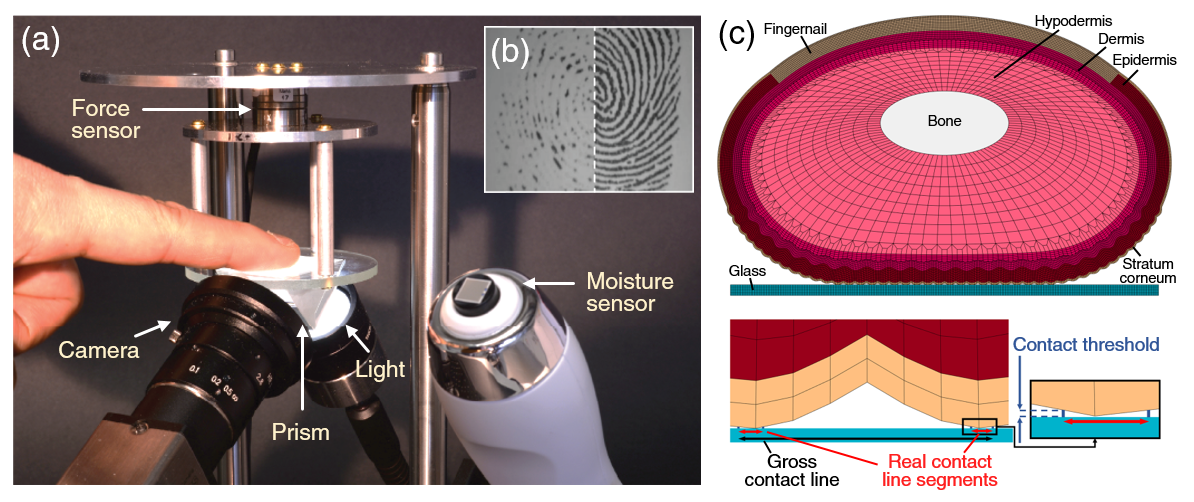
(a) One apparatus to measure three-dimensional contact forces, fingerprints over time, and finger moisture. (b) Two captured images showing the real contact area with a dry (left) or moist (right) finger. (c) One of our fingertip finite element models in frictional contact with a surface and the associated contact area calculation.

Members

Thumb ticker sm saekwang crop2
Haptic Intelligence
  • Doctoral Researcher
Thumb ticker sm gs photo recent square
Haptic Intelligence
  • Guest Scientist
Thumb ticker sm img 3687 2
Haptic Intelligence
Thumb ticker sm picture david
Haptic Intelligence
  • Research Scientist
Thumb ticker sm thumb ticker kjk 2024
Haptic Intelligence
Director

Publications

Haptic Intelligence Ph.D. Thesis Understanding the Influence of Moisture on Fingerpad-Surface Interactions Nam, S. University of Tübingen, Tübingen, Germany, October 2022, Department of Computer Science (Published)
People frequently touch objects with their fingers. The physical deformation of a finger pressing an object surface stimulates mechanoreceptors, resulting in a perceptual experience. Through interactions between perceptual sensations and motor control, humans naturally acquire the ability to manage friction under various contact conditions. Many researchers have advanced our understanding of human fingers to this point, but their complex structure and the variations in friction they experience due to continuously changing contact conditions necessitate additional study. Moisture is a primary factor that influences many aspects of the finger. In particular, sweat excreted from the numerous sweat pores on the fingerprints modifies the finger's material properties and the contact conditions between the finger and a surface. Measuring changes of the finger's moisture over time and in response to external stimuli presents a challenge for researchers, as commercial moisture sensors do not provide continuous measurements. This dissertation investigates the influence of moisture on fingerpad-surface interactions from diverse perspectives. First, we examine the extent to which moisture on the finger contributes to the sensation of stickiness during contact with glass. Second, we investigate the representative material properties of a finger at three distinct moisture levels, since the softness of human skin varies significantly with moisture. The third perspective is friction; we examine how the contact conditions, including the moisture of a finger, determine the available friction force opposing lateral sliding on glass. Fourth, we have invented and prototyped a transparent in vivo moisture sensor for the continuous measurement of finger hydration. In the first part of this dissertation, we explore how the perceptual intensity of light stickiness relates to the physical interaction between the skin and the surface. We conducted a psychophysical experiment in which nine participants actively pressed their index finger on a flat glass plate with a normal force close to 1.5 N and then detached it after a few seconds. A custom-designed apparatus recorded the contact force vector and the finger contact area during each interaction as well as pre- and post-trial finger moisture. After detaching their finger, participants judged the stickiness of the glass using a nine-point scale. We explored how sixteen physical variables derived from the recorded data correlate with each other and with the stickiness judgments of each participant. These analyses indicate that stickiness perception mainly depends on the pre-detachment pressing duration, the time taken for the finger to detach, and the impulse in the normal direction after the normal force changes sign; finger-surface adhesion seems to build with pressing time, causing a larger normal impulse during detachment and thus a more intense stickiness sensation. We additionally found a strong between-subjects correlation between maximum real contact area and peak pull-off force, as well as between finger moisture and impulse. When a fingerpad presses into a hard surface, the development of the contact area depends on the pressing force and speed. Importantly, it also varies with the finger's moisture, presumably because hydration changes the tissue's material properties. Therefore, for the second part of this dissertation, we collected data from one finger repeatedly pressing a glass plate under three moisture conditions, and we constructed a finite element model that we optimized to simulate the same three scenarios. We controlled the moisture of the subject's finger to be dry, natural, or moist and recorded 15 pressing trials in each condition. The measurements include normal force over time plus finger-contact images that are processed to yield gross contact area. We defined the axially symmetric 3D model's lumped parameters to include an SLS-Kelvin model (spring in series with parallel spring and damper) for the bulk tissue, plus an elastic epidermal layer. Particle swarm optimization was used to find the parameter values that cause the simulation to best match the trials recorded in each moisture condition. The results show that the softness of the bulk tissue reduces as the finger becomes more hydrated. The epidermis of the moist finger model is softest, while the natural finger model has the highest viscosity. In the third part of this dissertation, we focused on friction between the fingerpad and the surface. The magnitude of finger-surface friction available at the onset of full slip is crucial for understanding how the human hand can grip and manipulate objects. Related studies revealed the significance of moisture and contact time in enhancing friction. Recent research additionally indicated that surface temperature may also affect friction. However, previously reported friction coefficients have been measured only in dynamic contact conditions, where the finger is already sliding across the surface. In this study, we repeatedly measured the initial friction before full slip under eight contact conditions with low and high finger moisture, pressing time, and surface temperature. Moisture and pressing time both independently increased finger-surface friction across our population of twelve participants, and the effect of surface temperature depended on the contact conditions. Furthermore, detailed analysis of the recorded measurements indicates that micro stick-slip during the partial-slip phase contributes to enhanced friction. For the fourth and final part of this dissertation, we designed a transparent moisture sensor for continuous measurement of fingerpad hydration. Because various stimuli cause the sweat pores on fingerprints to excrete sweat, many researchers want to quantify the flow and assess its impact on the formation of the contact area. Unfortunately, the most popular sensor for skin hydration is opaque and does not offer continuous measurements. Our capacitive moisture sensor consists of a pair of inter-digital electrodes covered by an insulating layer, enabling impedance measurements across a wide frequency range. This proposed sensor is made entirely of transparent materials, which allows us to simultaneously measure the finger's contact area. Electrochemical impedance spectroscopy identifies the equivalent electrical circuit and the electrical component parameters that are affected by the amount of moisture present on the surface of the sensor. Most notably, the impedance at 1 kHz seems to best reflect the relative amount of sweat.
DOI BibTeX

Haptic Intelligence Article Contact Evolution of Dry and Hydrated Fingertips at Initial Touch Serhat, G., Vardar, Y., Kuchenbecker, K. J. PLOS ONE, 17(7):e0269722, July 2022, Gokhan Serhat and Yasemin Vardar contributed equally to this publication (Published)
Pressing the fingertips into surfaces causes skin deformations that enable humans to grip objects and sense their physical properties. This process involves intricate finger geometry, non-uniform tissue properties, and moisture, complicating the underlying contact mechanics. Here we explore the initial contact evolution of dry and hydrated fingers to isolate the roles of governing physical factors. Two participants gradually pressed an index finger on a glass surface under three moisture conditions: dry, water-hydrated, and glycerin-hydrated. Gross and real contact area were optically measured over time, revealing that glycerin hydration produced strikingly higher real contact area, while gross contact area was similar for all conditions. To elucidate the causes for this phenomenon, we investigated the combined effects of tissue elasticity, skin-surface friction, and fingerprint ridges on contact area using simulation. Our analyses show the dominant influence of elastic modulus over friction and an unusual contact phenomenon, which we call friction-induced hinging.
DOI BibTeX

Haptic Intelligence Miscellaneous Finger Contact during Pressing and Sliding on a Glass Plate Nam, S., Gueorguiev, D., Kuchenbecker, K. J. Poster presented at the EuroHaptics Workshop on Skin Mechanics and its Role in Manipulation and Perception, Hamburg, Germany, May 2022 (Published)
Light contact between the finger and the surface of an object sometimes causes an unanticipated slip. However, conditions causing this slip have not been fully understood, mainly because the biological components interact in complex ways to generate the skin-surface frictional properties. We investigated how the contact area starts slipping in various conditions of moisture, occlusion, and temperature during a lateral motion performed while pressing lightly on the surface.
BibTeX

Haptic Intelligence Article Optimizing a Viscoelastic Finite Element Model to Represent the Dry, Natural, and Moist Human Finger Pressing on Glass Nam, S., Kuchenbecker, K. J. IEEE Transactions on Haptics, 14(2):303-309, IEEE, April 2021, Presented at the IEEE World Haptics Conference (WHC) (Published)
When a fingerpad presses into a hard surface, the development of the contact area depends on the pressing force and speed. Importantly, it also varies with the finger's moisture, presumably because hydration changes the tissue's material properties. Therefore, we collected data from one finger repeatedly pressing a glass plate under three moisture conditions, and we constructed a finite element model that we optimized to simulate the same three scenarios. We controlled the moisture of the subject's finger to be dry, natural, or moist and recorded 15 pressing trials in each condition. The measurements include normal force over time plus finger-contact images that are processed to yield gross contact area. We defined the axially symmetric 3D model's lumped parameters to include an SLS-Kelvin model (spring in series with parallel spring and damper) for the bulk tissue, plus an elastic epidermal layer. Particle swarm optimization was used to find the parameter values that cause the simulation to best match the trials recorded in each moisture condition. The results show that the softness of the bulk tissue reduces as the finger becomes more hydrated. The epidermis of the moist finger model is softest, while the natural finger model has the highest viscosity.
DOI BibTeX

Haptic Intelligence Miscellaneous Sweat Softens the Outermost Layer of the Human Finger Pad: Evidence from Simulations and Experiments Nam, S., Kuchenbecker, K. J. Work-in-progress poster presented at EuroHaptics, Leiden, The Netherlands, September 2020 (Published)
The softness of human finger pads renders them highly effective at grasping objects. It has recently been debated whether sweat secreted from the finger pad alters the softness of the stratum corneum, the outermost layer of skin. However, it is not feasible to mechanically test in vivo skin to understand the properties of only the stratum corneum layer. To address this open question, we created a finite element model of a finger pad touching a glass plate in COMSOL Multiphysics, and we tuned it to fit contact data for a particular human finger. The experimental data were collected using a previously developed apparatus that records gross contact area and normal force over time; one participant conducted a finger-pressing test 15 times at each of three moisture levels (dry, moderate, and highly moist). We then used repeated contact simulations to determine the most likely mechanical properties of the stratum corneum layer for each condition. Applying a one-term Ogden hyper-elastic model with a fixed strain hardening exponent (α=9), we found the best shear moduli (μ) by comparing the contact area as a function of normal force between the simulations and the experiments. Our results show that the stratum corneum of the highly moist finger is indeed significantly softer than that of the same finger when it is only moderately moist or dry.
BibTeX

Haptic Intelligence Article Physical Variables Underlying Tactile Stickiness during Fingerpad Detachment Nam, S., Vardar, Y., Gueorguiev, D., Kuchenbecker, K. J. Frontiers in Neuroscience, 14:1-14, April 2020 (Published)
One may notice a relatively wide range of tactile sensations even when touching the same hard, flat surface in similar ways. Little is known about the reasons for this variability, so we decided to investigate how the perceptual intensity of light stickiness relates to the physical interaction between the skin and the surface. We conducted a psychophysical experiment in which nine participants actively pressed their finger on a flat glass plate with a normal force close to 1.5 N and detached it after a few seconds. A custom-designed apparatus recorded the contact force vector and the finger contact area during each interaction as well as pre- and post-trial finger moisture. After detaching their finger, participants judged the stickiness of the glass using a nine-point scale. We explored how sixteen physical variables derived from the recorded data correlate with each other and with the stickiness judgments of each participant. These analyses indicate that stickiness perception mainly depends on the pre-detachment pressing duration, the time taken for the finger to detach, and the impulse in the normal direction after the normal force changes sign; finger-surface adhesion seems to build with pressing time, causing a larger normal impulse during detachment and thus a more intense stickiness sensation. We additionally found a strong between-subjects correlation between maximum real contact area and peak pull-off force, as well as between finger moisture and impulse.
DOI BibTeX

Haptic Intelligence Miscellaneous Understanding the Pull-off Force of the Human Fingerpad Nam, S., Kuchenbecker, K. J. Work-in-progress paper (2 pages) presented at the IEEE World Haptics Conference (WHC), Tokyo, Japan, July 2019 (Published)
To understand the adhesive force that occurs when a finger pulls off of a smooth surface, we built an apparatus to measure the fingerpad’s moisture, normal force, and real contact area over time during interactions with a glass plate. We recorded a total of 450 trials (45 interactions by each of ten human subjects), capturing a wide range of values across the aforementioned variables. The experimental results showed that the pull-off force increases with larger finger contact area and faster detachment rate. Additionally, moisture generally increases the contact area of the finger, but too much moisture can restrict the increase in the pull-off force.
BibTeX