Quantifying the Quality of Haptic Interfaces
Shape-Changing Haptic Interfaces
Generating Clear Vibrotactile Cues with Magnets Embedded in a Soft Finger Sheath
Salient Full-Fingertip Haptic Feedback Enabled by Wearable Electrohydraulic Actuation
Cutaneous Electrohydraulic (CUTE) Wearable Devices for Pleasant Broad-Bandwidth Haptic Cues
Modeling Finger-Touchscreen Contact during Electrovibration
Perception of Ultrasonic Friction Pulses
Vibrotactile Playback for Teaching Sensorimotor Skills in Medical Procedures
CAPT Motor: A Two-Phase Ironless Motor Structure
4D Intraoperative Surgical Perception: Anatomical Shape Reconstruction from Multiple Viewpoints
Visual-Inertial Force Estimation in Robotic Surgery
Enhancing Robotic Surgical Training
AiroTouch: Naturalistic Vibrotactile Feedback for Large-Scale Telerobotic Assembly
Optimization-Based Whole-Arm Teleoperation for Natural Human-Robot Interaction
Finger-Surface Contact Mechanics in Diverse Moisture Conditions
Computational Modeling of Finger-Surface Contact
Perceptual Integration of Contact Force Components During Tactile Stimulation
Dynamic Models and Wearable Tactile Devices for the Fingertips
Novel Designs and Rendering Algorithms for Fingertip Haptic Devices
Dimensional Reduction from 3D to 1D for Realistic Vibration Rendering
Prendo: Analyzing Human Grasping Strategies for Visually Occluded Objects
Learning Upper-Limb Exercises from Demonstrations
Minimally Invasive Surgical Training with Multimodal Feedback and Automatic Skill Evaluation
Efficient Large-Area Tactile Sensing for Robot Skin
Haptic Feedback and Autonomous Reflexes for Upper-limb Prostheses
Gait Retraining
Modeling Hand Deformations During Contact
Intraoperative AR Assistance for Robot-Assisted Minimally Invasive Surgery
Immersive VR for Phantom Limb Pain
Visual and Haptic Perception of Real Surfaces
Haptipedia
Gait Propulsion Trainer
TouchTable: A Musical Interface with Haptic Feedback for DJs
Exercise Games with Baxter
Intuitive Social-Physical Robots for Exercise
How Should Robots Hug?
Hierarchical Structure for Learning from Demonstration
Fabrication of HuggieBot 2.0: A More Huggable Robot
Learning Haptic Adjectives from Tactile Data
Feeling With Your Eyes: Visual-Haptic Surface Interaction
S-BAN
General Tactile Sensor Model
Insight: a Haptic Sensor Powered by Vision and Machine Learning
Finger-Surface Contact Mechanics in Diverse Moisture Conditions
 ].
].
The human fingertip's instantaneous contact state with solid surfaces is strongly affected by its peripheral environment. Fluid on the contact surface and the secretion of sweat from the fingerpad's glands cause particularly profound effects because the outer layer of skin easily absorbs moisture. To elucidate fundamental aspects of tactile interaction, we study how moisture affects the fingertip's material properties, contact area, and creation of friction.
First, we have built an apparatus to measure finger-surface contact forces and contact area []. The camera placed underneath the transparent surface captures clear fingerprint images by means of a reflection-based optical design that contrasts between contact and non-contact areas. We used this setup to investigate the influence of different skin wetting conditions (dry, hydrated with water, and hydrated with glycerin) on the initial contact evolution. The area measurements showed that the chosen fluid can drastically alter the real contact area (where the fingerprints are in close contact with the glass); however, the gross contact area (the entire oval-shaped area over which contact occurs) was only slightly affected.
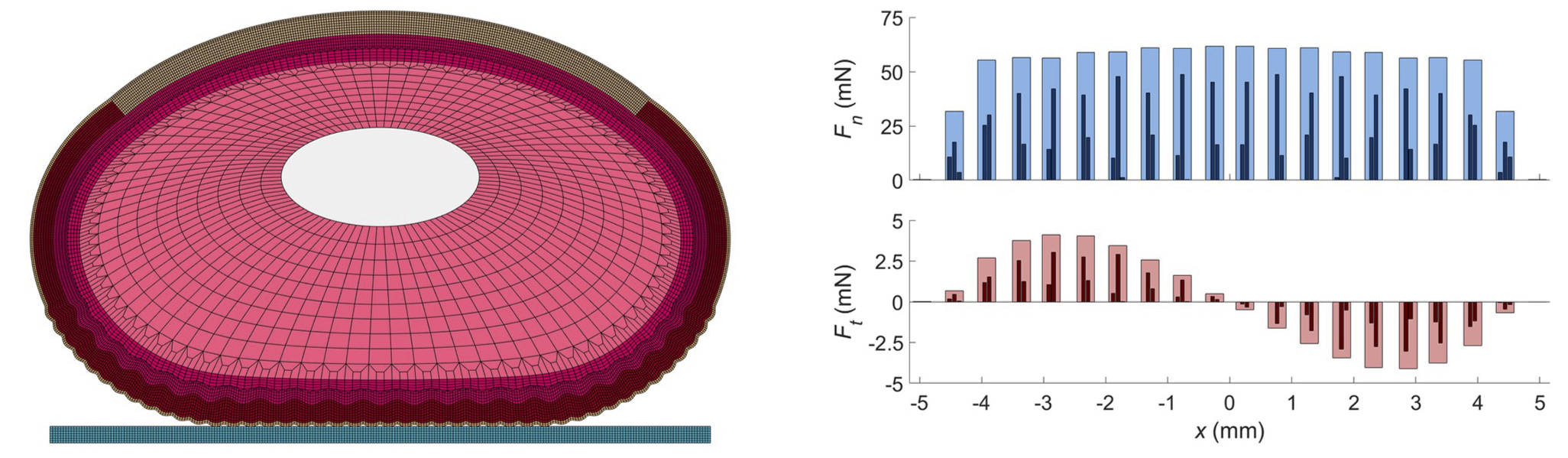
To explore the causes of the experimentally observed phenomena, we investigated the combined effects of tissue elasticity, skin-surface friction, and fingerprint ridges on contact area using a detailed finite element model that includes the anatomical layers within soft tissue. The computational and experimental results qualitatively agreed with each other. The simulations revealed the greater influence of the elastic modulus compared to friction during contact development. In addition, we detected an unusual and counter-intuitive contact phenomenon.
Members



Publications