Back

Haptic Intelligence Members Publications

HuggieBot: Evolution of an Interactive Hugging Robot with Visual and Haptic Perception
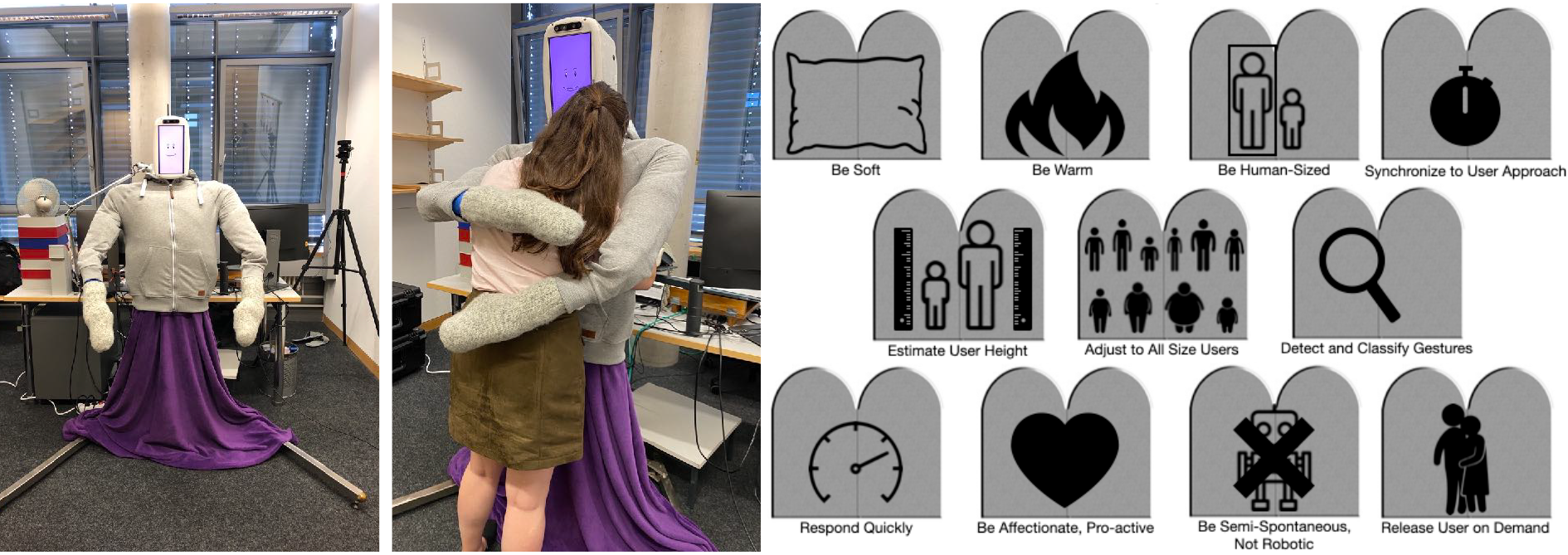
We designed, built, and evaluated a series of autonomous hugging robots. Left: HuggieBot 2.0 [File Icon] ready for a hug. This custom human-sized hugging robot has two padded arms, an inflated torso, and a face screen mounted to a rigid frame. Center: HuggieBot 2.0 hugging a user. A camera above the screen visually senses the user at the start of the interaction, and torque sensors on the shoulder flexion and elbow flexion joints are used to embrace the user with a comfortable pressure. Right: The eleven hugging design guidelines that have been validated through this project.

Members

Haptic Intelligence
  • Doctoral Researcher
Haptic Intelligence
Haptic Intelligence
  • Intern
Haptic Intelligence
Director

Publications

Haptic Intelligence Article In the Arms of a Robot: Designing Autonomous Hugging Robots with Intra-Hug Gestures Block, A. E., Seifi, H., Hilliges, O., Gassert, R., Kuchenbecker, K. J. ACM Transactions on Human-Robot Interaction, 12(2):1-49, June 2023, Special Issue on Designing the Robot Body: Critical Perspectives on Affective Embodied Interaction (Published)
Hugs are complex affective interactions that often include gestures like squeezes. We present six new guidelines for designing interactive hugging robots, which we validate through two studies with our custom robot. To achieve autonomy, we investigated robot responses to four human intra-hug gestures: holding, rubbing, patting, and squeezing. Thirty-two users each exchanged and rated sixteen hugs with an experimenter-controlled HuggieBot 2.0. The robot's inflated torso's microphone and pressure sensor collected data of the subjects' demonstrations that were used to develop a perceptual algorithm that classifies user actions with 88\% accuracy. Users enjoyed robot squeezes, regardless of their performed action, they valued variety in the robot response, and they appreciated robot-initiated intra-hug gestures. From average user ratings, we created a probabilistic behavior algorithm that chooses robot responses in real time. We implemented improvements to the robot platform to create HuggieBot 3.0 and then validated its gesture perception system and behavior algorithm with sixteen users. The robot's responses and proactive gestures were greatly enjoyed. Users found the robot more natural, enjoyable, and intelligent in the last phase of the experiment than in the first. After the study, they felt more understood by the robot and thought robots were nicer to hug.
DOI BibTeX

Haptic Intelligence Miscellaneous HuggieBot: A Human-Sized Haptic Interface Block, A. E., Seifi, H., Christen, S., Javot, B., Kuchenbecker, K. J. Hands-on demonstration presented at EuroHaptics, Hamburg, Germany, May 2022, Award for best hands-on demonstration (Published)
How many people have you hugged in these past two years of social distancing? Unfortunately, many people we interviewed exchanged fewer hugs with friends and family since the onset of the COVID-19 pandemic. Hugging has several health benefits, such as improved oxytocin levels, lowered blood pressure, and alleviated stress and anxiety. We created a human-sized haptic interface called HuggieBot to provide the benefits of hugs in situations when receiving a hug from another person is difficult or impossible. In this demonstration, participants of all shapes and sizes can walk up to HuggieBot, enter an embrace, perform several intra-hug gestures (hold still, rub, pat, or squeeze the robot) if desired, feel the robot's response, and leave the hug when they are ready.
BibTeX

Haptic Intelligence Ph.D. Thesis HuggieBot: An Interactive Hugging Robot With Visual and Haptic Perception Block, A. E. ETH Zürich, Zürich, Switzerland, August 2021, Department of Computer Science (Published)
Hugs are one of the first forms of contact and affection humans experience. Receiving a hug is one of the best ways to feel socially supported, and the lack of social touch can have severe adverse effects on an individual's well-being. Due to the prevalence and health benefits of hugging, roboticists are interested in creating robots that can hug humans as seamlessly as humans hug other humans. However, hugs are complex affective interactions that need to adapt to the height, body shape, and preferences of the hugging partner, and they often include intra-hug gestures like squeezes. This dissertation aims to create a series of hugging robots that use visual and haptic perception to provide enjoyable interactive hugs. Each of the four presented HuggieBot versions is evaluated by measuring how users emotionally and behaviorally respond to hugging it; HuggieBot 4.0 is explicitly compared to a human hugging partner using physiological measures. Building on research both within and outside of human-robot interaction (HRI), this thesis proposes eleven tenets of natural and enjoyable robotic hugging. These tenets were iteratively crafted through a design process combining user feedback and experimenter observation, and they were evaluated through user studies. A good hugging robot should (1) be soft, (2) be warm, (3) be human-sized, (4) autonomously invite the user for a hug when it detects someone in its personal space, and then it should wait for the user to begin walking toward it before closing its arms to ensure a consensual and synchronous hugging experience. It should also (5) adjust its embrace to the user's size and position, (6) reliably release when the user wants to end the hug, and (7) perceive the user's height and adapt its arm positions accordingly to comfortably fit around the user at appropriate body locations. Finally, a hugging robot should (8) accurately detect and classify gestures applied to its torso in real time, regardless of the user's hand placement, (9) respond quickly to their intra-hug gestures, (10) adopt a gesture paradigm that blends user preferences with slight variety and spontaneity, and (11) occasionally provide unprompted, proactive affective social touch to the user through intra-hug gestures. We believe these eleven tenets are essential to delivering high-quality robot hugs. Their presence results in a hug that pleases the user, and their absence results in a hug that is likely to be inadequate. We present these tenets as guidelines for future hugging robot creators to follow when designing new hugging robots to ensure user acceptance. We tested the four versions of HuggieBot through six user studies. First, we analyzed data collected in a previous study with a modified Willow Garage Personal Robot 2 (PR2) to evaluate human responses to different robot physical characteristics and hugging behaviors. Participants experienced and evaluated twelve hugs with the robot, divided into three randomly ordered trials that focused on physical robot characteristics (single factor, three levels) and nine randomly ordered trials with low, medium, and high hug pressure and duration (two factors, three levels each). Second, we created an entirely new robotic platform, HuggieBot 2.0, according to our first six tenets. The new platform features a soft, warm, inflated body (HuggieChest) and uses visual and haptic sensing to deliver closed-loop hugging. We first verified the outward appeal of this platform compared to the previous PR2-based HuggieBot 1.0 via an online video-watching study involving 117 users. We then conducted an in-person experiment in which 32 users each exchanged eight hugs with HuggieBot 2.0, experiencing all combinations of visual hug initiation, haptic sizing, and haptic releasing. We then refine the original fourth tenet (visually perceive its user) and present the remaining five tenets for designing interactive hugging robots; we validate the full list of eleven tenets through more in-person studies with our custom robot. To enable perceptive and pleasing autonomous robot behavior, we investigated robot responses to four human intra-hug gestures: holding, rubbing, patting, and squeezing. The robot's inflated torso's microphone and pressure sensor collected data of 32 people repeatedly demonstrating these gestures, which were used to develop a perceptual algorithm that classifies user actions with 88% accuracy. From user preferences, we created a probabilistic behavior algorithm that chooses robot responses in real time. We implemented improvements to the robot platform to create a third version of our robot, HuggieBot 3.0. We then validated its gesture perception system and behavior algorithm in a fifth user study with 16 users. Finally, we refined the quality and comfort of the embrace by adjusting the joint torques and joint angles of the closed pose position, we further improved the robot's visual perception to detect changes in user approach, we upgraded the robot's response to users who do not press on its back, and we had the robot respond to all intra-hug gestures with squeezes to create our final version of the robotic platform, HuggieBot 4.0. In our sixth user study, we investigated the emotional and physiological effects of hugging a robot compared to the effects of hugging a friendly but unfamiliar person. We continuously monitored participant heart rate and collected saliva samples at seven time points across the 3.5-hour study to measure the temporal evolution of cortisol and oxytocin. We used an adapted Trier Social Stress Test (TSST) protocol to reliably and ethically induce stress in the participants. They then experienced one of five different hug intervention methods before all interacting with HuggieBot 4.0. The results of these six user studies validated our eleven hugging tenets and informed the iterative design of HuggieBot. We see that users enjoy robot softness, robot warmth, and being physically squeezed by the robot. Users dislike being released too soon from a hug and equally dislike being held by the robot for too long. Adding haptic reactivity definitively improves user perception of a hugging robot; the robot's responses and proactive intra-hug gestures were greatly enjoyed. In our last study, we learned that HuggieBot can positively affect users on a physiological level and is somewhat comparable to hugging a person. Participants have more favorable opinions about hugging robots after prolonged interaction with HuggieBot in all of our research studies.
DOI BibTeX

Haptic Intelligence Miscellaneous Love, Actually? Robot Hugs, Oxytocin, and Cortisol Block, A. E., Kuchenbecker, S. Y., Lambercy, O., Gassert, R., Kuchenbecker, K. J. Workshop paper (5 pages) presented at the HRI Workshop on Workshop YOUR study design! Participatory critique and refinement of participants’ studies, Virtual, March 2021 (Published) BibTeX

Haptic Intelligence Conference Paper The Six Hug Commandments: Design and Evaluation of a Human-Sized Hugging Robot with Visual and Haptic Perception Block, A. E., Christen, S., Gassert, R., Hilliges, O., Kuchenbecker, K. J. In Proceedings of the ACM/IEEE International Conference on Human-Robot Interaction (HRI), 380-388, Virtual, March 2021 (Published)

Receiving a hug is one of the best ways to feel socially supported, and the lack of social touch can have severe negative effects on an individual's well-being. Based on previous research both within and outside of HRI, we propose six tenets (''commandments'') of natural and enjoyable robotic hugging: a hugging robot should be soft, be warm, be human sized, visually perceive its user, adjust its embrace to the user's size and position, and reliably release when the user wants to end the hug. Prior work validated the first two tenets, and the final four are new. We followed all six tenets to create a new robotic platform, HuggieBot 2.0, that has a soft, warm, inflated body (HuggieChest) and uses visual and haptic sensing to deliver closed-loop hugging. We first verified the outward appeal of this platform in comparison to the previous PR2-based HuggieBot 1.0 via an online video-watching study involving 117 users. We then conducted an in-person experiment in which 32 users each exchanged eight hugs with HuggieBot 2.0, experiencing all combinations of visual hug initiation, haptic sizing, and haptic releasing. The results show that adding haptic reactivity definitively improves user perception a hugging robot, largely verifying our four new tenets and illuminating several interesting opportunities for further improvement.
Block21-HRI-Commandments.pdf DOI BibTeX

Haptic Intelligence Miscellaneous Using Affective Touch for Emotional Support with a Hugging Robot Block, A. E., Hilliges, O., Gassert, R., Kuchenbecker, K. J. Workshop paper (2 pages) presented at the Human-Robot Interaction (HRI) Workshop on Affect and Embodiment, Cambridge, UK, March 2020 (Published) BibTeX

Haptic Intelligence Miscellaneous HuggieChest: An Inflatable Haptic Sensing Chest for a Hugging Robot Block, A. E., Kuchenbecker, K. J. Workshop paper (4 pages) presented at the IROS RoboTac Workshop on New Advances in Tactile Sensation, Perception, and Learning in Robotics: Emerging Materials and Technologies for Manipulation, Macao, China, November 2019 (Published)
During hugs, humans naturally provide and intuit subtle non-verbal cues that signify the desired strength and duration of an exchanged hug. Personal preferences for this close interaction may vary greatly between people; robots do not currently have the abilities to perceive or understand these preferences. This workshop paper discusses designing, building, and testing a novel inflatable chest that can simultaneously soften a robot and act as a tactile sensor to enable more natural and responsive hugging. Using PVC vinyl, two microphones, and two barometric pressure sensors, we created an inflatable two-chambered chest that forms the torso of a hugging robot. One chamber is located in the front of the robot, and the other chamber is in the back. While contacting HuggieChest in several ways common in hugs (start hug, rub, scratch, pat, squeeze, release), we recorded data from the two sensors in each chamber. The preliminary results suggest that the complementary haptic sensing channels allow the robot wearing the chest to detect coarse and fine contacts typically experienced during hugs, regardless of where the user contacts the robot. We also verified that we can detect contacts regardless of noise from the robot’s movement, as long as the HuggieChest is inflated within a certain pressure range.
BibTeX

Haptic Intelligence Miscellaneous Inflatable Haptic Sensor for the Torso of a Hugging Robot Block, A. E., Kuchenbecker, K. J. Work-in-progress paper (2 pages) presented at the IEEE World Haptics Conference (WHC), Tokyo, Japan, July 2019 (Published)
During hugs, humans naturally provide and intuit subtle non-verbal cues that signify the strength and duration of an exchanged hug. Personal preferences for this close interaction may vary greatly between people; robots do not currently have the abilities to perceive or understand these preferences. This work-in-progress paper discusses designing, building, and testing a novel inflatable torso that can simultaneously soften a robot and act as a tactile sensor to enable more natural and responsive hugging. Using PVC vinyl, a microphone, and a barometric pressure sensor, we created a small test chamber to demonstrate a proof of concept for the full torso. While contacting the chamber in several ways common in hugs (pat, squeeze, scratch, and rub), we recorded data from the two sensors. The preliminary results suggest that the complementary haptic sensing channels allow us to detect coarse and fine contacts typically experienced during hugs, regardless of user hand placement.
BibTeX

Haptic Intelligence Article Softness, Warmth, and Responsiveness Improve Robot Hugs Block, A. E., Kuchenbecker, K. J. International Journal of Social Robotics, 11(1):49-64, October 2018 (Published)
Hugs are one of the first forms of contact and affection humans experience. Due to their prevalence and health benefits, roboticists are naturally interested in having robots one day hug humans as seamlessly as humans hug other humans. This project's purpose is to evaluate human responses to different robot physical characteristics and hugging behaviors. Specifically, we aim to test the hypothesis that a soft, warm, touch-sensitive PR2 humanoid robot can provide humans with satisfying hugs by matching both their hugging pressure and their hugging duration. Thirty relatively young and rather technical participants experienced and evaluated twelve hugs with the robot, divided into three randomly ordered trials that focused on physical robot characteristics (single factor, three levels) and nine randomly ordered trials with low, medium, and high hug pressure and duration (two factors, three levels each). Analysis of the results showed that people significantly prefer soft, warm hugs over hard, cold hugs. Furthermore, users prefer hugs that physically squeeze them and release immediately when they are ready for the hug to end. Taking part in the experiment also significantly increased positive user opinions of robots and robot use.
DOI BibTeX

Haptic Intelligence Miscellaneous Emotionally Supporting Humans Through Robot Hugs Block, A. E., Kuchenbecker, K. J. 293-294, Workshop paper (2 pages) presented at the HRI Pioneers Workshop, Chicago, USA, March 2018 (Published)
Hugs are one of the first forms of contact and affection humans experience. Due to their prevalence and health benefits, we want to enable robots to safely hug humans. This research strives to create and study a high fidelity robotic system that provides emotional support to people through hugs. This paper outlines our previous work evaluating human responses to a prototype’s physical and behavioral characteristics, and then it lays out our ongoing and future work.
DOI BibTeX

Haptic Intelligence Miscellaneous Physical and Behavioral Factors Improve Robot Hug Quality Block, A. E., Kuchenbecker, K. J. Workshop Paper (2 pages) presented at the RO-MAN Workshop on Social Interaction and Multimodal Expression for Socially Intelligent Robots, Lisbon, Portugal, August 2017 (Published)
A hug is one of the most basic ways humans can express affection. As hugs are so common, a natural progression of robot development is to have robots one day hug humans as seamlessly as these intimate human-human interactions occur. This project’s purpose is to evaluate human responses to different robot physical characteristics and hugging behaviors. Specifically, we aim to test the hypothesis that a warm, soft, touch-sensitive PR2 humanoid robot can provide humans with satisfying hugs by matching both their hugging pressure and their hugging duration. Thirty participants experienced and evaluated twelve hugs with the robot, divided into three randomly ordered trials that focused on physical robot char- acteristics and nine randomly ordered trials with varied hug pressure and duration. We found that people prefer soft, warm hugs over hard, cold hugs. Furthermore, users prefer hugs that physically squeeze them and release immediately when they are ready for the hug to end.
BibTeX

Haptic Intelligence Miscellaneous How Should Robots Hug? Block, A. E., Kuchenbecker, K. J. Work-in-progress paper (2 pages) presented at the IEEE World Haptics Conference (WHC), Munich, Germany, June 2017 (Published) BibTeX