Quantifying the Quality of Haptic Interfaces
Shape-Changing Haptic Interfaces
Generating Clear Vibrotactile Cues with Magnets Embedded in a Soft Finger Sheath
Salient Full-Fingertip Haptic Feedback Enabled by Wearable Electrohydraulic Actuation
Cutaneous Electrohydraulic (CUTE) Wearable Devices for Pleasant Broad-Bandwidth Haptic Cues
Modeling Finger-Touchscreen Contact during Electrovibration
Perception of Ultrasonic Friction Pulses
Vibrotactile Playback for Teaching Sensorimotor Skills in Medical Procedures
CAPT Motor: A Two-Phase Ironless Motor Structure
4D Intraoperative Surgical Perception: Anatomical Shape Reconstruction from Multiple Viewpoints
Visual-Inertial Force Estimation in Robotic Surgery
Enhancing Robotic Surgical Training
AiroTouch: Naturalistic Vibrotactile Feedback for Large-Scale Telerobotic Assembly
Optimization-Based Whole-Arm Teleoperation for Natural Human-Robot Interaction
Finger-Surface Contact Mechanics in Diverse Moisture Conditions
Computational Modeling of Finger-Surface Contact
Perceptual Integration of Contact Force Components During Tactile Stimulation
Dynamic Models and Wearable Tactile Devices for the Fingertips
Novel Designs and Rendering Algorithms for Fingertip Haptic Devices
Dimensional Reduction from 3D to 1D for Realistic Vibration Rendering
Prendo: Analyzing Human Grasping Strategies for Visually Occluded Objects
Learning Upper-Limb Exercises from Demonstrations
Minimally Invasive Surgical Training with Multimodal Feedback and Automatic Skill Evaluation
Efficient Large-Area Tactile Sensing for Robot Skin
Haptic Feedback and Autonomous Reflexes for Upper-limb Prostheses
Gait Retraining
Modeling Hand Deformations During Contact
Intraoperative AR Assistance for Robot-Assisted Minimally Invasive Surgery
Immersive VR for Phantom Limb Pain
Visual and Haptic Perception of Real Surfaces
Haptipedia
Gait Propulsion Trainer
TouchTable: A Musical Interface with Haptic Feedback for DJs
Exercise Games with Baxter
Intuitive Social-Physical Robots for Exercise
How Should Robots Hug?
Hierarchical Structure for Learning from Demonstration
Fabrication of HuggieBot 2.0: A More Huggable Robot
Learning Haptic Adjectives from Tactile Data
Feeling With Your Eyes: Visual-Haptic Surface Interaction
S-BAN
General Tactile Sensor Model
Insight: a Haptic Sensor Powered by Vision and Machine Learning
Vibrotactile Playback for Teaching Sensorimotor Skills in Medical Procedures
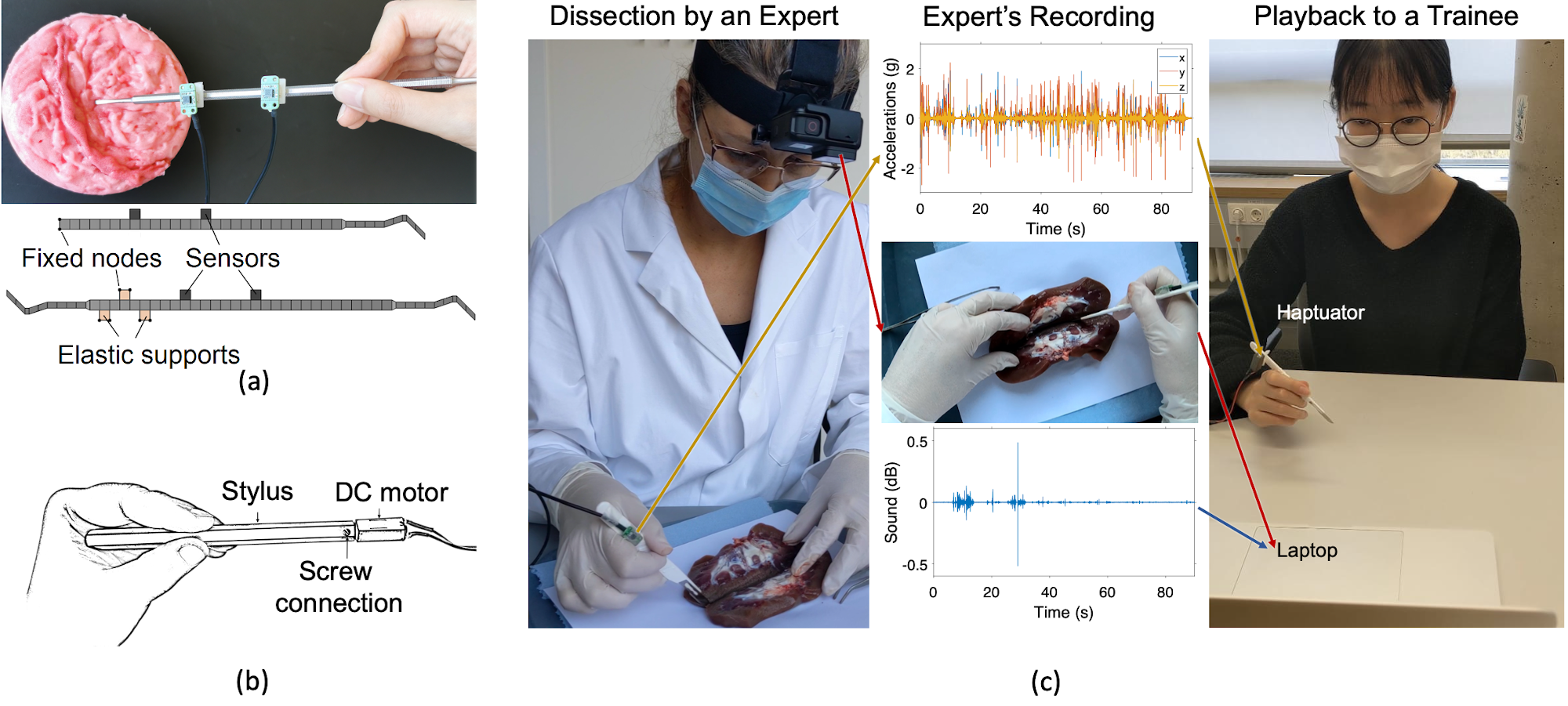
Clinicians perform many tasks that require complex sensorimotor skills, which are challenging and take time to master. Experts strongly recommend using simulators for training, as the patient's safety is of top priority. However, creating effective simulators requires a deep understanding of both engineering and medicine. Considering these challenges, we developed a method to capture clinically relevant vibrotactile cues without disrupting the procedure and replay these cues along with video and audio for training [ ].
].
We attach a small accelerometer to the tool to robustly measure the rich physical contact vibrations felt by the expert without disturbing their movements. We seek to optimize the location of the accelerometer to maximize its vibration-sensing capability in the frequency range relevant to touch. For this goal, we characterize the dynamic properties of the selected medical tool by utilizing finite element analysis along with physical experiments []. We plan to validate the effectiveness of the optimized accelerometer placement through comparisons with other configurations during actual tool use. Finally, we process the contact vibrations measured with an optimally placed accelerometer and record them with the corresponding sound and video.
For training, we replay the audio, video, and vibration signals using a vibrotactile actuator along with a display. Listening to and watching the tool interacting with the tissue while also feeling what the expert felt provides a realistic experience with many advantages compared to physical and virtual simulators. Commonly used vibrotactile actuators are either expensive or have limited vibration output amplitudes. To tackle these problems, we designed a cost-effective DC-motor-based vibrotactile actuation system that can generate high-fidelity haptic feedback on a stylus. We plan to use this compact and effective actuation approach for replaying the recorded vibrotactile cues.
Members




Publications