Back

Haptic Intelligence Members Publications

AiroTouch: Naturalistic Vibrotactile Feedback for Large-Scale Telerobotic Assembly
Airotouch sab
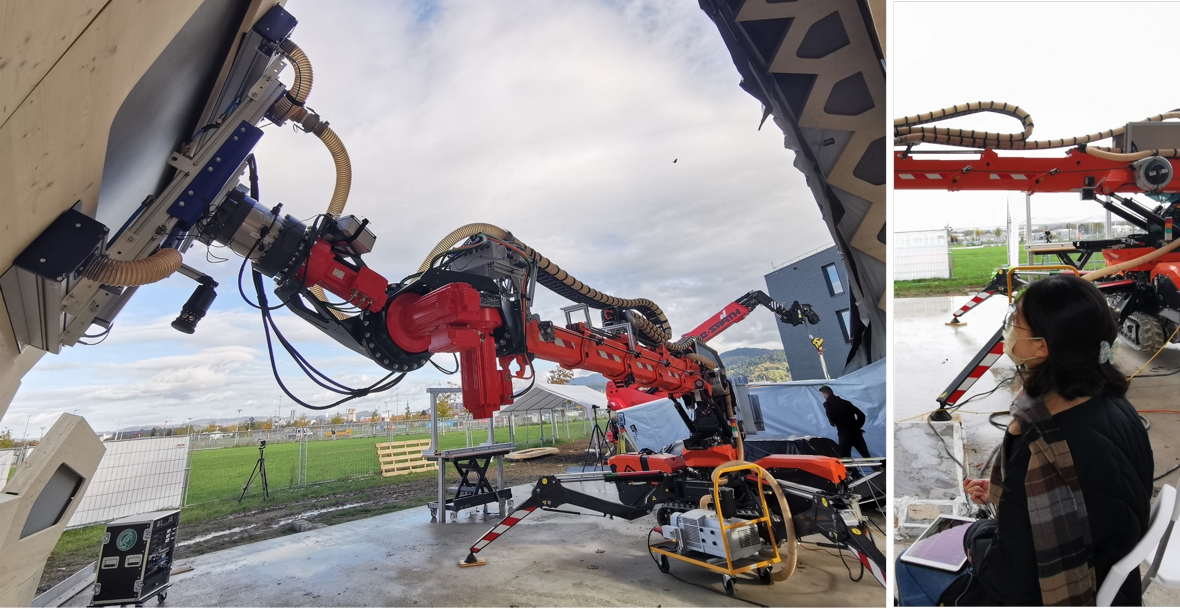
Our wireless haptic feedback system was used on a construction robot during on-site assembly of the LivMatS Biomimetic Shell in Freiburg. AiroTouch uses an accelerometer and a voice-coil actuator to provide observers with naturalistic feedback of the robot's end-effector vibrations.

Members

Thumb ticker sm img 8126
Haptic Intelligence
  • Postdoctoral Researcher
Thumb ticker sm bj square
Haptic Intelligence
  • Research Engineer
Thumb ticker sm 0
Haptic Intelligence
  • Research Scientist
Thumb ticker sm dsc 5108
Haptic Intelligence
  • Research Scientist
Thumb ticker sm minerva
Haptic Intelligence
  • Doctoral Researcher
Thumb ticker sm a12664b3 1f05 4eff 89f7 92ed87336fd9
Haptic Intelligence
Thumb ticker sm thumb ticker kjk 2024
Haptic Intelligence
Director

Publications

Haptic Intelligence Miscellaneous Whole-Arm Humanoid Robot Teleoperation with Naturalistic Vibrotactile Feedback Gong, Y., Hudhud Mughrabi, M., L’Orsa, R., Mohan, M., Kuchenbecker, K. J. Work-in-progress paper (2 pages) presented at the IEEE World Haptics Conference (WHC), Suwon, South Korea, July 2025 (Published) BibTeX

Haptic Intelligence Ph.D. Thesis Engineering and Evaluating Naturalistic Vibrotactile Feedback for Telerobotic Assembly Gong, Y. University of Stuttgart, Stuttgart, Germany, August 2024, Faculty of Engineering Design, Production Engineering and Automotive Engineering (Published)
Teleoperation allows workers on a construction site to assemble pre-fabricated building components by controlling powerful machines from a safe distance. However, teleoperation's primary reliance on visual feedback limits the operator's efficiency in situations with stiff contact or poor visibility, compromising their situational awareness and thus increasing the difficulty of the task; it also makes construction machines more difficult to learn to operate. To bridge this gap, we propose that reliable, economical, and easy-to-implement naturalistic vibrotactile feedback could improve telerobotic control interfaces in construction and other application areas such as surgery. This type of feedback enables the operator to feel the natural vibrations experienced by the robot, which contain crucial information about its motions and its physical interactions with the environment. This dissertation explores how to deliver naturalistic vibrotactile feedback from a robot's end-effector to the hand of an operator performing telerobotic assembly tasks; furthermore, it seeks to understand the effects of such haptic cues. The presented research can be divided into four parts. We first describe the engineering of AiroTouch, a naturalistic vibrotactile feedback system tailored for use on construction sites but suitable for many other applications of telerobotics. Then we evaluate AiroTouch and explore the effects of the naturalistic vibrotactile feedback it delivers in three user studies conducted either in laboratory settings or on a construction site. We begin this dissertation by developing guidelines for creating a haptic feedback system that provides high-quality naturalistic vibrotactile feedback. These guidelines include three sections: component selection, component placement, and system evaluation. We detail each aspect with the parameters that need to be considered. Based on these guidelines, we adapt widely available commercial audio equipment to create our system called AiroTouch, which measures the vibration experienced by each robot tool with a high-bandwidth three-axis accelerometer and enables the user to feel this vibration in real time through a voice-coil actuator. Accurate haptic transmission is achieved by optimizing the positions of the system's off-the-shelf sensors and actuators and is then verified through measurements. The second part of this thesis presents our initial validation of AiroTouch. We explored how adding this naturalistic type of vibrotactile feedback affects the operator during small-scale telerobotic assembly. Due to the limited accessibility of teleoperated robots and to maintain safety, we conducted a user study in lab with a commercial bimanual dexterous teleoperation system developed for surgery (Intuitive da Vinci Si). Thirty participants used this robot equipped with AiroTouch to assemble a small stiff structure under three randomly ordered haptic feedback conditions: no vibrations, one-axis vibrations, and summed three-axis vibrations. The results show that participants learn to take advantage of both tested versions of the haptic feedback in the given tasks, as significantly lower vibrations and forces are observed in the second trial. Subjective responses indicate that naturalistic vibrotactile feedback increases the realism of the interaction and reduces the perceived task duration, task difficulty, and fatigue. To test our approach on a real construction site, we enhanced AiroTouch using wireless signal-transmission technologies and waterproofing, and then we adapted it to a mini-crane construction robot. A study was conducted to evaluate how naturalistic vibrotactile feedback affects an observer's understanding of telerobotic assembly performed by this robot on a construction site. Seven adults without construction experience observed a mix of manual and autonomous assembly processes both with and without naturalistic vibrotactile feedback. Qualitative analysis of their survey responses and interviews indicates that all participants had positive responses to this technology and believed it would be beneficial for construction activities. Finally, we evaluated the effects of naturalistic vibrotactile feedback provided by wireless AiroTouch during live teleoperation of the mini-crane. Twenty-eight participants remotely controlled the mini-crane to complete three large-scale assembly-related tasks in lab, both with and without this type of haptic feedback. Our results show that naturalistic vibrotactile feedback enhances the participants' awareness of both robot motion and contact between the robot and other objects, particularly in scenarios with limited visibility. These effects increase participants' confidence when controlling the robot. Moreover, there is a noticeable trend of reduced vibration magnitude in the conditions where this type of haptic feedback is provided. The primary contribution of this dissertation is the clear explanation of details that are essential for the effective implementation of naturalistic vibrotactile feedback. We demonstrate that our accessible, audio-based approach can enhance user performance and experience during telerobotic assembly in construction and other application domains. These findings lay the foundation for further exploration of the potential benefits of incorporating haptic cues to enhance user experience during teleoperation.
BibTeX

Haptic Intelligence Article AiroTouch: Enhancing Telerobotic Assembly through Naturalistic Haptic Feedback of Tool Vibrations Gong, Y., Mat Husin, H., Erol, E., Ortenzi, V., Kuchenbecker, K. J. Frontiers in Robotics and AI, 11(1355205):1-15, May 2024 (Published)
Teleoperation allows workers to safely control powerful construction machines; however, its primary reliance on visual feedback limits the operator's efficiency in situations with stiff contact or poor visibility, hindering its use for assembly of pre-fabricated building components. Reliable, economical, and easy-to-implement haptic feedback could fill this perception gap and facilitate the broader use of robots in construction and other application areas. Thus, we adapted widely available commercial audio equipment to create AiroTouch, a naturalistic haptic feedback system that measures the vibration experienced by each robot tool and enables the operator to feel a scaled version of this vibration in real time. Accurate haptic transmission was achieved by optimizing the positions of the system's off-the-shelf accelerometers and voice-coil actuators. A study was conducted to evaluate how adding this naturalistic type of vibrotactile feedback affects the operator during telerobotic assembly. Thirty participants used a bimanual dexterous teleoperation system (Intuitive da Vinci Si) to build a small rigid structure under three randomly ordered haptic feedback conditions: no vibrations, one-axis vibrations, and summed three-axis vibrations. The results show that users took advantage of both tested versions of the naturalistic haptic feedback after gaining some experience with the task, causing significantly lower vibrations and forces in the second trial. Subjective responses indicate that haptic feedback increased the realism of the interaction and reduced the perceived task duration, task difficulty, and fatigue. As hypothesized, higher haptic feedback gains were chosen by users with larger hands and for the smaller sensed vibrations in the one-axis condition. These results elucidate important details for effective implementation of naturalistic vibrotactile feedback and demonstrate that our accessible audio-based approach could enhance user performance and experience during telerobotic assembly in construction and other application domains.
DOI BibTeX

Haptic Intelligence Miscellaneous AiroTouch: Naturalistic Vibrotactile Feedback for Telerobotic Construction Gong, Y., Javot, B., Lauer, A. P. R., Sawodny, O., Kuchenbecker, K. J. Hands-on demonstration presented at the IEEE World Haptics Conference (WHC), Delft, The Netherlands, July 2023 (Published) BibTeX

Haptic Intelligence Conference Paper Naturalistic Vibrotactile Feedback Could Facilitate Telerobotic Assembly on Construction Sites Gong, Y., Javot, B., Lauer, A. P. R., Sawodny, O., Kuchenbecker, K. J. In Proceedings of the IEEE World Haptics Conference (WHC), 169-175, Delft, The Netherlands, July 2023 (Published)
Telerobotics is regularly used on construction sites to build large structures efficiently. A human operator remotely controls the construction robot under direct visual feedback, but visibility is often poor. Future construction robots that move autonomously will also require operator monitoring. Thus, we designed a wireless haptic feedback system to provide the operator with task-relevant mechanical information from a construction robot in real time. Our AiroTouch system uses an accelerometer to measure the robot end-effector's vibrations and uses off-the-shelf audio equipment and a voice-coil actuator to display them to the user with high fidelity. A study was conducted to evaluate how this type of naturalistic vibration feedback affects the observer's understanding of telerobotic assembly on a real construction site. Seven adults without construction experience observed a mix of manual and autonomous assembly processes both with and without naturalistic vibrotactile feedback. Qualitative analysis of their survey responses and interviews indicated that all participants had positive responses to this technology and believed it would be beneficial for construction activities.
DOI BibTeX

Haptic Intelligence Miscellaneous Naturalistic Vibrotactile Feedback Could Facilitate Telerobotic Assembly on Construction Sites Gong, Y., Javot, B., Lauer, A. P. R., Sawodny, O., Kuchenbecker, K. J. Poster presented at the ICRA Workshop on Future of Construction: Robot Perception, Mapping, Navigation, Control in Unstructured and Cluttered Environments, London, UK, June 2023 (Published) BibTeX

Haptic Intelligence Miscellaneous AiroTouch: Naturalistic Vibrotactile Feedback for Telerobotic Construction-Related Tasks Gong, Y., Tashiro, N., Javot, B., Lauer, A. P. R., Sawodny, O., Kuchenbecker, K. J. Extended abstract (1 page) presented at the ICRA Workshop on Communicating Robot Learning across Human-Robot Interaction, London, UK, May 2023 (Published) BibTeX