Back

Haptic Intelligence Members Publications

How Should Robots Hug?

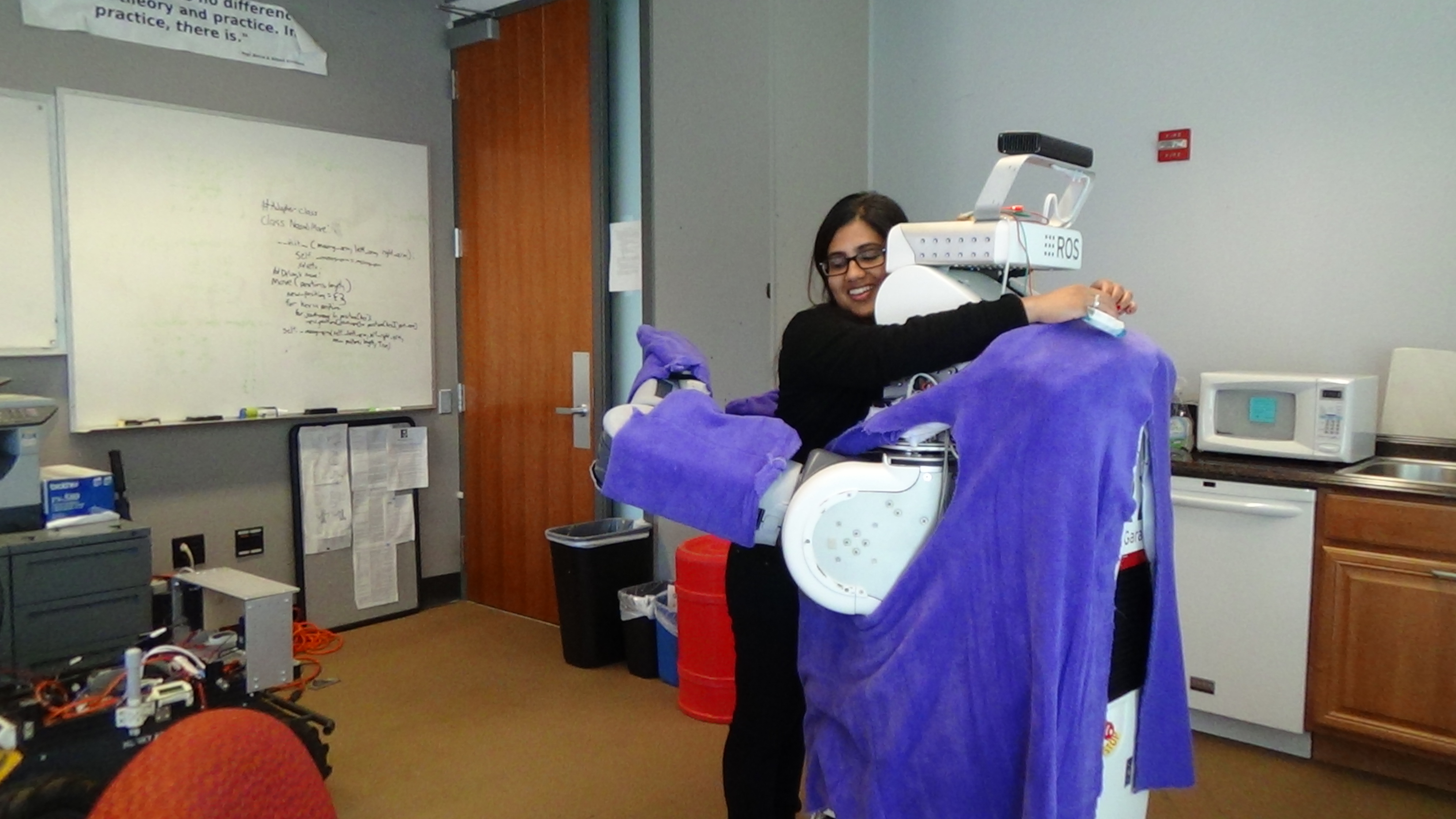
Dsc00201
A participant hugging the PR2 with its custom Soft-Warm outfit during the experiment.

Members

Thumb ticker sm img 4960
Haptic Intelligence
  • Doctoral Researcher
Thumb ticker sm thumb ticker kjk 2024
Haptic Intelligence
Director

Publications

Haptic Intelligence Article Softness, Warmth, and Responsiveness Improve Robot Hugs Block, A. E., Kuchenbecker, K. J. International Journal of Social Robotics, 11(1):49-64, October 2018 (Published)
Hugs are one of the first forms of contact and affection humans experience. Due to their prevalence and health benefits, roboticists are naturally interested in having robots one day hug humans as seamlessly as humans hug other humans. This project's purpose is to evaluate human responses to different robot physical characteristics and hugging behaviors. Specifically, we aim to test the hypothesis that a soft, warm, touch-sensitive PR2 humanoid robot can provide humans with satisfying hugs by matching both their hugging pressure and their hugging duration. Thirty relatively young and rather technical participants experienced and evaluated twelve hugs with the robot, divided into three randomly ordered trials that focused on physical robot characteristics (single factor, three levels) and nine randomly ordered trials with low, medium, and high hug pressure and duration (two factors, three levels each). Analysis of the results showed that people significantly prefer soft, warm hugs over hard, cold hugs. Furthermore, users prefer hugs that physically squeeze them and release immediately when they are ready for the hug to end. Taking part in the experiment also significantly increased positive user opinions of robots and robot use.
DOI BibTeX

Haptic Intelligence Miscellaneous Emotionally Supporting Humans Through Robot Hugs Block, A. E., Kuchenbecker, K. J. 293-294, Workshop paper (2 pages) presented at the HRI Pioneers Workshop, Chicago, USA, March 2018 (Published)
Hugs are one of the first forms of contact and affection humans experience. Due to their prevalence and health benefits, we want to enable robots to safely hug humans. This research strives to create and study a high fidelity robotic system that provides emotional support to people through hugs. This paper outlines our previous work evaluating human responses to a prototype’s physical and behavioral characteristics, and then it lays out our ongoing and future work.
DOI BibTeX

Haptic Intelligence Miscellaneous Physical and Behavioral Factors Improve Robot Hug Quality Block, A. E., Kuchenbecker, K. J. Workshop Paper (2 pages) presented at the RO-MAN Workshop on Social Interaction and Multimodal Expression for Socially Intelligent Robots, Lisbon, Portugal, August 2017 (Published)
A hug is one of the most basic ways humans can express affection. As hugs are so common, a natural progression of robot development is to have robots one day hug humans as seamlessly as these intimate human-human interactions occur. This project’s purpose is to evaluate human responses to different robot physical characteristics and hugging behaviors. Specifically, we aim to test the hypothesis that a warm, soft, touch-sensitive PR2 humanoid robot can provide humans with satisfying hugs by matching both their hugging pressure and their hugging duration. Thirty participants experienced and evaluated twelve hugs with the robot, divided into three randomly ordered trials that focused on physical robot char- acteristics and nine randomly ordered trials with varied hug pressure and duration. We found that people prefer soft, warm hugs over hard, cold hugs. Furthermore, users prefer hugs that physically squeeze them and release immediately when they are ready for the hug to end.
BibTeX

Haptic Intelligence Miscellaneous How Should Robots Hug? Block, A. E., Kuchenbecker, K. J. Work-in-progress paper (2 pages) presented at the IEEE World Haptics Conference (WHC), Munich, Germany, June 2017 (Published) BibTeX