Quantifying the Quality of Haptic Interfaces
Shape-Changing Haptic Interfaces
Generating Clear Vibrotactile Cues with Magnets Embedded in a Soft Finger Sheath
Salient Full-Fingertip Haptic Feedback Enabled by Wearable Electrohydraulic Actuation
Cutaneous Electrohydraulic (CUTE) Wearable Devices for Pleasant Broad-Bandwidth Haptic Cues
Modeling Finger-Touchscreen Contact during Electrovibration
Perception of Ultrasonic Friction Pulses
CAPT Motor: A Two-Phase Ironless Motor Structure
4D Intraoperative Surgical Perception: Anatomical Shape Reconstruction from Multiple Viewpoints
Visual-Inertial Force Estimation in Robotic Surgery
Enhancing Robotic Surgical Training
AiroTouch: Naturalistic Vibrotactile Feedback for Large-Scale Telerobotic Assembly
Optimization-Based Whole-Arm Teleoperation for Natural Human-Robot Interaction
Finger-Surface Contact Mechanics in Diverse Moisture Conditions
Perceptual Integration of Contact Force Components During Tactile Stimulation
Dynamic Models and Wearable Tactile Devices for the Fingertips
Novel Designs and Rendering Algorithms for Fingertip Haptic Devices
Dimensional Reduction from 3D to 1D for Realistic Vibration Rendering
Prendo: Analyzing Human Grasping Strategies for Visually Occluded Objects
Learning Upper-Limb Exercises from Demonstrations
Minimally Invasive Surgical Training with Multimodal Feedback and Automatic Skill Evaluation
Efficient Large-Area Tactile Sensing for Robot Skin
Haptic Feedback and Autonomous Reflexes for Upper-limb Prostheses
Gait Retraining
Intraoperative AR Assistance for Robot-Assisted Minimally Invasive Surgery
Haptipedia
Exercise Games with Baxter
Intuitive Social-Physical Robots for Exercise
Insight: a Haptic Sensor Powered by Vision and Machine Learning
Gait Retraining
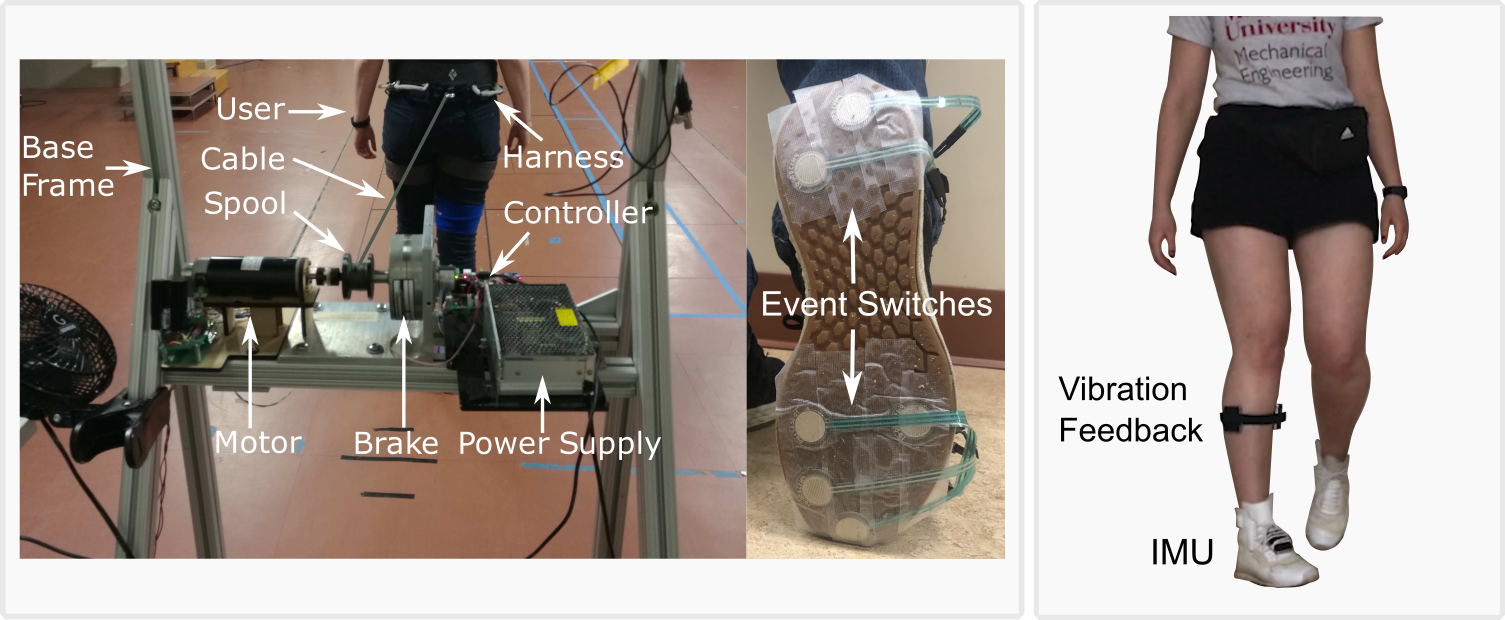
Restoring healthy gait after injury, stroke, or joint disease is a core part of the rehabilitation process. Novel haptic devices provide an opportunity to supplement current medical practice to improve walking speed, symmetry, or joint loading in clinical populations. These devices can be used in-clinic, such as our Gait Propulsion Trainer (GPT), and some could also support at-home treatment, such as wearable biofeedback.
Walking speed and symmetry are high priorities for people with hemiparesis from stroke. Invented through a collaboration with Stony Brook University, the GPT helps such individuals by applying periodic stance-phase resistance as the user walks overground [ ]. It consists of two main components: (1) the stationary device provides resistance forces via a cable that tethers the pelvis to a magnetic-particle brake [], and (2) the wearable system detects gait events via foot switches to control the timing of the resistance forces []. A preliminary study was conducted with a 24-year-old female with left-side hemiparesis and gait asymmetry following pediatric traumatic brain injury. GPT resistance increased paretic leg propulsive forces generated in late stance by 25% over baseline values, and increased propulsion persisted when GPT resistance was removed in post-braking trials. The results of other GPT studies are being analyzed.
Unlike stroke, knee osteoarthritis is a degenerative disease whose progression is exacerbated by knee loading. Targeted gait retraining to decrease joint loading is an effective conservative treatment strategy that has previously been limited to laboratory settings. To enable ubiquitous rehabilitation in natural environments, we are working to characterize efficacy and user response to a wearable haptic biofeedback device developed by SageMotion, LLC []. Insights from ongoing experiments with this system will inform our invention of new hardware and software for haptic gait rehabilitation.
With increased characterization of the long-term effects of gait retraining on hemiparetic or osteoarthritic gait, these emerging devices can help reshape the rehabilitation process for improved clinical outcomes.
Members



Publications