Ungrounded Vari-Dimensional Tactile Fingertip Feedback for Virtual Object Interaction


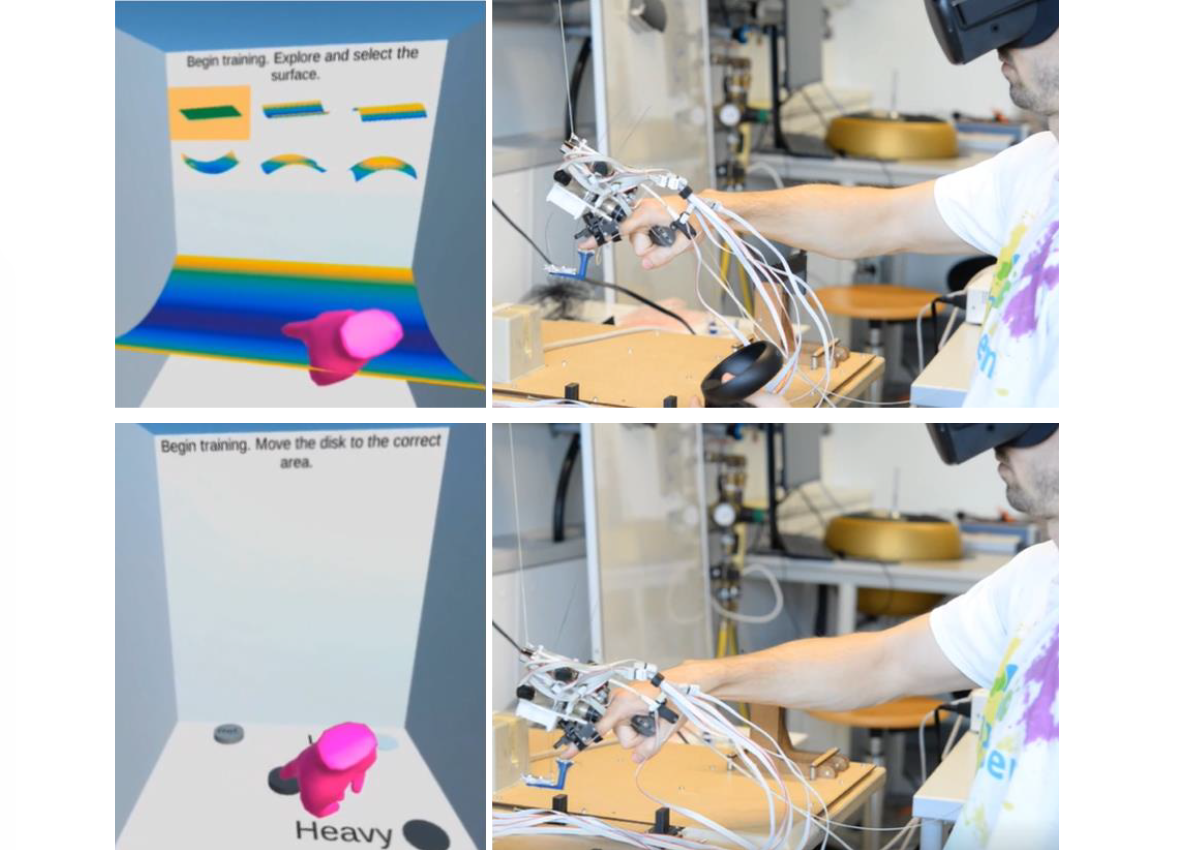
Compared to grounded force feedback, providing tactile feedback via a wearable device can free the user and broaden the potential applications of simulated physical interactions. However, neither the limitations nor the full potential of tactile-only feedback have been precisely examined. Here we investigate how the dimensionality of cutaneous fingertip feedback affects user movements and virtual object recognition. We combine a recently invented 6-DOF fingertip device with motion tracking, a head-mounted display, and novel contact-rendering algorithms to enable a user to tactilely explore immersive virtual environments. We evaluate rudimentary 1-DOF, moderate 3-DOF, and complex 6-DOF tactile feedback during shape discrimination and mass discrimination, also comparing to interactions with real objects. Results from 20 naive study participants show that higher-dimensional tactile feedback may indeed allow completion of a wider range of virtual tasks, but that feedback dimensionality surprisingly does not greatly affect the exploratory techniques employed by the user.
| Author(s): | Eric M. Young and Katherine J. Kuchenbecker |
| Book Title: | CHI ’21: Proceedings of the 2021 CHI Conference on Human Factors in Computing Systems |
| Pages: | 217 |
| Year: | 2021 |
| Month: | May |
| Day: | 8-13 |
| Publisher: | ACM |
| Project(s): | |
| Bibtex Type: | Conference Paper (inproceedings) |
| Address: | New York, NY |
| DOI: | 10.1145/3411764.3445369 |
| Event Name: | Conference on Human Factors in Computing Systems (CHI 2021) |
| Event Place: | Yokohama |
| State: | Published |
| URL: | https://dl.acm.org/doi/pdf/10.1145/3411764.3445369 |
| Electronic Archiving: | grant_archive |
| ISBN: | 978-1-4503-8096-6 |
BibTex
@inproceedings{Young21-CHI-Virtual,
  title = {Ungrounded Vari-Dimensional Tactile Fingertip Feedback for Virtual Object Interaction},
  booktitle = {CHI '21: Proceedings of the 2021 CHI Conference on Human Factors in Computing Systems},
  abstract = {Compared to grounded force feedback, providing tactile feedback via a wearable device can free the user and broaden the potential applications of simulated physical interactions. However, neither the limitations nor the full potential of tactile-only feedback have been precisely examined. Here we investigate how the dimensionality of cutaneous fingertip feedback affects user movements and virtual object recognition. We combine a recently invented 6-DOF fingertip device with motion tracking, a head-mounted display, and novel contact-rendering algorithms to enable a user to tactilely explore immersive virtual environments. We evaluate rudimentary 1-DOF, moderate 3-DOF, and complex 6-DOF tactile feedback during shape discrimination and mass discrimination, also comparing to interactions with real objects. Results from 20 naive study participants show that higher-dimensional tactile feedback may indeed allow completion of a wider range of virtual tasks, but that feedback dimensionality surprisingly does not greatly affect the exploratory techniques employed by the user.},
  pages = {217},
  publisher = {ACM},
  address = {New York, NY},
  month = may,
  year = {2021},
  slug = {young21-chi-virtual},
  author = {Young, Eric M. and Kuchenbecker, Katherine J.},
  url = {https://dl.acm.org/doi/pdf/10.1145/3411764.3445369},
  month_numeric = {5}
}