Quantifying the Quality of Haptic Interfaces
Shape-Changing Haptic Interfaces
Generating Clear Vibrotactile Cues with Magnets Embedded in a Soft Finger Sheath
Salient Full-Fingertip Haptic Feedback Enabled by Wearable Electrohydraulic Actuation
Cutaneous Electrohydraulic (CUTE) Wearable Devices for Pleasant Broad-Bandwidth Haptic Cues
Modeling Finger-Touchscreen Contact during Electrovibration
Perception of Ultrasonic Friction Pulses
Vibrotactile Playback for Teaching Sensorimotor Skills in Medical Procedures
CAPT Motor: A Two-Phase Ironless Motor Structure
4D Intraoperative Surgical Perception: Anatomical Shape Reconstruction from Multiple Viewpoints
Visual-Inertial Force Estimation in Robotic Surgery
Enhancing Robotic Surgical Training
AiroTouch: Naturalistic Vibrotactile Feedback for Large-Scale Telerobotic Assembly
Optimization-Based Whole-Arm Teleoperation for Natural Human-Robot Interaction
Finger-Surface Contact Mechanics in Diverse Moisture Conditions
Computational Modeling of Finger-Surface Contact
Perceptual Integration of Contact Force Components During Tactile Stimulation
Dynamic Models and Wearable Tactile Devices for the Fingertips
Novel Designs and Rendering Algorithms for Fingertip Haptic Devices
Dimensional Reduction from 3D to 1D for Realistic Vibration Rendering
Prendo: Analyzing Human Grasping Strategies for Visually Occluded Objects
Learning Upper-Limb Exercises from Demonstrations
Minimally Invasive Surgical Training with Multimodal Feedback and Automatic Skill Evaluation
Efficient Large-Area Tactile Sensing for Robot Skin
Haptic Feedback and Autonomous Reflexes for Upper-limb Prostheses
Gait Retraining
Modeling Hand Deformations During Contact
Intraoperative AR Assistance for Robot-Assisted Minimally Invasive Surgery
Immersive VR for Phantom Limb Pain
Visual and Haptic Perception of Real Surfaces
Haptipedia
Gait Propulsion Trainer
TouchTable: A Musical Interface with Haptic Feedback for DJs
Exercise Games with Baxter
Intuitive Social-Physical Robots for Exercise
How Should Robots Hug?
Hierarchical Structure for Learning from Demonstration
Fabrication of HuggieBot 2.0: A More Huggable Robot
Learning Haptic Adjectives from Tactile Data
Feeling With Your Eyes: Visual-Haptic Surface Interaction
S-BAN
General Tactile Sensor Model
Insight: a Haptic Sensor Powered by Vision and Machine Learning
Material Intelligence of Animal Whiskers
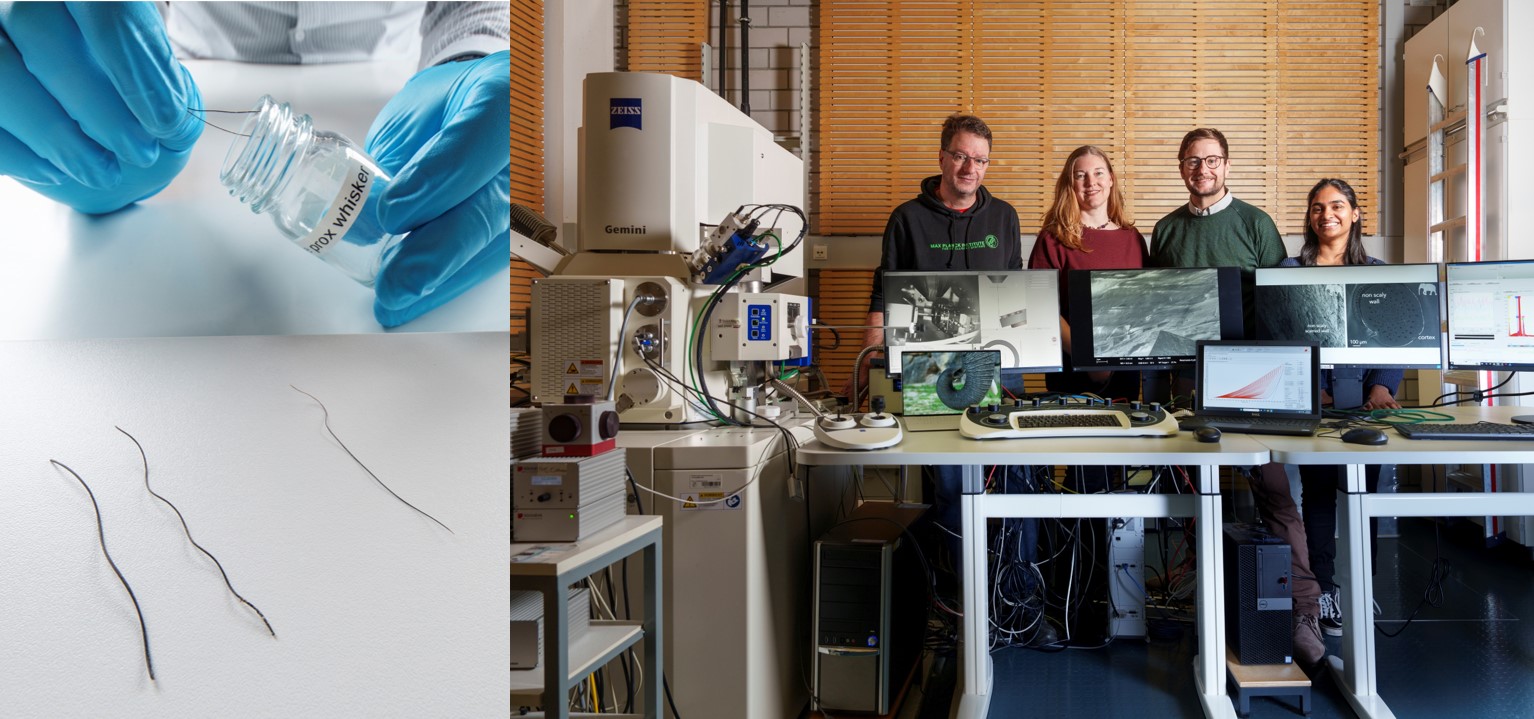
 ], we can see the brilliant ways in which material organization tunes the neuromechanics of animal touch sensing.
Feathers help birds fly, fur keeps mammals warm, and whiskers help facilitate sensing. While these functions are quite specific, the form of these structures (feathers, fur, and whiskers) are all composed of keratin. We are taking inspiration from one particular animal structure, whiskers, to understand how this keratin building block can help facilitate sensing in animals. A wide range of terrestrial and aquatic mammal species use these whiskers as tactile sensory organs emerging from the skin for environmental monitoring tasks such as detecting unseen obstacles or perceiving wind direction. Most research focuses on understanding the complex whisker structures' geometry or their neuromechanics, studying the mechanoreceptors in the skin connected to the elongated whisker, which is assumed to be homogeneous.
We seek to understand how variations in stiffness, porosity, and geometry can impact the transmission of vibrations through biological composites such as whiskers, body hairs, skin, and feathers. We are working to combine material science, medical imaging, and biophysics with mechanical engineering modeling to determine how materials play a role in animal touch. Interestingly, the haptic interactions of these keratin-based structures bear significant resemblance to tool-mediated surface interactions by humans, as haptic vibrations travel from the contact through the whisker or the stylus to sensitive skin tissue in both cases. Thus, our experience with human touch can sometimes facilitate insights about animal touch.
This research project involves collaborations with Michael Brecht (Humboldt University of Berlin), Lena V. Kaufmann (Humboldt University of Berlin), Felicitas Predel (Max Planck Institute for Solid State Research), Vesna Srot (Max Planck Institute for Solid State Research), and Peter A. van Aken (Max Planck Institute for Solid State Research).
Members









Publications