Back

Haptic Intelligence Members Publications

Quantifying the Quality of Haptic Interfaces
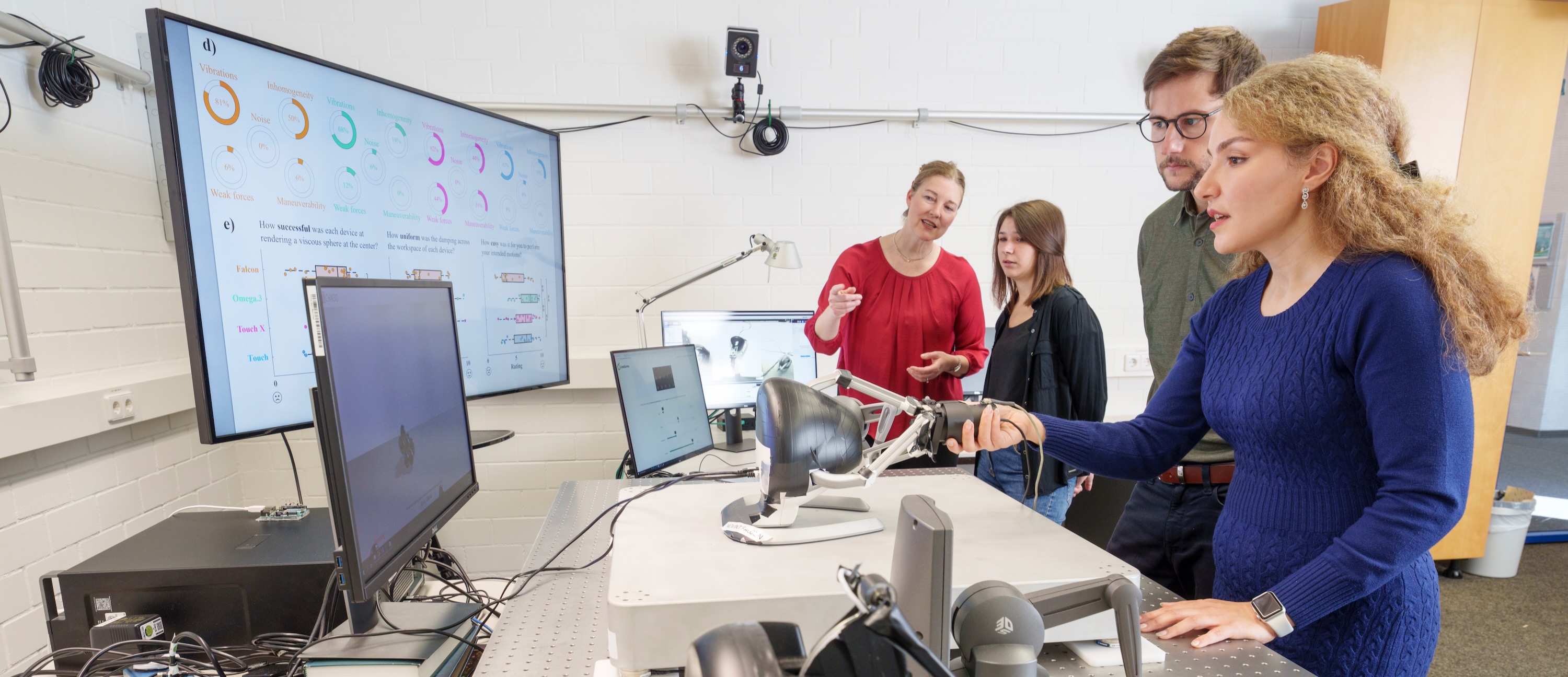
Farimah Fazlollahi evaluates a Falcon device that is actively rendering a virtual benchmark environment. Haptify, our measurement-based benchmarking system, captures interaction data through precise motion, force, and vibration sensors.

Members

Haptic Intelligence
  • Postdoctoral Researcher
Haptic Intelligence
Haptic Intelligence
  • Intern
Haptic Intelligence
  • Research Scientist
Haptic Intelligence
  • Research Scientist
Haptic Intelligence
Director

Publications

Haptic Intelligence Ph.D. Thesis Haptify: A Measurement-Based System for Quantifying the Quality of Haptic Interfaces Fazlollahi, F. University of Tübingen, Tübingen, Germany, March 2026, Department of Computer Science (Published)
Grounded force-feedback (GFF) devices, exoskeletons, and other haptic robots modulate human movement through carefully engineered mechanical, electrical, and computational designs. Given their significant societal potential and often high cost, it is essential to fairly and efficiently assess the quality of these intimate cyber-physical interfaces. However, existing device specifications and low-level performance metrics often fail to capture the nuanced qualities that expert users perceive during hands-on experimentation. To address this gap, this thesis introduces Haptify, a comprehensive benchmarking system that can thoroughly, fairly, and noninvasively evaluate GFF haptic devices. Haptify integrates multiple sensing modalities - a seven-camera optical motion-capture system, a custom-built 60-cm-square force plate, and an instrumented end-effector that can be adapted to different devices - to record the interaction between the human hand, the device, and the ground during both passive and active experiments. With this setup, users hold the device end-effector and move it through a series of carefully designed tasks while Haptify measures kinematic and kinetic responses. From this process, we establish six key ways to assess GFF device performance: workspace shape, global free-space forces, global free-space vibrations, local dynamic forces and torques, frictionless surface rendering, and stiffness rendering. These benchmarks enable systematic evaluation and comparison across devices. We first apply Haptify to benchmark two GFF devices produced by 3D Systems: the widely used Touch and the more expensive Touch X. Results reveal that the Touch X offers a slightly smaller workspace than the Touch, but it produces smaller and more predictable free-space forces, reduced vibrations, more consistent dynamic forces and torques, and higher-quality rendering of both frictionless surfaces and stiff virtual objects. To further validate and extend our approach, we conducted a user study with sixteen expert hapticians who used Haptify to evaluate four commercial GFF devices: Novint Falcon, Force Dimension Omega.3, Touch, and Touch X. Experts tested the devices in unpowered mode and across five representative virtual benchmark environments, providing extensive quantitative ratings and qualitative feedback. We distilled recurring themes from their input and analyzed correlations between expert opinions and sensor-based measurements. Our findings show that expert judgments of fundamental haptic quality indicators align closely with the metrics derived from Haptify. Moreover, device performance both unpowered and in active benchmarks can be used to predict its suitability for more complex applications, such as teleoperated surgery. By linking expert assessments with external measurement data, this thesis establishes a combined qualitative-quantitative framework for benchmarking haptic robots. This approach not only enables fair comparison across diverse devices but also establishes a direct connection between objective measurements and the subjective expertise of experienced hapticians. In doing so, it lays the foundation for more rigorous, transparent, and application-relevant evaluation of haptic technologies.
BibTeX

Haptic Intelligence Miscellaneous Quantifying Texture-Rendering Quality Across Haptic Devices Fazlollahi, F., Seifi, H., Ballardini, G., Taghizadeh, Z., Schulz, A. K., MacLean, K. E., Kuchenbecker, K. J. Work-in-progress paper (2 pages) presented at the IEEE World Haptics Conference (WHC), Suwon, South Korea, July 2025 (Published) BibTeX

Haptic Intelligence Miscellaneous Haptify: A Measurement System for Benchmarking Grounded Force-Feedback Devices Fazlollahi, F., Kuchenbecker, K. J. Extended abstract (3 pages) presented at the German Robotics Conference (GRC), Nuremberg, Germany , March 2025 (Published)
Grounded force-feedback (GFF) devices are a well-established and diverse category of haptic technology based on robotic arms. However, the number of designs and their specifications make it challenging to compare devices effectively. We address this challenge by presenting Haptify, a benchmarking system capable of evaluating GFF haptic devices in a thorough, fair, and non-invasive way. The user holds the instrumented device end-effector and moves it through a series of passive and active experiments. Haptify captures the interaction between the hand, device, and ground using a seven-camera optical motion-capture system, a custom 60-cm-square force plate, and a customized sensing end-effector. We propose six key metrics for evaluating GFF device performance: workspace shape, global free-space forces, global free-space vibrations, local dynamic forces and torques, frictionless surface rendering, and stiffness rendering. We then benchmark two commercial haptic devices using Haptify. The more expensive Touch X has a smaller workspace than the 3D Systems Touch, but it outputs smaller free-space forces and vibrations, smaller and more predictable dynamic forces and torques, and higher-quality renderings of a frictionless surface and high stiffness.
BibTeX

Haptic Intelligence Miscellaneous Improving Haptic Rendering Quality by Measuring and Compensating for Undesired Forces Fazlollahi, F., Taghizadeh, Z., Kuchenbecker, K. J. Work-in-progress paper (1 page) presented at the IEEE World Haptics Conference (WHC), Delft, the Netherlands, July 2023 (Published) BibTeX

Haptic Intelligence Article Haptify: A Measurement-Based Benchmarking System for Grounded Force-Feedback Devices Fazlollahi, F., Kuchenbecker, K. J. IEEE Transactions on Robotics, 39(2):1622-1636, April 2023 (Published)
Grounded force-feedback (GFF) devices are an established and diverse class of haptic technology based on robotic arms. However, the number of designs and how they are specified make comparing devices difficult. We thus present Haptify, a benchmarking system that can thoroughly, fairly, and noninvasively evaluate GFF haptic devices. The user holds the instrumented device end-effector and moves it through a series of passive and active experiments. Haptify records the interaction between the hand, device, and ground with a seven-camera optical motion-capture system, a 60-cm-square custom force plate, and a customized sensing end-effector. We demonstrate six key ways to assess GFF device performance: workspace shape, global free-space forces, global free-space vibrations, local dynamic forces and torques, frictionless surface rendering, and stiffness rendering. We then use Haptify to benchmark two commercial haptic devices. With a smaller workspace than the 3D Systems Touch, the more expensive Touch X outputs smaller free-space forces and vibrations, smaller and more predictable dynamic forces and torques, and higher-quality renderings of a frictionless surface and high stiffness.
DOI BibTeX

Haptic Intelligence Miscellaneous Comparing Two Grounded Force-Feedback Haptic Devices Fazlollahi, F., Kuchenbecker, K. J. Hands-on demonstration presented at EuroHaptics, Hamburg, Germany, May 2022 (Published)
Even when they are not powered, grounded force-feedback haptic devices apply forces on the user's hand. These undesired forces stem from gravity, friction, and other nonidealities, and they still exist when the device renders a virtual environment. This demo invites users to compare how the 3D Systems Touch and Touch X devices render the same haptic content. Participants will try both devices in free space and touch a stiff frictionless virtual surface. After reflecting on the differences between the two devices, each person will receive a booklet showing the quantitative performance criteria we measured for both devices using Haptify, our benchmarking system.
BibTeX

Haptic Intelligence Miscellaneous How Do Expert Hapticians Evaluate Grounded Force-Feedback Devices? Fazlollahi, F., Seifi, H., MacLean, K., Kuchenbecker, K. J. 341, Work-in-progress paper (1 page) presented at the IEEE World Haptics Conference (WHC), Montreal, Canada, July 2021 (Published)
The specifications typically reported for grounded force-feedback (GFF) devices do not capture performance quality in a consistent or meaningful way. We designed a study to identify the physical interrogations that expert hapticians employ when evaluating such a device. We report pilot data from one expert who tested three commercial GFF devices in unpowered and powered modes while demonstrating hand motions and describing the interactions. Finally, we outline how we will record expert interactions with a high-resolution apparatus and link measurements with interview data.
DOI BibTeX

Haptic Intelligence Miscellaneous Haptify: A Comprehensive Benchmarking System for Grounded Force-Feedback Haptic Devices Fazlollahi, F., Kuchenbecker, K. J. Work-in-progress poster presented at EuroHaptics, Leiden, the Netherlands, September 2020 (Published)
Over the past three decades, hundreds of grounded force-feedback (GFF) haptic devices have been invented. Our previous work on Haptipedia shows that there is no standard framework for reporting device attributes, and some crucial attributes are not stated in the literature. To capture important characteristics of haptic interfaces, we have built a benchmarking setup, Haptify. This poster presents our experimental setup, raw recorded data for a common GFF haptic interface, preliminary analysis of our haptic recordings, and our future goals.
BibTeX