Quantifying the Quality of Haptic Interfaces
Shape-Changing Haptic Interfaces
Generating Clear Vibrotactile Cues with Magnets Embedded in a Soft Finger Sheath
Salient Full-Fingertip Haptic Feedback Enabled by Wearable Electrohydraulic Actuation
Cutaneous Electrohydraulic (CUTE) Wearable Devices for Pleasant Broad-Bandwidth Haptic Cues
Modeling Finger-Touchscreen Contact during Electrovibration
Perception of Ultrasonic Friction Pulses
Vibrotactile Playback for Teaching Sensorimotor Skills in Medical Procedures
CAPT Motor: A Two-Phase Ironless Motor Structure
4D Intraoperative Surgical Perception: Anatomical Shape Reconstruction from Multiple Viewpoints
Visual-Inertial Force Estimation in Robotic Surgery
Enhancing Robotic Surgical Training
AiroTouch: Naturalistic Vibrotactile Feedback for Large-Scale Telerobotic Assembly
Optimization-Based Whole-Arm Teleoperation for Natural Human-Robot Interaction
Finger-Surface Contact Mechanics in Diverse Moisture Conditions
Computational Modeling of Finger-Surface Contact
Perceptual Integration of Contact Force Components During Tactile Stimulation
Dynamic Models and Wearable Tactile Devices for the Fingertips
Novel Designs and Rendering Algorithms for Fingertip Haptic Devices
Dimensional Reduction from 3D to 1D for Realistic Vibration Rendering
Prendo: Analyzing Human Grasping Strategies for Visually Occluded Objects
Learning Upper-Limb Exercises from Demonstrations
Minimally Invasive Surgical Training with Multimodal Feedback and Automatic Skill Evaluation
Efficient Large-Area Tactile Sensing for Robot Skin
Haptic Feedback and Autonomous Reflexes for Upper-limb Prostheses
Gait Retraining
Modeling Hand Deformations During Contact
Intraoperative AR Assistance for Robot-Assisted Minimally Invasive Surgery
Immersive VR for Phantom Limb Pain
Visual and Haptic Perception of Real Surfaces
Haptipedia
Gait Propulsion Trainer
TouchTable: A Musical Interface with Haptic Feedback for DJs
Exercise Games with Baxter
Intuitive Social-Physical Robots for Exercise
How Should Robots Hug?
Hierarchical Structure for Learning from Demonstration
Fabrication of HuggieBot 2.0: A More Huggable Robot
Learning Haptic Adjectives from Tactile Data
Feeling With Your Eyes: Visual-Haptic Surface Interaction
S-BAN
General Tactile Sensor Model
Insight: a Haptic Sensor Powered by Vision and Machine Learning
Giving Touch to Soft Robot Fingertips Using Vision, Audio and Machine Learning
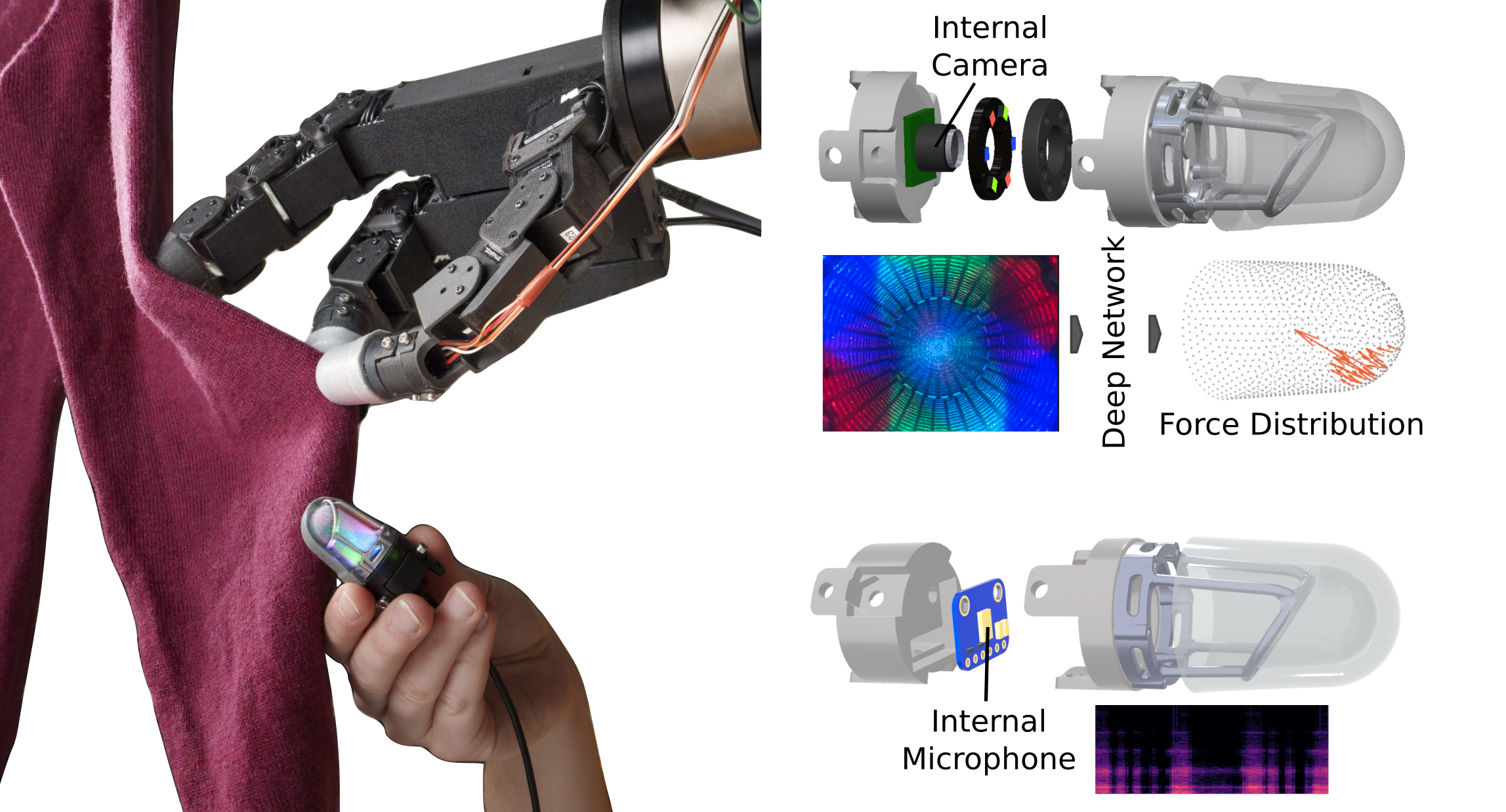
 ]. We also explore audio-based touch for fabric recognition by integrating a microphone into the same soft fingertip design.
Autonomous robots have the potential to become dexterous and work flexibly together with humans. To achieve this goal, their hardware needs to become more robust and provide richer sensory feedback, while their learning algorithms need to become more data-efficient and safety-aware. A clear shortcoming of current commodity robotic hardware is the complete lack or low quality of the tactile sensations it can acquire. In contrast, humans have a rich sense of touch and use it constantly-mostly subconsciously. In fact, if human haptic perception is impaired, dexterous manipulation becomes very challenging or even impossible. High-resolution haptic sensing similar to the human fingertip can enable robots to execute delicate manipulation tasks like picking up small objects, inserting a key into a lock, or handing a full cup of coffee to a human.
This project aims to extend the capabilities of robotic manipulation by creating learning-based tactile sensors to capture the rich components of touch information. For this goal, we explore vision-based and audio-based technologies processed with machine learning to create fast and robust touch sensing. As part of this project, we present Minsight [], a fingertip-sized vision-based tactile sensor based on the Insight technology [], capable of sensing forces on its omnidirectional sensing surface down to 0.05 N with an update rate of 60 Hz. This approach uses a camera to monitor changes in internal light intensity and/or color caused by deformations of the sensor's surrounding material due to external contact forces. The centrally positioned sensing component, a camera, does not bear the contact load, which ensures the high durability of the sensor.
We investigate, how Minsight's high-resolution tactile information can be used by learning-based processing methods to create robust manipulation strategies. We are furthermore looking into extending high-resolution vision-based sensing with an additional modality to capture also the high-frequency temporal aspects of touch, which are useful to feel surface textures or fabrics. To do so, we created a microphone-based twin sensor to Minsight, which captures audio with a bandwidth of 50 Hz to 15 kHz and use both of them for dynamic exploration of fabrics with a robot hand.
This research project involves collaborations with Prof. Georg Martius (University of Tübingen) and Laura Schiller (University of Tübingen).
Members








Publications