Quantifying the Quality of Haptic Interfaces
Shape-Changing Haptic Interfaces
Generating Clear Vibrotactile Cues with Magnets Embedded in a Soft Finger Sheath
Salient Full-Fingertip Haptic Feedback Enabled by Wearable Electrohydraulic Actuation
Cutaneous Electrohydraulic (CUTE) Wearable Devices for Pleasant Broad-Bandwidth Haptic Cues
Modeling Finger-Touchscreen Contact during Electrovibration
Perception of Ultrasonic Friction Pulses
Vibrotactile Playback for Teaching Sensorimotor Skills in Medical Procedures
CAPT Motor: A Two-Phase Ironless Motor Structure
4D Intraoperative Surgical Perception: Anatomical Shape Reconstruction from Multiple Viewpoints
Visual-Inertial Force Estimation in Robotic Surgery
Enhancing Robotic Surgical Training
AiroTouch: Naturalistic Vibrotactile Feedback for Large-Scale Telerobotic Assembly
Optimization-Based Whole-Arm Teleoperation for Natural Human-Robot Interaction
Finger-Surface Contact Mechanics in Diverse Moisture Conditions
Computational Modeling of Finger-Surface Contact
Perceptual Integration of Contact Force Components During Tactile Stimulation
Dynamic Models and Wearable Tactile Devices for the Fingertips
Novel Designs and Rendering Algorithms for Fingertip Haptic Devices
Dimensional Reduction from 3D to 1D for Realistic Vibration Rendering
Prendo: Analyzing Human Grasping Strategies for Visually Occluded Objects
Learning Upper-Limb Exercises from Demonstrations
Minimally Invasive Surgical Training with Multimodal Feedback and Automatic Skill Evaluation
Efficient Large-Area Tactile Sensing for Robot Skin
Haptic Feedback and Autonomous Reflexes for Upper-limb Prostheses
Gait Retraining
Modeling Hand Deformations During Contact
Intraoperative AR Assistance for Robot-Assisted Minimally Invasive Surgery
Immersive VR for Phantom Limb Pain
Visual and Haptic Perception of Real Surfaces
Haptipedia
Gait Propulsion Trainer
TouchTable: A Musical Interface with Haptic Feedback for DJs
Exercise Games with Baxter
Intuitive Social-Physical Robots for Exercise
How Should Robots Hug?
Hierarchical Structure for Learning from Demonstration
Fabrication of HuggieBot 2.0: A More Huggable Robot
Learning Haptic Adjectives from Tactile Data
Feeling With Your Eyes: Visual-Haptic Surface Interaction
S-BAN
General Tactile Sensor Model
Insight: a Haptic Sensor Powered by Vision and Machine Learning
Generating Clear Vibrotactile Cues with Magnets Embedded in a Soft Finger Sheath
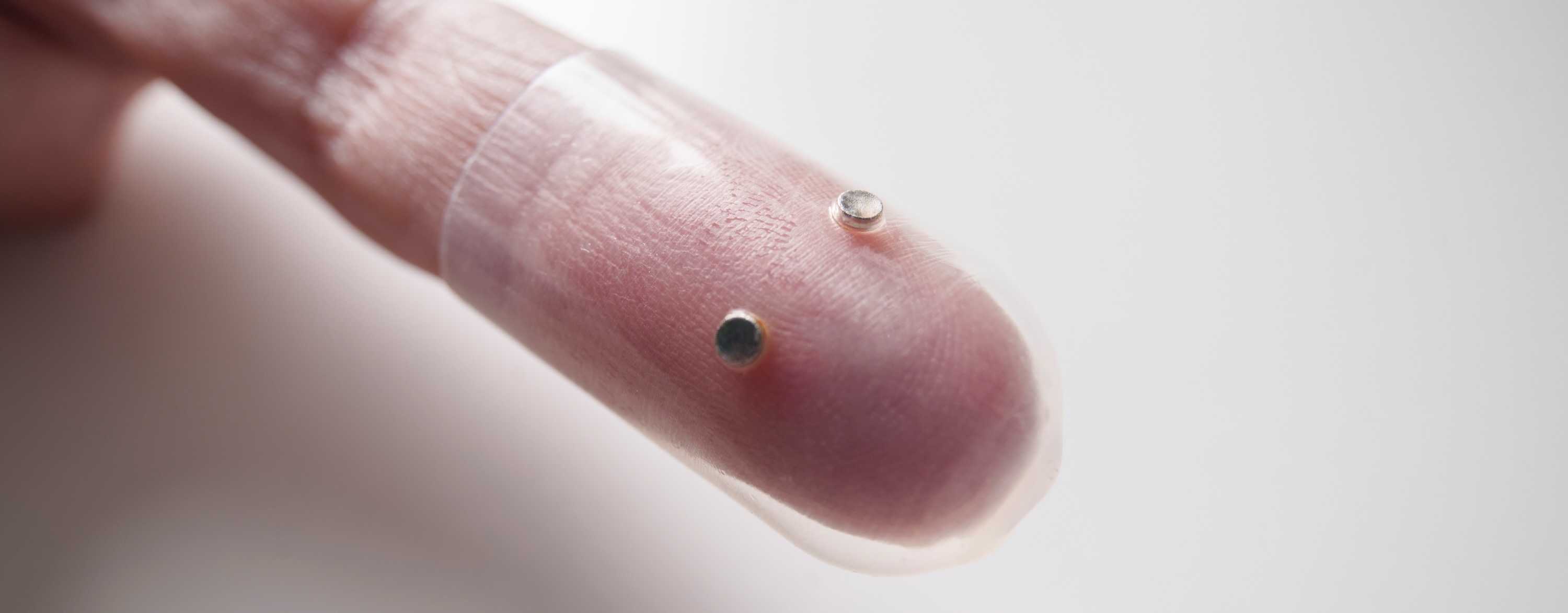
 ] that is driven by sound recordings via a nearby air coil. We are investigating the influence of magnet locations and polarities across frequencies using finite element simulation [] and perceptual studies.
Wearable vibrotactile displays can stimulate the sense of touch and enrich diverse applications including gaming, computer-aided design, and remote surgery. However, when crafted from typical rigid robotic components, such interfaces tend to be heavy, bulky, and expensive. Sleeker designs may alleviate these disadvantages, but they often struggle to create clear haptic cues.
In this project we developed a lightweight wearable silicone finger sheath that can deliver salient and rich vibrotactile cues via electromagnetic actuation []. We fabricate the sheath on a ferromagnetic mandrel with a process based on dip molding. A miniature neodymium magnet embedded within the silicone layers is driven to vibrate by applying alternating current to a nearby air-coil. The bidirectional coupling between the magnet and the skin and the enlarged stimulation area created by the rubber sheath contribute to enhanced sensation on the fingertip.
Experiments were conducted to determine the amplitude of the magnetic force and the frequency response function for the displacement amplitude of the magnet perpendicular to the skin. In addition, high-fidelity finite element analyses based on the DigiTip model [] were performed to simulate the dynamic response of the device covering the fingertip to investigate the trends observed in the measurements. The experimental and simulated results showed consistent dynamic behavior from 10 to 1000 Hz, with the displacement amplitude decreasing after about 300 Hz. A cue identification experiment and a demonstration in virtual reality validated the feasibility of this approach to fingertip haptics.
We are currently investigating the influence of magnet locations and polarities across frequencies using finite element simulations [] and human perception experiments with pairs of magnets embedded in silicone sheaths.
Members




Publications