Back

Haptic Intelligence Members Publications

Enhancing Robotic Surgical Training

Surgical training wide
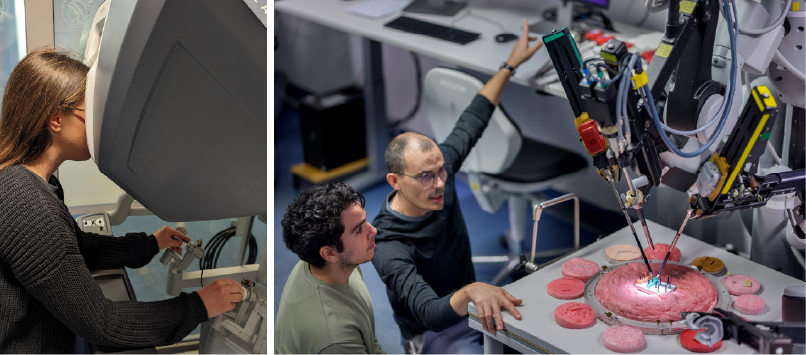
A participant is seated at the da Vinci Si surgeon console, where we have integrated eye tracking, visual augmented reality, and various kinds of haptic feedback. They control the movements of the da Vinci instruments across the room to accomplish a training task.

Members

Thumb ticker sm yardensharon
Haptic Intelligence
  • Research Scientist
Thumb ticker sm burak
Haptic Intelligence
  • Doctoral Researcher
Thumb ticker sm guido
Haptic Intelligence
  • Doctoral Researcher
Thumb ticker sm thumb ticker 20241029 forte paola 1 2560pxwidth   copy  1
Haptic Intelligence, Perceiving Systems
  • Postdoctoral Researcher
Thumb ticker sm bj square
Haptic Intelligence
  • Research Engineer
Thumb ticker sm passimage
Haptic Intelligence
  • Master Student
Thumb ticker sm rachaell orsa
Haptic Intelligence
  • Research Scientist
Thumb ticker sm 0
Haptic Intelligence
  • Research Scientist
Thumb ticker sm whatsapp image 2024 08 16 at 9.40.10 am
Haptic Intelligence
  • Intern
Thumb ticker sm ben
Haptic Intelligence
  • Postdoctoral Researcher
Thumb ticker sm thumb ticker kjk 2024
Haptic Intelligence
Director

Publications

Haptic Intelligence Article Simulation Training with Haptic Feedback of Instrument Vibrations Reduces Resident Workload During Live Robot-Assisted Sleeve Gastrectomy Gomez, E. D., Mat Husin, H., Dumon, K. R., Williams, N. N., Kuchenbecker, K. J. Surgical Endoscopy, 39(3):1523-1535, April 2025 (Published)
Background: New surgeons experience heavy workload during robot-assisted surgery partially because they must use vision to compensate for the lack of haptic feedback. We hypothesize that providing realistic haptic feedback during dry-lab simulation training may accelerate learning and reduce workload during subsequent surgery on patients. Methods: We conducted a single-blinded study with twelve general surgery residents (third and seventh post-graduate year, PGY) randomized into haptic and control groups. Participants performed five simulated bariatric surgeries on a custom inanimate simulator followed by live robot-assisted sleeve gastrectomies (RASGs) using da Vinci robots. The haptic group received naturalistic haptic feedback of instrument vibrations during their first four simulated procedures. Participants completed pre-/post-procedure STAI and post-procedure NASA-TLX questionnaires in both simulation and the operating room (OR). Results: Higher PGY level (simulation: p<0.001, OR p=0.004), shorter operative time (simulation: p<0.001, OR: p=0.003), and lower pre-procedure STAI (simulation: p=0.003, OR: p<0.001) were significantly associated with lower self-reported overall workload in both operative settings; PGY-7s reported about 10% lower workload than PGY-3s. The haptic group had significantly lower overall covariate-adjusted NASA-TLX during the fourth (p=0.03) and fifth (p=0.04) simulated procedures and across all OR procedures (p=0.047), though not for only the first three OR procedures. Haptic feedback reduced physical demand (simulation: p<0.001, OR: p=0.001) and increased perceived performance (simulation: p=0.031, OR: p<0.001) in both settings. Conclusion: Haptic feedback of instrument vibrations provided during robotic surgical simulation reduces trainee workload during both simulation and live OR cases. The implications of workload reduction and its potential effects on patient safety warrant further investigation.
DOI BibTeX

Haptic Intelligence Article AiroTouch: Enhancing Telerobotic Assembly through Naturalistic Haptic Feedback of Tool Vibrations Gong, Y., Mat Husin, H., Erol, E., Ortenzi, V., Kuchenbecker, K. J. Frontiers in Robotics and AI, 11(1355205):1-15, May 2024 (Published)
Teleoperation allows workers to safely control powerful construction machines; however, its primary reliance on visual feedback limits the operator's efficiency in situations with stiff contact or poor visibility, hindering its use for assembly of pre-fabricated building components. Reliable, economical, and easy-to-implement haptic feedback could fill this perception gap and facilitate the broader use of robots in construction and other application areas. Thus, we adapted widely available commercial audio equipment to create AiroTouch, a naturalistic haptic feedback system that measures the vibration experienced by each robot tool and enables the operator to feel a scaled version of this vibration in real time. Accurate haptic transmission was achieved by optimizing the positions of the system's off-the-shelf accelerometers and voice-coil actuators. A study was conducted to evaluate how adding this naturalistic type of vibrotactile feedback affects the operator during telerobotic assembly. Thirty participants used a bimanual dexterous teleoperation system (Intuitive da Vinci Si) to build a small rigid structure under three randomly ordered haptic feedback conditions: no vibrations, one-axis vibrations, and summed three-axis vibrations. The results show that users took advantage of both tested versions of the naturalistic haptic feedback after gaining some experience with the task, causing significantly lower vibrations and forces in the second trial. Subjective responses indicate that haptic feedback increased the realism of the interaction and reduced the perceived task duration, task difficulty, and fatigue. As hypothesized, higher haptic feedback gains were chosen by users with larger hands and for the smaller sensed vibrations in the one-axis condition. These results elucidate important details for effective implementation of naturalistic vibrotactile feedback and demonstrate that our accessible audio-based approach could enhance user performance and experience during telerobotic assembly in construction and other application domains.
DOI BibTeX

Haptic Intelligence Article Effects of Automated Skill Assessment on Robotic Surgery Training Brown, J. D., Kuchenbecker, K. J. The International Journal of Medical Robotics and Computer Assisted Surgery, 19(2):e2492, April 2023 (Published)
Background: Several automated skill-assessment approaches have been proposed for robotic surgery, but their utility is not well understood. This article investigates the effects of one machine-learning-based skill-assessment approach on psychomotor skill development in robotic surgery training. Methods: N=29 trainees (medical students and residents) with no robotic surgery experience performed five trials of inanimate peg transfer with an Intuitive Surgical da Vinci Standard robot. Half of the participants received no post-trial feedback. The other half received automatically calculated scores from five Global Evaluative Assessment of Robotic Skill (GEARS) domains post-trial. Results: There were no significant differences between the groups regarding overall improvement or skill improvement rate. However, participants who received post-trial feedback rated their overall performance improvement significantly lower than participants who did not receive feedback. Conclusions: These findings indicate that automated skill evaluation systems might improve trainee selfawareness but not accelerate early-stage psychomotor skill development in robotic surgery training.
DOI BibTeX

Haptic Intelligence Conference Paper Wrist-Squeezing Force Feedback Improves Accuracy and Speed in Robotic Surgery Training Machaca, S., Cao, E., Chi, A., Adrales, G., Kuchenbecker, K. J., Brown, J. D. In Proceedings of the IEEE RAS/EMBS International Conference for Biomedical Robotics and Biomechatronics (BioRob), Seoul, South Korea, August 2022 (Published)
Current robotic minimally invasive surgery (RMIS) platforms provide surgeons with no haptic feedback of the robot's physical interactions. This limitation forces surgeons to rely heavily on visual feedback and can make it challenging for surgical trainees to manipulate tissue gently. Prior research has demonstrated that haptic feedback can increase task accuracy in RMIS training. However, it remains unclear whether these improvements represent a fundamental improvement in skill, or if they simply stem from re-prioritizing accuracy over task completion time. In this study, we provide haptic feedback of the force applied by the surgical instruments using custom wrist-squeezing devices. We hypothesize that individuals receiving haptic feedback will increase accuracy (produce less force) while increasing their task completion time, compared to a control group receiving no haptic feedback. To test this hypothesis, N=21 novice participants were asked to repeatedly complete a ring rollercoaster surgical training task as quickly as possible. Results show that participants receiving haptic feedback apply significantly less force (0.67 N) than the control group, and they complete the task no faster or slower than the control group after twelve repetitions. Furthermore, participants in the feedback group decreased their task completion times significantly faster (7.68 \%) than participants in the control group (5.26 \%). This form of haptic feedback, therefore, has the potential to help trainees improve their technical accuracy without compromising speed.
DOI BibTeX

Haptic Intelligence Article Design of Interactive Augmented Reality Functions for Robotic Surgery and Evaluation in Dry-Lab Lymphadenectomy Forte, M., Gourishetti, R., Javot, B., Engler, T., Gomez, E. D., Kuchenbecker, K. J. The International Journal of Medical Robotics and Computer Assisted Surgery, 18(2):e2351, April 2022 (Published)
Augmented reality (AR) has been widely researched for use in healthcare. Prior AR for robot-assisted minimally invasive surgery has mainly focused on superimposing preoperative 3D images onto patient anatomy. This paper presents alternative interactive AR tools for robotic surgery. We designed, built, and evaluated four voice-controlled functions: viewing a live video of the operating room, viewing two-dimensional preoperative images, measuring 3D distances, and warning about out-of-view instruments. This low-cost system was developed on a da Vinci Si, and it can be integrated into surgical robots equipped with a stereo camera and a stereo viewer. Eight experienced surgeons performed dry-lab lymphadenectomies and reported that the functions improved the procedure. They particularly appreciated the possibility of accessing the patient's medical records on demand, measuring distances intraoperatively, and interacting with the functions using voice commands. The positive evaluations garnered by these alternative AR functions and interaction methods provide support for further exploration.
DOI BibTeX

Haptic Intelligence Master Thesis Robotic Surgery Training in AR: Multimodal Record and Replay Krauthausen, F. University of Stuttgart, Stuttgart, Germany, May 2021, Study Program in Software Engineering (Published) BibTeX

Haptic Intelligence Miscellaneous Bimanual Wrist-Squeezing Haptic Feedback Changes Speed-Force Tradeoff in Robotic Surgery Training Cao, E., Machaca, S., Bernard, T., Wolfinger, B., Patterson, Z., Chi, A., Adrales, G. L., Kuchenbecker, K. J., Brown, J. D. Extended abstract presented as an ePoster at the Annual Meeting of the Society of American Gastrointestinal and Endoscopic Surgeons (SAGES), Baltimore, USA, April 2019 (Published) URL BibTeX

Haptic Intelligence Article Using Contact Forces and Robot Arm Accelerations to Automatically Rate Surgeon Skill at Peg Transfer Brown, J. D., O’Brien, C. E., Leung, S. C., Dumon, K. R., Lee, D. I., Kuchenbecker, K. J. IEEE Transactions on Biomedical Engineering, 64(9):2263-2275, September 2017 (Published) DOI BibTeX

Haptic Intelligence Conference Paper A Wrist-Squeezing Force-Feedback System for Robotic Surgery Training Brown, J. D., Fernandez, J. N., Cohen, S. P., Kuchenbecker, K. J. In Proceedings of the IEEE World Haptics Conference (WHC), 107-112, Munich, Germany, June 2017 (Published)
Over time, surgical trainees learn to compensate for the lack of haptic feedback in commercial robotic minimally invasive surgical systems. Incorporating touch cues into robotic surgery training could potentially shorten this learning process if the benefits of haptic feedback were sustained after it is removed. In this paper, we develop a wrist-squeezing haptic feedback system and evaluate whether it holds the potential to train novice da Vinci users to reduce the force they exert on a bimanual inanimate training task. Subjects were randomly divided into two groups according to a multiple baseline experimental design. Each of the ten participants moved a ring along a curved wire nine times while the haptic feedback was conditionally withheld, provided, and withheld again. The realtime tactile feedback of applied force magnitude significantly reduced the integral of the force produced by the da Vinci tools on the task materials, and this result remained even when the haptic feedback was removed. Overall, our findings suggest that wrist-squeezing force feedback can play an essential role in helping novice trainees learn to minimize the force they exert with a surgical robot.
DOI BibTeX