Back

Haptic Intelligence Members Publications

Cutaneous Electrohydraulic (CUTE) Wearable Devices for Pleasant Broad-Bandwidth Haptic Cues
Cute
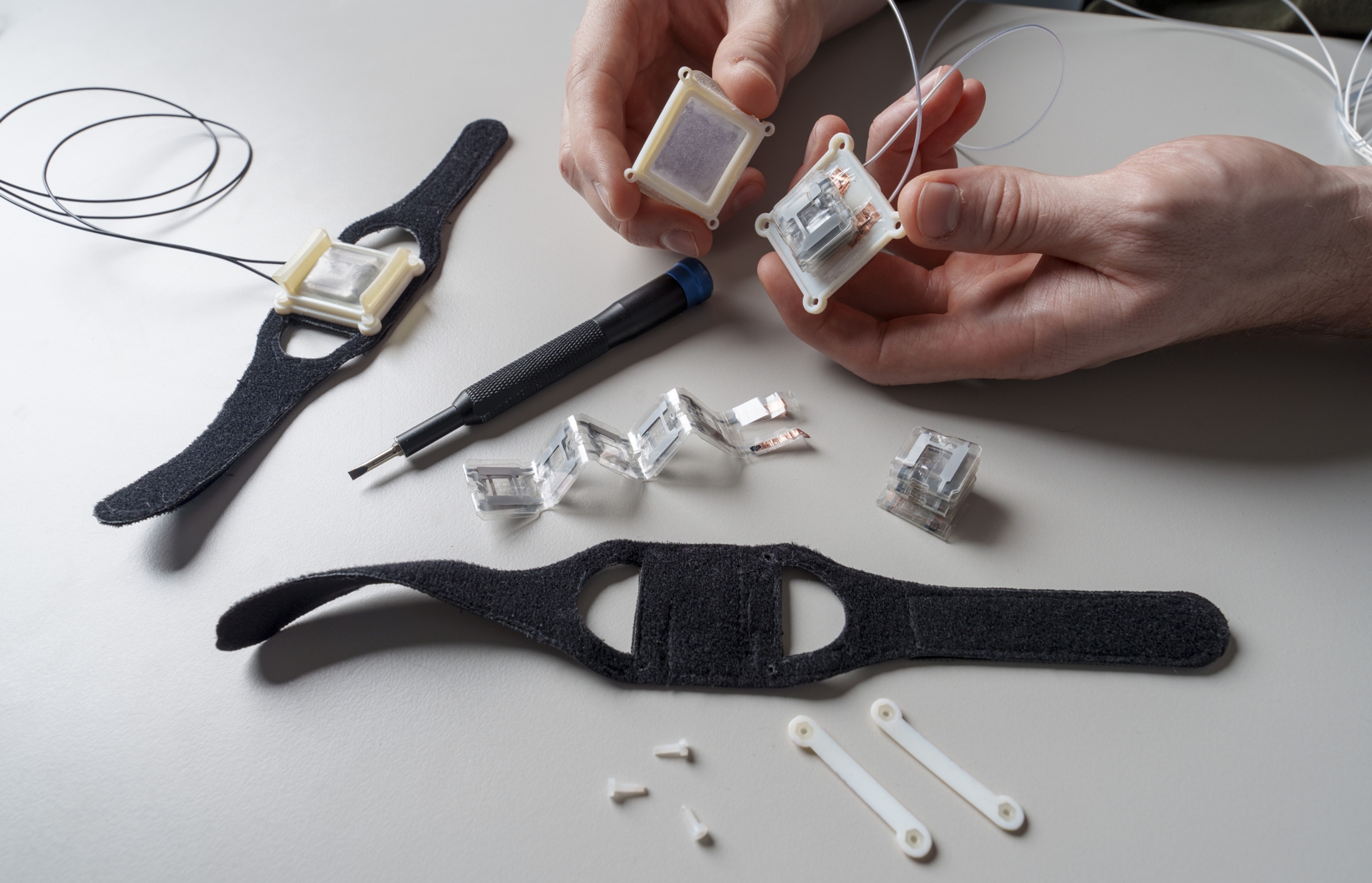
CUTE wearable devices are electrically driven and can produce a remarkable range of tactile sensations on the user's wrist, offering haptic feedback that is precise, expressive, and more pleasant than the buzzing vibrations of many of today's consumer devices [File IconFile Icon].

Members

Thumb ticker sm cropped headshot
Haptic Intelligence, Robotic Materials
  • Doctoral Researcher
Thumb ticker sm headshot square
Robotic Materials
  • Doctoral Researcher
Thumb ticker sm dsc 0061 2
Robotic Materials
Tenure track professor University of Stuttgart
Thumb ticker sm picture2
Haptic Intelligence
  • Research Scientist
Thumb ticker sm uli
Haptic Intelligence
  • Doctoral Researcher
Thumb ticker sm profmpi
Haptic Intelligence
  • Intern
Thumb ticker sm keplinger christoph geringauflo  send
Robotic Materials, Physical Intelligence
Managing Director
Thumb ticker sm thumb ticker kjk 2024
Haptic Intelligence
Director

Publications

Haptic Intelligence Master Thesis Wrist-Worn Pressure Pulses for Phantom Directional Cues in VR Kadmani, A. Technical University of Munich, Munich, Germany, September 2025, M.Sc. in Electrical Engineering and Information Technology (Published)
Haptic feedback in today's VR systems is often limited to vibration delivered through handheld controllers, leaving a gap for compact devices that can convey spatial cues without occupying the hands. This thesis presents the design and evaluation of SuperCUTE, a wrist-worn pressure feedback device that uses four soft electrohydraulic actuators to elicit phantom tactile sensations around the wrist. The device was evaluated with n = 20 participants in a user study comprising two tasks. In Task 1 (circular GUI), single-actuator cues produced tightly clustered responses (median resultant length R = 0.92); about 70% of trials fell within ± 22.5° of the stimulated cardinal. Adjacent-actuator pairs yielded in-between percepts (about 70% of reports), and intensity imbalance shifted perceived location toward the stronger actuator; reported intensity was higher for strong than weak drives (mean 0.76 vs. 0.32). Across cues, Rayleigh tests indicated strong clustering of response angles (median R ≈ 0.82). In Task 2 (VR), hand trajectories during 5 s cues aligned with cue geometry; end-directions showed strong clustering (median R ≈ 0.78), and latency estimated from a 1 cm displacement threshold had a median of 1.25 s (IQR 0.61 s). Questionnaire responses indicated clear, comfortable, and usable cues. Overall, pressure pulses are a feasible approach for directional wrist cues in VR. We provide device documentation, datasets, and analysis code to support pressure-based wearable haptics.
BibTeX

Haptic Intelligence Robotic Materials Miscellaneous Learning-Based Touch Detection and Force Estimation in Cutaneous Electrohydraulic Devices Sanchez-Tamayo, N., Singer, D., Keplinger, C., Kuchenbecker, K. J. Work-in-progress paper (2 pages) presented at the IEEE World Haptics Conference (WHC), Suwon, South Korea, July 2025 (Published) BibTeX

Haptic Intelligence Robotic Materials Article Cutaneous Electrohydraulic (CUTE) Wearable Devices for Pleasant Broad-Bandwidth Haptic Cues Sanchez-Tamayo, N., Yoder, Z., Rothemund, P., Ballardini, G., Keplinger, C., Kuchenbecker, K. J. Advanced Science, 11(48):2402461, December 2024, This article was selected for the inside front cover. https://doi.org/10.1002/advs.202470295 (Published)

By focusing on vibrations, current wearable haptic devices underutilize the skin's perceptual capabilities. Devices that provide richer haptic stimuli, including contact feedback and/or variable pressure, are typically heavy and bulky due to the underlying actuator technology and the low sensitivity of hairy skin, which covers most of the body. This paper presents a system architecture for compact wearable devices that deliver salient and pleasant broad-bandwidth haptic cues: Cutaneous Electrohydraulic (CUTE) devices combine a custom materials design for soft haptic electrohydraulic actuators that feature high stroke, high force, and electrical safety with a comfortable mounting strategy that places the actuator in a non-contact resting position. A prototypical wrist-wearable CUTE device produces rich tactile sensations by making and breaking contact with the skin (2.44 mm actuation stroke), applying high controllable forces (exceeding 2.3 N), and delivering vibrations at a wide range of amplitudes and frequencies (0-200 Hz). A perceptual study with fourteen participants achieved 97.9\% recognition accuracy across six diverse cues and verified their pleasant and expressive feel. This system architecture for wearable devices gives unprecedented control over the haptic cues delivered to the skin, providing an elegant and discreet way to activate the user's sense of touch.
Video DOI BibTeX

Haptic Intelligence Robotic Materials Miscellaneous Active Haptic Feedback for a Virtual Wrist-Anchored User Interface Bartels, J. U., Sanchez-Tamayo, N., Sedlmair, M., Kuchenbecker, K. J. Adjunct Proceedings of the Annual ACM Symposium on User Interface Software and Technology (UIST), (53)1-3, Hands-on demonstration presented at the Annual ACM Symposium on User Interface Software and Technology (UIST), Pittsburgh, USA, October 2024 (Published)
The presented system combines a virtual wrist-anchored user interface (UI) with a new low-profle, wrist-worn device that provides salient and expressive haptic feedback such as contact, pressure and broad-bandwidth vibration. This active feedback is used to add tactile cues to interactions with virtual mid-air UI elements that track the user's wrist; we demonstrate a simple menu-interaction task to showcase the utility of haptics for interactions with virtual buttons and sliders. Moving forward, we intend to use this platform to develop haptic guidelines for body-anchored interfaces and test multiple haptic devices across the body to create engaging interactions.
DOI BibTeX

Haptic Intelligence Master Thesis Estimating Contact Forces Across Soft Capacitive Tactile Sensors Using Machine Learning Tiwari, A. Saarland University, Saarbrücken, Germany, July 2024, M.Sc. in Embedded Systems (Published)
Robots have become an essential part of the modern world, playing a crucial role in applications from manufacturing to healthcare. Despite significant advancements, the operational range of robots remains relatively narrow, often limited to controlled environments and simple, predetermined tasks. Tactile sensors show promise in broadening this range by enhancing a robot's performance in fine manipulation tasks. These sensors enable robots to perceive contact, providing a more nuanced understanding of their environment in real time. The challenge, however, lies in deriving meaningful and interpretable insights from these sensors, such as contact location and force, which are crucial for dexterous manipulation tasks. To address this challenge, this thesis develops machine learning-based software that achieves precise real-time contact location and force sensing across the entire surface of a grid-based soft capacitive tactile sensor, enabling rapid and straightforward deployment and facilitating transferability to other sensor instances, all while retaining the advantageous attributes of capacitance technology. Machine learning models were trained using data captured by indenting the sensor surface and measuring the sensor responses and the applied normal forces. Convolutional neural networks (CNNs) were selected for their low prediction errors in contact force estimation with the collected dataset. Two distinct models were developed: one for estimating contact forces at a single point and another for estimating normal force distributions. The transferability of the trained models across different sensor instances was evaluated and improved. The single point contact force estimation model's practical utility was demonstrated through real-time closed-loop control of a Franka Emika Panda robot arm through two specific tasks: tactile servoing in 1D and active object centering in 2D. This research contributes to enhancing the accessibility of soft tactile sensors in robotic applications through machine learning and demonstrates that this approach can improve the capabilities of tactile sensors.
BibTeX

Haptic Intelligence Robotic Materials Miscellaneous Cutaneous Electrohydraulic (CUTE) Wearable Devices for Multimodal Haptic Feedback Sanchez-Tamayo, N., Yoder, Z., Ballardini, G., Rothemund, P., Keplinger, C., Kuchenbecker, K. J. Extended abstract (1 page) presented at the IEEE RoboSoft Workshop on Multimodal Soft Robots for Multifunctional Manipulation, Locomotion, and Human-Machine Interaction, San Diego, USA, April 2024 (Published) BibTeX