Back

Perceiving Systems Members Publications

Implicit Representations
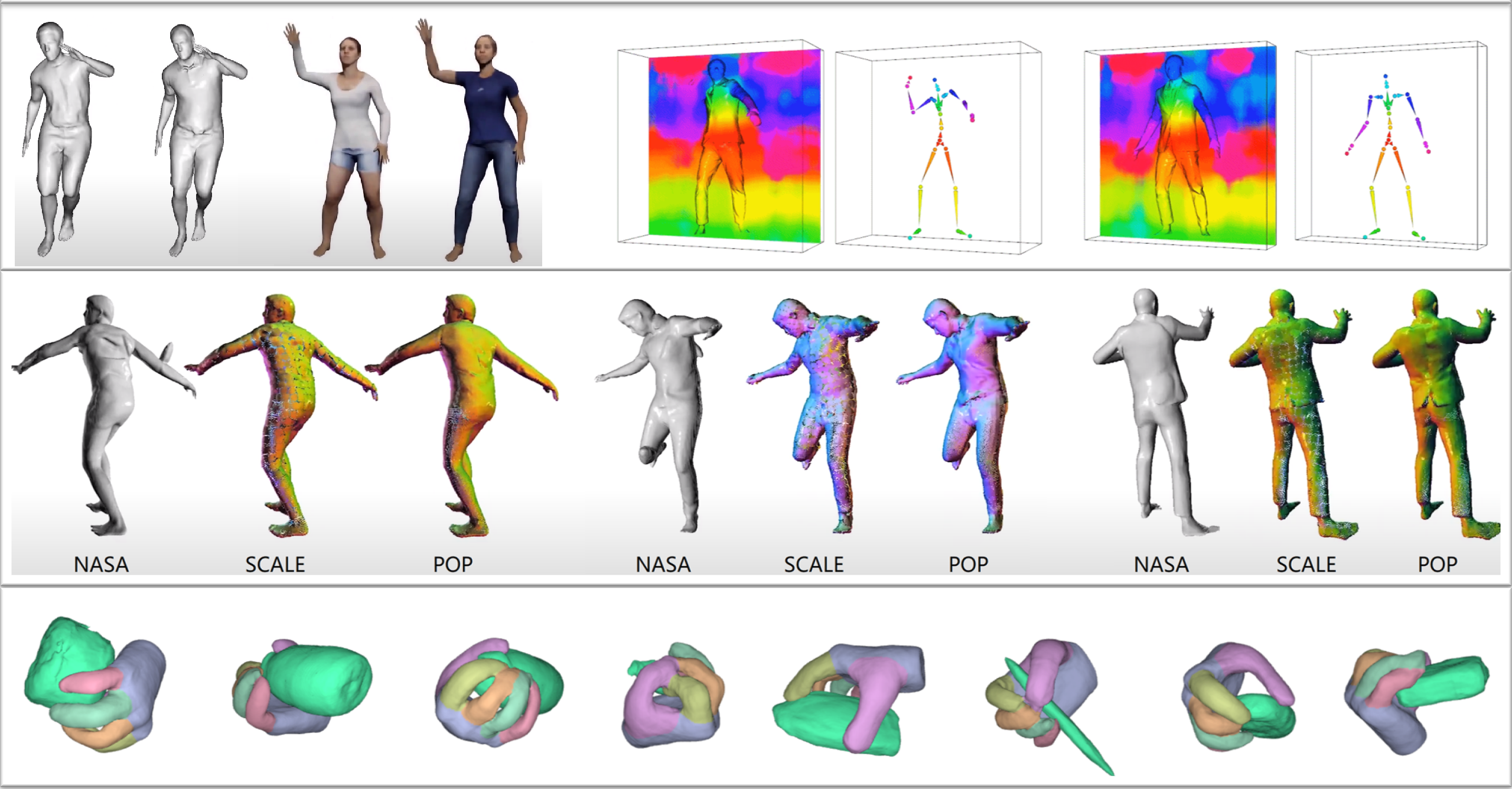
(Top to bottom) Deep implicit shapes for modeling clothed humans. A novel articulated point cloud shape representation of clothed bodies. Implicit representations for contact and interaction modeling.

Members

Perceiving Systems
Emeritus / Acting Director
Perceiving Systems
Guest Scientist
Perceiving Systems
  • Guest Scientist
no image
Perceiving Systems
Perceiving Systems
Guest Scientist
Perceiving Systems
  • Intern
Empirical Inference
Research Group Leader
Perceiving Systems
Perceiving Systems
  • Guest Scientist
Perceiving Systems
  • Guest Scientist

Publications

Perceiving Systems Conference Paper ICON: Implicit Clothed humans Obtained from Normals Xiu, Y., Yang, J., Tzionas, D., Black, M. J. In 2022 IEEE/CVF Conference on Computer Vision and Pattern Recognition (CVPR 2022), 13286-13296 , IEEE, Piscataway, NJ, IEEE/CVF Conference on Computer Vision and Pattern Recognition (CVPR 2022), June 2022 (Published)
Current methods for learning realistic and animatable 3D clothed avatars need either posed 3D scans or 2D images with carefully controlled user poses. In contrast, our goal is to learn the avatar from only 2D images of people in unconstrained poses. Given a set of images, our method estimates a detailed 3D surface from each image and then combines these into an animatable avatar. Implicit functions are well suited to the first task, as they can capture details like hair or clothes. Current methods, however, are not robust to varied human poses and often produce 3D surfaces with broken or disembodied limbs, missing details, or non-human shapes. The problem is that these methods use global feature encoders that are sensitive to global pose. To address this, we propose ICON ("Implicit Clothed humans Obtained from Normals"), which uses local features, instead. ICON has two main modules, both of which exploit the SMPL(-X) body model. First, ICON infers detailed clothed-human normals (front/back) conditioned on the SMPL(-X) normals. Second, a visibility-aware implicit surface regressor produces an iso-surface of a human occupancy field. Importantly, at inference time, a feedback loop alternates between refining the SMPL(-X) mesh using the inferred clothed normals and then refining the normals. Given multiple reconstructed frames of a subject in varied poses, we use SCANimate to produce an animatable avatar from them. Evaluation on the AGORA and CAPE datasets shows that ICON outperforms the state of the art in reconstruction, even with heavily limited training data. Additionally, it is much more robust to out-of-distribution samples, e.g., in-the-wild poses/images and out-of-frame cropping. ICON takes a step towards robust 3D clothed human reconstruction from in-the-wild images. This enables creating avatars directly from video with personalized and natural pose-dependent cloth deformation.
Home Code Demo Video arXiv Paper Sup. Mat. Poster DOI URL BibTeX

Autonomous Vision Perceiving Systems Conference Paper MetaAvatar: Learning Animatable Clothed Human Models from Few Depth Images Wang, S., Mihajlovic, M., Ma, Q., Geiger, A., Tang, S. In Advances in Neural Information Processing Systems 34, 4:2810-2822, (Editors: Ranzato, M. and Beygelzimer, A. and Dauphin, Y. and Liang, P. S. and Wortman Vaughan, J.), Curran Associates, Inc., Red Hook, NY, 35th Conference on Neural Information Processing Systems (NeurIPS 2021), December 2021 (Published)
In this paper, we aim to create generalizable and controllable neural signed distance fields (SDFs) that represent clothed humans from monocular depth observations. Recent advances in deep learning, especially neural implicit representations, have enabled human shape reconstruction and controllable avatar generation from different sensor inputs. However, to generate realistic cloth deformations from novel input poses, watertight meshes or dense full-body scans are usually needed as inputs. Furthermore, due to the difficulty of effectively modeling pose-dependent cloth deformations for diverse body shapes and cloth types, existing approaches resort to per-subject/cloth-type optimization from scratch, which is computationally expensive. In contrast, we propose an approach that can quickly generate realistic clothed human avatars, represented as controllable neural SDFs, given only monocular depth images. We achieve this by using meta-learning to learn an initialization of a hypernetwork that predicts the parameters of neural SDFs. The hypernetwork is conditioned on human poses and represents a clothed neural avatar that deforms non-rigidly according to the input poses. Meanwhile, it is meta-learned to effectively incorporate priors of diverse body shapes and cloth types and thus can be much faster to fine-tune compared to models trained from scratch. We qualitatively and quantitatively show that our approach outperforms state-of-the-art approaches that require complete meshes as inputs while our approach requires only depth frames as inputs and runs orders of magnitudes faster. Furthermore, we demonstrate that our meta-learned hypernetwork is very robust, being the first to generate avatars with realistic dynamic cloth deformations given as few as 8 monocular depth frames.
Project page arXiv URL BibTeX

Perceiving Systems Conference Paper The Power of Points for Modeling Humans in Clothing Ma, Q., Yang, J., Tang, S., Black, M. J. In Proc. International Conference on Computer Vision (ICCV), 10954-10964, IEEE, Piscataway, NJ, International Conference on Computer Vision, October 2021 (Published)
Currently it requires an artist to create 3D human avatars with realistic clothing that can move naturally. Despite progress on 3D scanning and modeling of human bodies, there is still no technology that can easily turn a static scan into an animatable avatar. Automating the creation of such avatars would enable many applications in games, social networking, animation, and AR/VR to name a few. The key problem is one of representation. Standard 3D meshes are widely used in modeling the minimally-clothed body but do not readily capture the complex topology of clothing. Recent interest has shifted to implicit surface models for this task but they are computationally heavy and lack compatibility with existing 3D tools. What is needed is a 3D representation that can capture varied topology at high resolution and that can be learned from data. We argue that this representation has been with us all along — the point cloud. Point clouds have properties of both implicit and explicit representations that we exploit to model 3D garment geometry on a human body. We train a neural network with a novel local clothing geometric feature to represent the shape of different outfits. The network is trained from 3D point clouds of many types of clothing, on many bodies, in many poses, and learns to model pose-dependent clothing deformations. The geometry feature can be optimized to fit a previously unseen scan of a person in clothing, enabling the scan to be reposed realistically. Our model demonstrates superior quantitative and qualitative results in both multi-outfit modeling and unseen outfit animation. The code is available for research purposes.
Project Page Code Video Dataset arXiv PDF Supp. Poster DOI BibTeX

Perceiving Systems Autonomous Vision Conference Paper SNARF: Differentiable Forward Skinning for Animating Non-Rigid Neural Implicit Shapes Chen, X., Zheng, Y., Black, M. J., Hilliges, O., Geiger, A. In Proc. International Conference on Computer Vision (ICCV), 11574-11584, IEEE, Piscataway, NJ, International Conference on Computer Vision, October 2021 (Published)
Neural implicit surface representations have emerged as a promising paradigm to capture 3D shapes in a continuous and resolution-independent manner. However, adapting them to articulated shapes is non-trivial. Existing approaches learn a backward warp field that maps deformed to canonical points. However, this is problematic since the backward warp field is pose dependent and thus requires large amounts of data to learn. To address this, we introduce SNARF, which combines the advantages of linear blend skinning (LBS) for polygonal meshes with those of neural implicit surfaces by learning a forward deformation field without direct supervision. This deformation field is defined in canonical, pose-independent, space, enabling generalization to unseen poses. Learning the deformation field from posed meshes alone is challenging since the correspondences of deformed points are defined implicitly and may not be unique under changes of topology. We propose a forward skinning model that finds all canonical correspondences of any deformed point using iterative root finding. We derive analytical gradients via implicit differentiation, enabling end-to-end training from 3D meshes with bone transformations. Compared to state-of-the-art neural implicit representations, our approach generalizes better to unseen poses while preserving accuracy. We demonstrate our method in challenging scenarios on (clothed) 3D humans in diverse and unseen poses.
pdf pdf 2 supplementary material project blog blog 2 video video 2 code DOI URL BibTeX

Perceiving Systems Conference Paper LEAP: Learning Articulated Occupancy of People Mihajlovic, M., Zhang, Y., Black, M. J., Tang, S. In 2021 IEEE/CVF Conference on Computer Vision and Pattern Recognition (CVPR 2021), 10456-10466, IEEE, Piscataway, NJ, IEEE/CVF Conference on Computer Vision and Pattern Recognition (CVPR 2021), June 2021 (Published)
Substantial progress has been made on modeling rigid 3D objects using deep implicit representations. Yet, extending these methods to learn neural models of human shape is still in its infancy. Human bodies are complex and the key challenge is to learn a representation that generalizes such that it can express body shape deformations for unseen subjects in unseen, highly-articulated, poses. To address this challenge, we introduce LEAP (LEarning Articulated occupancy of People), a novel neural occupancy representation of the human body. Given a set of bone transformations (i.e. joint locations and rotations) and a query point in space, LEAP first maps the query point to a canonical space via learned linear blend skinning (LBS) functions and then efficiently queries the occupancy value via an occupancy network that models accurate identity- and pose- dependent deformations in the canonical space. Experiments show that our canonicalized occupancy estimation with the learned LBS functions greatly improves the generalization capability of the learned occupancy representation across various human shapes and poses, outperforming existing solutions in all settings.
project arXiv pdf code DOI BibTeX

Perceiving Systems Conference Paper SCALE: Modeling Clothed Humans with a Surface Codec of Articulated Local Elements Ma, Q., Saito, S., Yang, J., Tang, S., Black, M. J. In 2021 IEEE/CVF Conference on Computer Vision and Pattern Recognition (CVPR 2021), 16077-16088, IEEE, Piscataway, NJ, IEEE/CVF Conference on Computer Vision and Pattern Recognition (CVPR 2021), June 2021 (Published)
Learning to model and reconstruct humans in clothing is challenging due to articulation, non-rigid deformation, and varying clothing types and topologies. To enable learning, the choice of representation is the key. Recent work uses neural networks to parameterize local surface elements. This approach captures locally coherent geometry and non-planar details, can deal with varying topology, and does not require registered training data. However, naively using such methods to model 3D clothed humans fails to capture fine-grained local deformations and generalizes poorly. To address this, we present three key innovations: First, we deform surface elements based on a human body model such that large-scale deformations caused by articulation are explicitly separated from topological changes and local clothing deformations. Second, we address the limitations of existing neural surface elements by regressing local geometry from local features, significantly improving the expressiveness. Third, we learn a pose embedding on a 2D parameterization space that encodes posed body geometry, improving generalization to unseen poses by reducing non-local spurious correlations. We demonstrate the efficacy of our surface representation by learning models of complex clothing from point clouds. The clothing can change topology and deviate from the topology of the body. Once learned, we can animate previously unseen motions, producing high-quality point clouds, from which we generate realistic images with neural rendering. We assess the importance of each technical contribution and show that our approach outperforms the state-of-the- art methods in terms of reconstruction accuracy and inference time. The code is available for research purposes at https://qianlim.github.io/SCALE.
Project Page Code Video arXiv PDF Supp. Poster DOI BibTeX

Perceiving Systems Conference Paper SCANimate: Weakly Supervised Learning of Skinned Clothed Avatar Networks Saito, S., Yang, J., Ma, Q., Black, M. J. In 2021 IEEE/CVF Conference on Computer Vision and Pattern Recognition (CVPR 2021), 2885-2896, IEEE, Piscataway, NJ, IEEE/CVF Conference on Computer Vision and Pattern Recognition (CVPR 2021), June 2021 (Published)
We present SCANimate, an end-to-end trainable framework that takes raw 3D scans of a clothed human and turns them into an animatable avatar. These avatars are driven by pose parameters and have realistic clothing that moves and deforms naturally. SCANimate does not rely on a customized mesh template or surface mesh registration. We observe that fitting a parametric 3D body model, like SMPL, to a clothed human scan is tractable while surface registration of the body topology to the scan is often not, because clothing can deviate significantly from the body shape. We also observe that articulated transformations are invertible, resulting in geometric cycle-consistency in the posed and unposed shapes. These observations lead us to a weakly supervised learning method that aligns scans into a canonical pose by disentangling articulated deformations without template-based surface registration. Furthermore, to complete missing regions in the aligned scans while modeling pose-dependent deformations, we introduce a locally pose-aware implicit function that learns to complete and model geometry with learned pose correctives. In contrast to commonly used global pose embeddings, our local pose conditioning significantly reduces long-range spurious correlations and improves generalization to unseen poses, especially when training data is limited. Our method can be applied to pose- aware appearance modeling to generate a fully textured avatar. We demonstrate our approach on various clothing types with different amounts of training data, outperforming existing solutions and other variants in terms of fidelity and generality in every setting. The code is available at https://scanimate.is.tue.mpg.de.
Project Page PDF Supp. Video arXiv Poster code DOI URL BibTeX

Perceiving Systems Empirical Inference Conference Paper Grasping Field: Learning Implicit Representations for Human Grasps Karunratanakul, K., Yang, J., Zhang, Y., Black, M., Muandet, K., Tang, S. In 2020 International Conference on 3D Vision (3DV 2020), 333-344, IEEE, Piscataway, NJ, International Conference on 3D Vision (3DV 2020), November 2020 (Published)
Robotic grasping of house-hold objects has made remarkable progress in recent years. Yet, human grasps are still difficult to synthesize realistically. There are several key reasons: (1) the human hand has many degrees of freedom (more than robotic manipulators); (2) the synthesized hand should conform to the surface of the object; and (3) it should interact with the object in a semantically and physically plausible manner. To make progress in this direction, we draw inspiration from the recent progress on learning-based implicit representations for 3D object reconstruction. Specifically, we propose an expressive representation for human grasp modelling that is efficient and easy to integrate with deep neural networks. Our insight is that every point in a three-dimensional space can be characterized by the signed distances to the surface of the hand and the object, respectively. Consequently, the hand, the object, and the contact area can be represented by implicit surfaces in a common space, in which the proximity between the hand and the object can be modelled explicitly. We name this 3D to 2D mapping as Grasping Field, parameterize it with a deep neural network, and learn it from data. We demonstrate that the proposed grasping field is an effective and expressive representation for human grasp generation. Specifically, our generative model is able to synthesize high-quality human grasps, given only on a 3D object point cloud. The extensive experiments demonstrate that our generative model compares favorably with a strong baseline and approaches the level of natural human grasps. Furthermore, based on the grasping field representation, we propose a deep network for the challenging task of 3D hand-object interaction reconstruction from a single RGB image. Our method improves the physical plausibility of the hand-object contact reconstruction and achieves comparable performance for 3D hand reconstruction compared to state-of-the-art methods. Our model and code are available for research purpose at https://github.com/korrawe/grasping_field.
pdf arXiv code DOI BibTeX