Back

Perceiving Systems Members Publications

Model-based Anthropometry

Research photo pipeline6
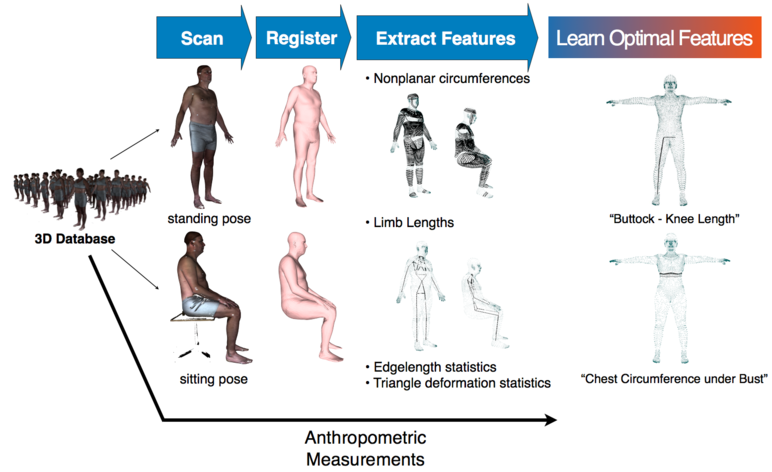
We predict anthropometric measurements from multiple poses using a model-based approach. We start with a database of 3D scans in multiple poses (standing, sitting) with corresponding anthropometric measurements (CAESAR). First, we register the scans using prior knowledge about human body shape (a human body model). Second, we extract shape features. We consider local features, such as body circumferences and limb lengths, as well as global features, such as statistics on edge lengths and triangle deformations of the registered meshes. Third, we learn optimal features for predicting each measurement.
Additional

Members

Thumb ticker sm thumb img 1084 2
Perceiving Systems
Thumb ticker sm headshot2021
Perceiving Systems
Director
Thumb ticker sm thumb img 1090
Perceiving Systems

Publications

Perceiving Systems Conference Paper Model-based Anthropometry: Predicting Measurements from 3D Human Scans in Multiple Poses Tsoli, A., Loper, M., Black, M. J. In Proceedings Winter Conference on Applications of Computer Vision, 83-90, IEEE , IEEE Winter Conference on Applications of Computer Vision (WACV) , March 2014
Extracting anthropometric or tailoring measurements from 3D human body scans is important for applications such as virtual try-on, custom clothing, and online sizing. Existing commercial solutions identify anatomical landmarks on high-resolution 3D scans and then compute distances or circumferences on the scan. Landmark detection is sensitive to acquisition noise (e.g. holes) and these methods require subjects to adopt a specific pose. In contrast, we propose a solution we call model-based anthropometry. We fit a deformable 3D body model to scan data in one or more poses; this model-based fitting is robust to scan noise. This brings the scan into registration with a database of registered body scans. Then, we extract features from the registered model (rather than from the scan); these include, limb lengths, circumferences, and statistical features of global shape. Finally, we learn a mapping from these features to measurements using regularized linear regression. We perform an extensive evaluation using the CAESAR dataset and demonstrate that the accuracy of our method outperforms state-of-the-art methods.
pdf DOI BibTeX