Designing and simulating realistic clothing is challenging and, while several methods have addressed the capture of clothing from 3D scans, previous methods have been limited to single garments and simple motions, lack detail, or require specialized texture patterns. Here we address the problem of capturing regular clothing on fully dressed people in motion. People typically wear multiple pieces of clothing at a time. To estimate the shape of such clothing, track it over time, and render it believably, each garment must be segmented from the others and the body. Our ClothCap approach uses a new multi-part 3D model of clothed bodies, automatically segments each piece of clothing, estimates the naked body shape and pose under the clothing, and tracks the 3D deformations of the clothing over time. We estimate the garments and their motion from 4D scans; that is, high-resolution 3D scans of the subject in motion at 60 fps. The model allows us to capture a clothed person in motion, extract their clothing, and retarget the clothing to new body shapes. ClothCap provides a step towards virtual try-on with a technology for capturing, modeling, and analyzing clothing in motion.
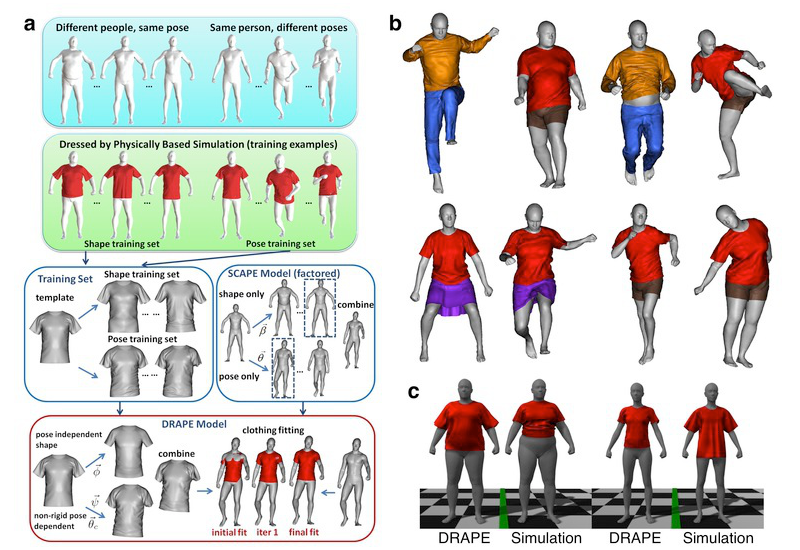
We describe a complete system for animating realistic clothing on synthetic bodies of any shape and pose without manual intervention. The key component of the method is a model of clothing called DRAPE (DRessing Any PErson) that is learned from a physics-based simulation of clothing on bodies of different shapes and poses. The DRAPE model has the desirable property of "factoring" clothing deformations due to body shape from those due to pose variation. This factorization provides an approximation to the physical clothing deformation and greatly simplifies clothing synthesis. Given a parameterized model of the human body with known shape and pose parameters, we describe an algorithm that dresses the body with a garment that is customized to fit and possesses realistic wrinkles. DRAPE can be used to dress static bodies or animated sequences with a learned model of the cloth dynamics. Since the method is fully automated, it is appropriate for dressing large numbers of virtual characters of varying shape. The method is significantly more efficient than physical simulation.
We describe a solution to the challenging problem of estimating human body shape from a single photograph or painting. Our approach computes shape and pose parameters of a 3D human body model directly from monocular image cues and advances the state of the art in several directions. First, given a user-supplied estimate of the subject's height and a few clicked points on the body we estimate an initial 3D articulated body pose and shape. Second, using this initial guess we generate a tri-map of regions inside, outside and on the boundary of the human, which is used to segment the image using graph cuts. Third, we learn a low-dimensional linear model of human shape in which variations due to height are concentrated along a single dimension, enabling height-constrained estimation of body shape. Fourth, we formulate the problem of parametric human shape from shading. We estimate the body pose, shape and reflectance as well as the scene lighting that produces a synthesized body that robustly matches the image evidence. Quantitative experiments demonstrate how smooth shading provides powerful constraints on human shape. We further demonstrate a novel application in which we extract 3D human models from archival photographs and paintings.