Comparing the appearance of corresponding body parts is essential for person re-identification. However, body parts are frequently misaligned be- tween detected boxes, due to the detection errors and the pose/viewpoint changes. In this paper, we propose a network that learns a part-aligned representation for person re-identification. Our model consists of a two-stream network, which gen- erates appearance and body part feature maps respectively, and a bilinear-pooling layer that fuses two feature maps to an image descriptor. We show that it results in a compact descriptor, where the inner product between two image descriptors is equivalent to an aggregation of the local appearance similarities of the cor- responding body parts, and thereby significantly reduces the part misalignment problem. Our approach is advantageous over other pose-guided representations by learning part descriptors optimal for person re-identification. Training the net- work does not require any part annotation on the person re-identification dataset. Instead, we simply initialize the part sub-stream using a pre-trained sub-network of an existing pose estimation network and train the whole network to minimize the re-identification loss. We validate the effectiveness of our approach by demon- strating its superiority over the state-of-the-art methods on the standard bench- mark datasets including Market-1501, CUHK03, CUHK01 and DukeMTMC, and standard video dataset MARS.
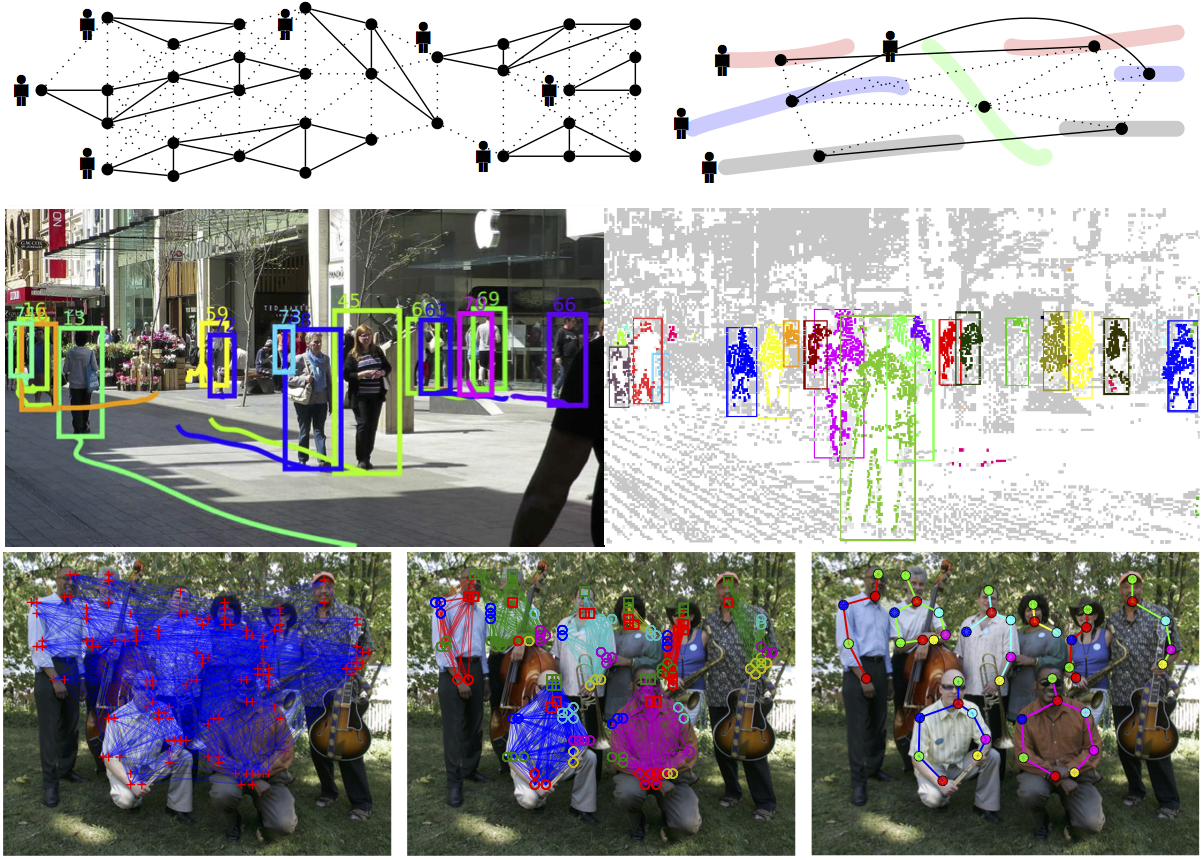
This paper considers the task of articulated human pose estimation of multiple people in real-world images. We propose an approach that jointly solves the tasks of detection and pose estimation: it infers the number of persons in a scene, identifies occluded body parts, and disambiguates body parts between people in close proximity of each other.
This joint formulation is in contrast to previous strategies, that address the problem by first detecting people and subsequently estimating their body pose. We propose a partitioning and labeling formulation of a set of body-part hypotheses generated with CNN-based part detectors. Our formulation, an instance of an integer linear program, implicitly performs non-maximum suppression on the set of part candidates and groups them to form configurations of body parts respecting geometric and appearance constraints. Experiments on four different datasets demonstrate state-of-the-art results for both single person and multi person pose estimation.