Datasets
Facade Segmentation Benchmarks
-
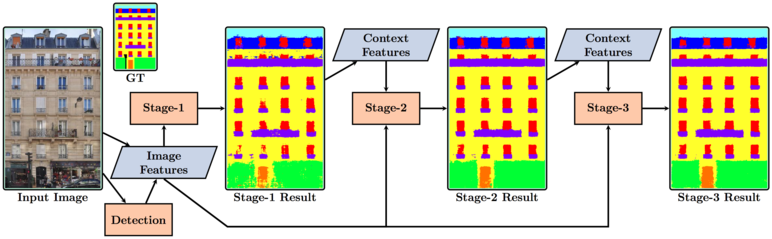
ECP Dataset [1]: This prominent dataset consists of 104 Hausmannian architectural buildings from Paris. There are seven semantic classes in this dataset.
-
Graz Dataset [2]: Has 50 facade images of various architectures (Classicims, Biedermeier, Historicism, Art Noveau) from buildings in Graz. There are 4 semantic classes in this dataset.
-
eTRIMS Dataset [3]: Consists of 60 non-rectified facade images which are more irregular and follow only weak architectural principles. Can be accessed here: url.
-
CMP Dataset [4]: Has 378 rectified facades of diverse styles and 12 semantic classes in its base set. Can be accessed here: url.
-
LabelMeFacade Dataset [5]: This consists of building facade images taken from LabelMe segmentation dataset [6]. Facades in this dataset are highly irregular with lot of diversity across images.
References:
- Teboul, O. Ecole centrale paris facades database. 2010.
- Riemenschneider, H., Krispel, U., Thaller, W., Donoser, M., Havemann, S., Fellner, D., & Bischof, H. Irregular lattices for complex shape grammar facade parsing. In Computer Vision and Pattern Recognition (CVPR), pp. 1640-1647, June 2012.
- Korc, F., & Förstner, W. eTRIMS Image Database for interpreting images of man-made scenes. Dept. of Photogrammetry, University of Bonn, Tech. Rep. TRIGG-P-2009-01, April 2009.
- Tyleček, R., & Šára, R. Spatial Pattern Templates for Recognition of Objects with Regular Structure. In Proc. of German Conference on Pattern Recognition (GCPR), pp. 364-374, 2013.
- Frohlich, B., Rodner, E., & Denzler, J. A fast approach for pixelwise labeling of facade images. In International Conference on Pattern Recognition (ICPR), pp. 3029-3032, 2010.
- Russell, B. C., Torralba, A., Murphy, K. P., & Freeman, W. T. LabelMe: a database and web-based tool for image annotation. International journal of computer vision, 77(1-3), 157-173, 2008.
Code
The source code is hosted in the following bit-bucket page:
https://bitbucket.org/rgadde/wacv15_code
If you find our code or results useful for your publication, please consider citing the following works:
@inproceedings{jampani15wacv,
  title = {Efficient Facade Segmentation using Auto-Context},
  author = {Jampani, Varun and Gadde, Raghudeep and Gehler, Peter V.},
  booktitle = {IEEE Winter Conference on Applications of Computer Vision (WACV)},
  month = jan,
  url = {http://wacv2015.org},
  year = {2015}
}
@article{gadde2016efficient,
  title={Efficient 2D and 3D Facade Segmentation using Auto-Context},
  author={Gadde, Raghudeep and Jampani, Varun and Marlet, Renaud and Gehler, Peter V},
  journal={arXiv preprint arXiv:1606.06437},
  year={2016}
}
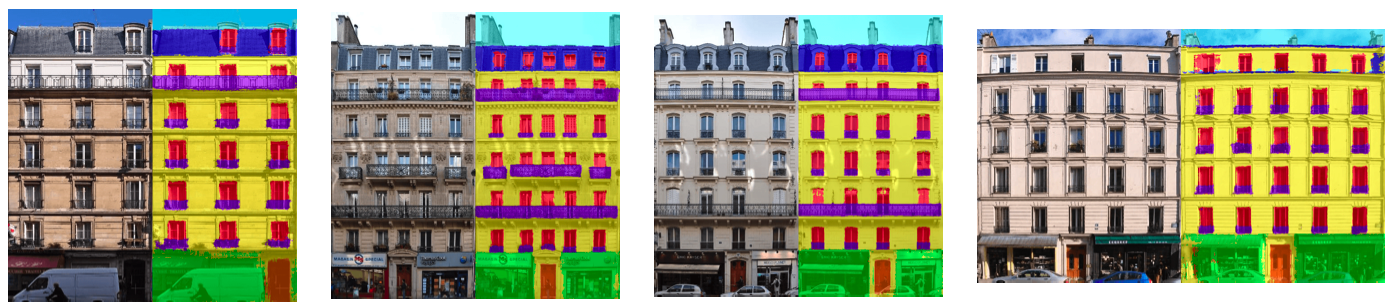
We include the following visual results for some datasets. If your research requires other results, please contact us.
On ECP Dataset
- Folds [zip(3.6KB)]
- Visual results [zip(69MB)]
On Graz Dataset
- Folds [zip(3.1KB)]
- Visual results [zip(74MB)]

On eTRIMS Dataset
- Folds [zip(3.1KB)]
- Visual results [zip(59MB)]

On CMP Dataset
- Folds [zip(1.9KB)]

On LabelMeFacade Dataset
Members



Publications