Back

Perceiving Systems Members Publications

Modeling Human Movement
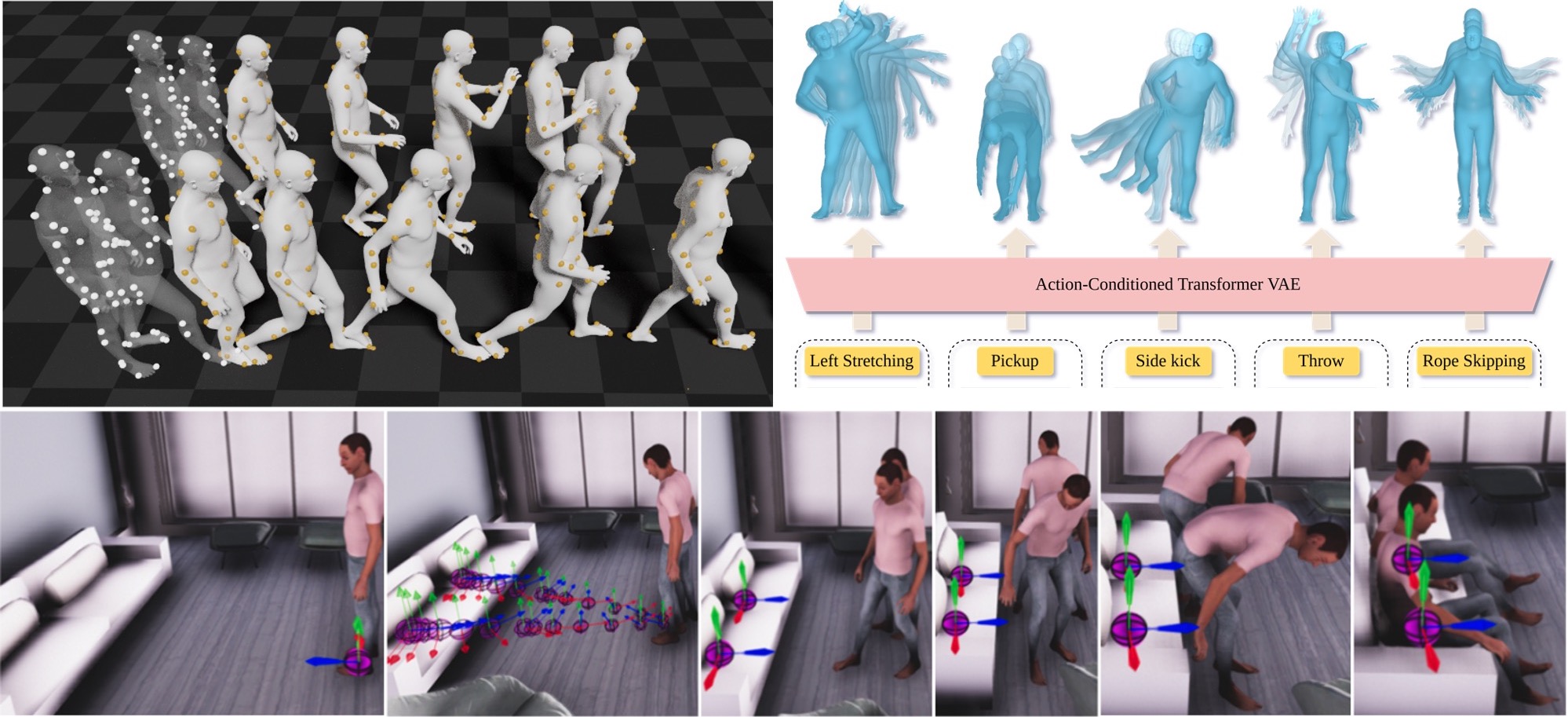
Clockwise from upper left: MOJO [File Icon] predicts human movement given past movement. ACTOR [File Icon] generates diverse human movements conditioned on an action label. SAMP [File Icon] produces human motions to satisfy goals like "sit on the sofa".

Members

no image
Perceiving Systems
Perceiving Systems
Perceiving Systems
Affiliated Researcher
Movement Generation and Control
Visiting Researcher
Perceiving Systems
Affiliated Researcher
Perceiving Systems
Ph.D. Student
Perceiving Systems
Guest Scientist
Perceiving Systems
Perceiving Systems
  • Guest Scientist
Perceiving Systems
  • Doctoral Researcher
Perceiving Systems
Emeritus / Acting Director

Publications

Perceiving Systems Conference Paper MotionFix: Text-Driven 3D Human Motion Editing Athanasiou, N., Cseke, A., Diomataris, M., Black, M. J., Varol, G. In SIGGRAPH Asia 2024 Conference Proceedings, ACM, SIGGRAPH Asia , December 2024 (Published)
The focus of this paper is 3D motion editing. Given a 3D human motion and a textual description of the desired modification, our goal is to generate an edited motion as described by the text. The challenges include the lack of training data and the design of a model that faithfully edits the source motion. In this paper, we address both these challenges. We build a methodology to semi-automatically collect a dataset of triplets in the form of (i) a source motion, (ii) a target motion, and (iii) an edit text, and create the new dataset. Having access to such data allows us to train a conditional diffusion model that takes both the source motion and the edit text as input. We further build various baselines trained only on text-motion pairs datasets and show superior performance of our model trained on triplets. We introduce new retrieval-based metrics for motion editing and establish a new benchmark on the evaluation set. Our results are encouraging, paving the way for further research on fine-grained motion generation. Code and models will be made publicly available.
Code (GitHub) Website Data Exploration ArXiv URL BibTeX

Perceiving Systems Conference Paper SINC: Spatial Composition of 3D Human Motions for Simultaneous Action Generation Athanasiou, N., Petrovich, M., Black, M. J., Varol, G. In Proc. International Conference on Computer Vision (ICCV), 9984-9995, International Conference on Computer Vision, October 2023 (Published)
Our goal is to synthesize 3D human motions given textual inputs describing multiple simultaneous actions, for example ‘waving hand’ while ‘walking’ at the same time. We refer to generating such simultaneous movements as performing ‘spatial compositions’. In contrast to ‘temporal compositions’ that seek to transition from one action to another in a sequence, spatial compositing requires understanding which body parts are involved with which action. Motivated by the observation that the correspondence between actions and body parts is encoded in powerful language models, we extract this knowledge by prompting GPT-3 with text such as “what parts of the body are moving when someone is doing the action <action name>?”. Given this action-part mapping, we automatically create new training data by artificially combining body parts from multiple text-motion pairs together. We extend previous work on text-to-motions synthesis to train on spatial compositions, and introduce SINC (“SImultaneous actioN Compositions for 3D human motions”). We experimentally validate that our additional GPT-guided data helps to better learn compositionality compared to training only on existing real data of simultaneous actions, which is limited in quantity.
website code paper-arxiv video BibTeX

Perceiving Systems Conference Paper TEACH: Temporal Action Composition for 3D Humans Athanasiou, N., Petrovich, M., Black, M. J., Varol, G. In 2022 International Conference on 3D Vision (3DV), 414-423, 3DV'22, September 2022 (Published)
Given a series of natural language descriptions, our task is to generate 3D human motions that correspond semantically to the text, and follow the temporal order of the instructions. In particular, our goal is to enable the synthesis of a series of actions, which we refer to as temporal action composition. The current state of the art in text-conditioned motion synthesis only takes a single action or a single sentence as input. This is partially due to lack of suitable training data containing action sequences, but also due to the computational complexity of their non-autoregressive model formulation, which does not scale well to long sequences. In this work, we address both issues. First, we exploit the recent BABEL motion-text collection, which has a wide range of labeled actions, many of which occur in a sequence with transitions between them. Next, we design a Transformer-based approach that operates non-autoregressively within an action, but autoregressively within the sequence of actions. This hierarchical formulation proves effective in our experiments when compared with multiple baselines. Our approach, called TEACH for “TEmporal Action Compositions for Human motions”, produces realistic human motions for a wide variety of actions and temporal compositions from language descriptions. To encourage work on this new task, we make our code available for research purposes at teach.is.tue.mpg.de.
code arXiv website video camera-ready DOI URL BibTeX

Perceiving Systems Conference Paper Action-Conditioned 3D Human Motion Synthesis with Transformer VAE Petrovich, M., Black, M. J., Varol, G. In Proc. International Conference on Computer Vision (ICCV), 10965-10975, IEEE, Piscataway, NJ, International Conference on Computer Vision, October 2021 (Published)
We tackle the problem of action-conditioned generation of realistic and diverse human motion sequences. In contrast to methods that complete, or extend, motion sequences, this task does not require an initial pose or sequence. Here we learn an action-aware latent representation for human motions by training a generative variational autoencoder (VAE). By sampling from this latent space and querying a certain duration through a series of positional encodings, we synthesize variable-length motion sequences conditioned on a categorical action. Specifically, we design a Transformer-based architecture, ACTOR, for encoding and decoding a sequence of parametric SMPL human body models estimated from action recognition datasets. We evaluate our approach on the NTU RGB+D, HumanAct12 and UESTC datasets and show improvements over the state of the art. Furthermore, we present two use cases: improving action recognition through adding our synthesized data to training, and motion denoising. Code and models are available on our project page.
website code paper-arxiv video DOI BibTeX

Perceiving Systems Conference Paper Stochastic Scene-Aware Motion Prediction Hassan, M., Ceylan, D., Villegas, R., Saito, J., Yang, J., Zhou, Y., Black, M. In Proc. International Conference on Computer Vision (ICCV), 11354-11364, IEEE, Piscataway, NJ, International Conference on Computer Vision, October 2021 (Published)
A long-standing goal in computer vision is to capture, model, and realistically synthesize human behavior. Specifically, by learning from data, our goal is to enable virtual humans to navigate within cluttered indoor scenes and naturally interact with objects. Such embodied behavior has applications in virtual reality, computer games, and robotics, while synthesized behavior can be used as training data. The problem is challenging because real human motion is diverse and adapts to the scene. For example, a person can sit or lie on a sofa in many places and with varying styles. We must model this diversity to synthesize virtual humans that realistically perform human-scene interactions. We present a novel data-driven, stochastic motion synthesis method that models different styles of performing a given action with a target object. Our Scene-Aware Motion Prediction method (SAMP) generalizes to target objects of various geometries while enabling the character to navigate in cluttered scenes. To train SAMP, we collected mocap data covering various sitting, lying down, walking, and running styles. We demonstrate SAMP on complex indoor scenes and achieve superior performance than existing solutions.
Project Page pdf DOI BibTeX

Perceiving Systems Conference Paper We are More than Our Joints: Predicting how 3D Bodies Move Zhang, Y., Black, M. J., Tang, S. In 2021 IEEE/CVF Conference on Computer Vision and Pattern Recognition (CVPR 2021), 3371-3381, IEEE, Piscataway, NJ, IEEE/CVF Conference on Computer Vision and Pattern Recognition (CVPR 2021), June 2021 (Published)
A key step towards understanding human behavior is the prediction of 3D human motion. Successful solutions have many applications in human tracking, HCI, and graphics. Most previous work focuses on predicting a time series of future 3D joint locations given a sequence 3D joints from the past. This Euclidean formulation generally works better than predicting pose in terms of joint rotations. Body joint locations, however, do not fully constrain 3D human pose, leaving degrees of freedom (like rotation about a limb) undefined. Note that 3D joints can be viewed as a sparse point cloud. Thus the problem of human motion prediction can be seen as a problem of point cloud prediction. With this observation, we instead predict a sparse set of locations on the body surface that correspond to motion capture markers. Given such markers, we fit a parametric body model to recover the 3D body of the person. These sparse surface markers also carry detailed information about human movement that is not present in the joints, increasing the naturalness of the predicted motions. Using the AMASS dataset, we train MOJO (More than Our JOints), which is a novel variational autoencoder with a latent DCT space that generates motions from latent frequencies. MOJO preserves the full temporal resolution of the input motion, and sampling from the latent frequencies explicitly introduces high-frequency components into the generated motion. We note that motion prediction methods accumulate errors over time, resulting in joints or markers that diverge from true human bodies. To address this, we fit the SMPL-X body model to the predictions at each time step, projecting the solution back onto the space of valid bodies, before propagating the new markers in time. Quantitative and qualitative experiments show that our approach produces state-of-the-art results and realistic 3D body animations. The code is available for research purposes at https://yz-cnsdqz.github.io/MOJO/MOJO.html.
code arXiv DOI BibTeX

Perceiving Systems Movement Generation and Control Article Robust Physics-based Motion Retargeting with Realistic Body Shapes Borno, M. A., Righetti, L., Black, M. J., Delp, S. L., Fiume, E., Romero, J. Computer Graphics Forum, 37:6:1-12, July 2018
Motion capture is often retargeted to new, and sometimes drastically different, characters. When the characters take on realistic human shapes, however, we become more sensitive to the motion looking right. This means adapting it to be consistent with the physical constraints imposed by different body shapes. We show how to take realistic 3D human shapes, approximate them using a simplified representation, and animate them so that they move realistically using physically-based retargeting. We develop a novel spacetime optimization approach that learns and robustly adapts physical controllers to new bodies and constraints. The approach automatically adapts the motion of the mocap subject to the body shape of a target subject. This motion respects the physical properties of the new body and every body shape results in a different and appropriate movement. This makes it easy to create a varied set of motions from a single mocap sequence by simply varying the characters. In an interactive environment, successful retargeting requires adapting the motion to unexpected external forces. We achieve robustness to such forces using a novel LQR-tree formulation. We show that the simulated motions look appropriate to each character’s anatomy and their actions are robust to perturbations.
pdf video BibTeX

Perceiving Systems Conference Paper A simple yet effective baseline for 3d human pose estimation Martinez, J., Hossain, R., Romero, J., Little, J. J. In Proceedings IEEE International Conference on Computer Vision (ICCV), IEEE, Piscataway, NJ, USA, IEEE International Conference on Computer Vision (ICCV), October 2017
Following the success of deep convolutional networks, state-of-the-art methods for 3d human pose estimation have focused on deep end-to-end systems that predict 3d joint locations given raw image pixels. Despite their excellent performance, it is often not easy to understand whether their remaining error stems from a limited 2d pose (visual) understanding, or from a failure to map 2d poses into 3-dimensional positions. With the goal of understanding these sources of error, we set out to build a system that given 2d joint locations predicts 3d positions. Much to our surprise, we have found that, with current technology, "lifting" ground truth 2d joint locations to 3d space is a task that can be solved with a remarkably low error rate: a relatively simple deep feed-forward network outperforms the best reported result by about 30\% on Human3.6M, the largest publicly available 3d pose estimation benchmark. Furthermore, training our system on the output of an off-the-shelf state-of-the-art 2d detector (\ie, using images as input) yields state of the art results -- this includes an array of systems that have been trained end-to-end specifically for this task. Our results indicate that a large portion of the error of modern deep 3d pose estimation systems stems from their visual analysis, and suggests directions to further advance the state of the art in 3d human pose estimation.
video code arxiv pdf preprint BibTeX

Perceiving Systems Conference Paper Deep representation learning for human motion prediction and classification Bütepage, J., Black, M., Kragic, D., Kjellström, H. In Proceedings IEEE Conference on Computer Vision and Pattern Recognition (CVPR) 2017, 1591-1599, IEEE, Piscataway, NJ, USA, IEEE Conference on Computer Vision and Pattern Recognition (CVPR), July 2017
Generative models of 3D human motion are often restricted to a small number of activities and can therefore not generalize well to novel movements or applications. In this work we propose a deep learning framework for human motion capture data that learns a generic representation from a large corpus of motion capture data and generalizes well to new, unseen, motions. Using an encoding-decoding network that learns to predict future 3D poses from the most recent past, we extract a feature representation of human motion. Most work on deep learning for sequence prediction focuses on video and speech. Since skeletal data has a different structure, we present and evaluate different network architectures that make different assumptions about time dependencies and limb correlations. To quantify the learned features, we use the output of different layers for action classification and visualize the receptive fields of the network units. Our method outperforms the recent state of the art in skeletal motion prediction even though these use action specific training data. Our results show that deep feedforward networks, trained from a generic mocap database, can successfully be used for feature extraction from human motion data and that this representation can be used as a foundation for classification and prediction.
arXiv BibTeX

Perceiving Systems Conference Paper On human motion prediction using recurrent neural networks Martinez, J., Black, M. J., Romero, J. In Proceedings IEEE Conference on Computer Vision and Pattern Recognition (CVPR) 2017, 4674-4683, IEEE, Piscataway, NJ, USA, IEEE Conference on Computer Vision and Pattern Recognition (CVPR), July 2017
Human motion modelling is a classical problem at the intersection of graphics and computer vision, with applications spanning human-computer interaction, motion synthesis, and motion prediction for virtual and augmented reality. Following the success of deep learning methods in several computer vision tasks, recent work has focused on using deep recurrent neural networks (RNNs) to model human motion, with the goal of learning time-dependent representations that perform tasks such as short-term motion prediction and long-term human motion synthesis. We examine recent work, with a focus on the evaluation methodologies commonly used in the literature, and show that, surprisingly, state-of-the-art performance can be achieved by a simple baseline that does not attempt to model motion at all. We investigate this result, and analyze recent RNN methods by looking at the architectures, loss functions, and training procedures used in state-of-the-art approaches. We propose three changes to the standard RNN models typically used for human motion, which result in a simple and scalable RNN architecture that obtains state-of-the-art performance on human motion prediction.
arXiv BibTeX