Language, Vision, and World Models
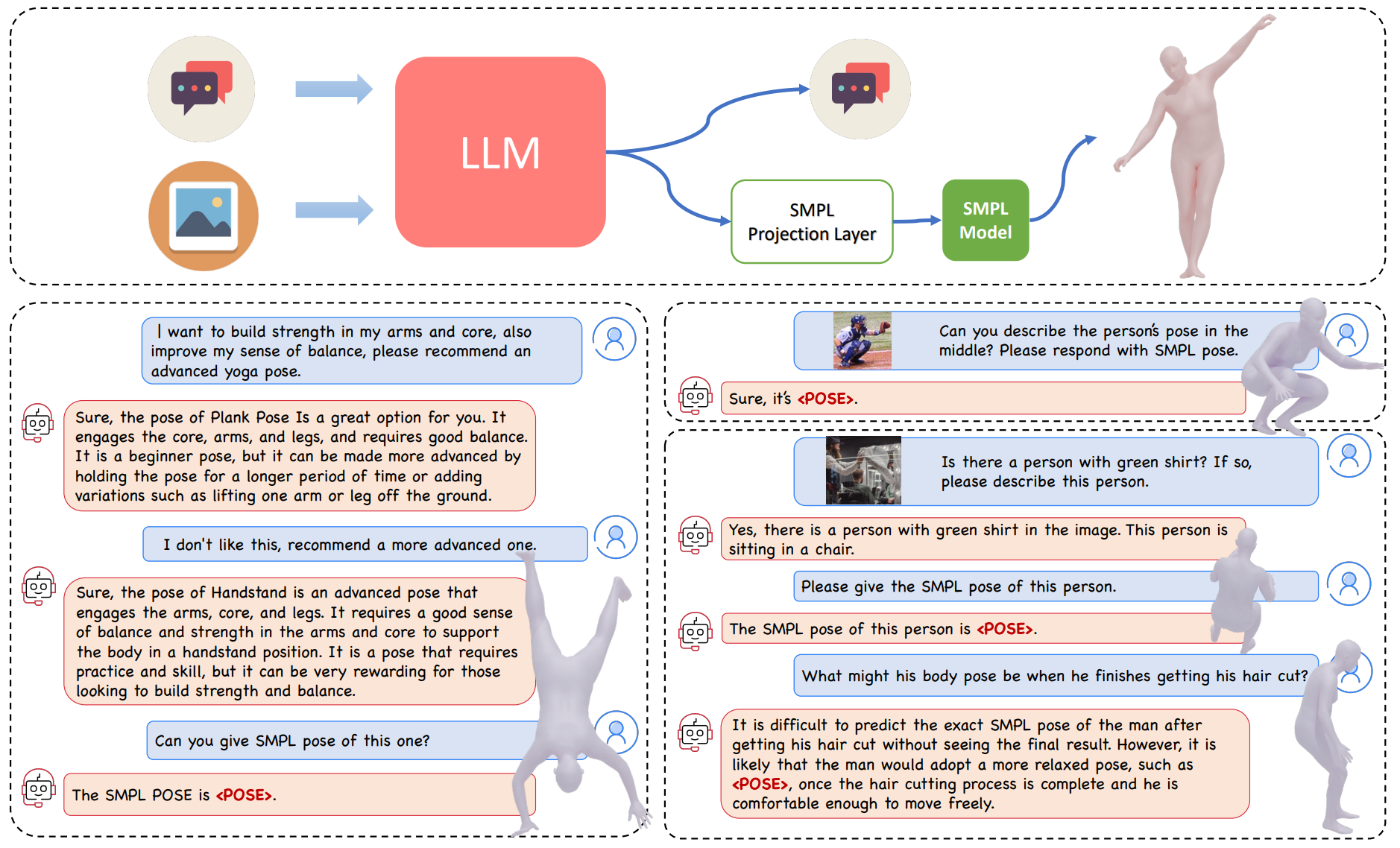
 ] embeds SMPL poses as distinct signal tokens within a multimodal LLM, enabling the direct generation of 3D body poses from both textual and visual inputs. Leveraging the powerful capabilities of multimodal LLMs, ChatPose empowers LLMs to apply their extensive world knowledge in reasoning about human poses, unifying classical 3D human pose and generation tasks while enabling user interaction.
 Can we leverage large language models (LLMs) to teach computer to see? How much do multi-modal vision-language models (VLMs) really understand about the 3D world and how it works?
We were using language to help solve vision problems well before LLMs arrived. For example, SHAPY [] leverages textual descriptions of human body shape as a form of side information to train a model to estimate metrically accurate 3D human body shape. BARC [] uses dog breed information to learn 3D dog shapes from 2D images; dogs of the same breed should have more similar shapes than dogs of different breeds. But our use of language is much richer than this.
Human pose: Traditional 3D human pose estimation involves regressing pose parameters from pixels. With ChatPose [], we take a different approach and fine tune a VLM to reason about human pose given an image or text. When asked about 3D pose, ChatPose outputs a special token, the embedding of which is converted to continuous pose parameters by an MLP. ChatPose can infer human poses by exploiting its general knowledge of humans, opening an entirely new avenue for research on 3D human pose estimation and understanding.
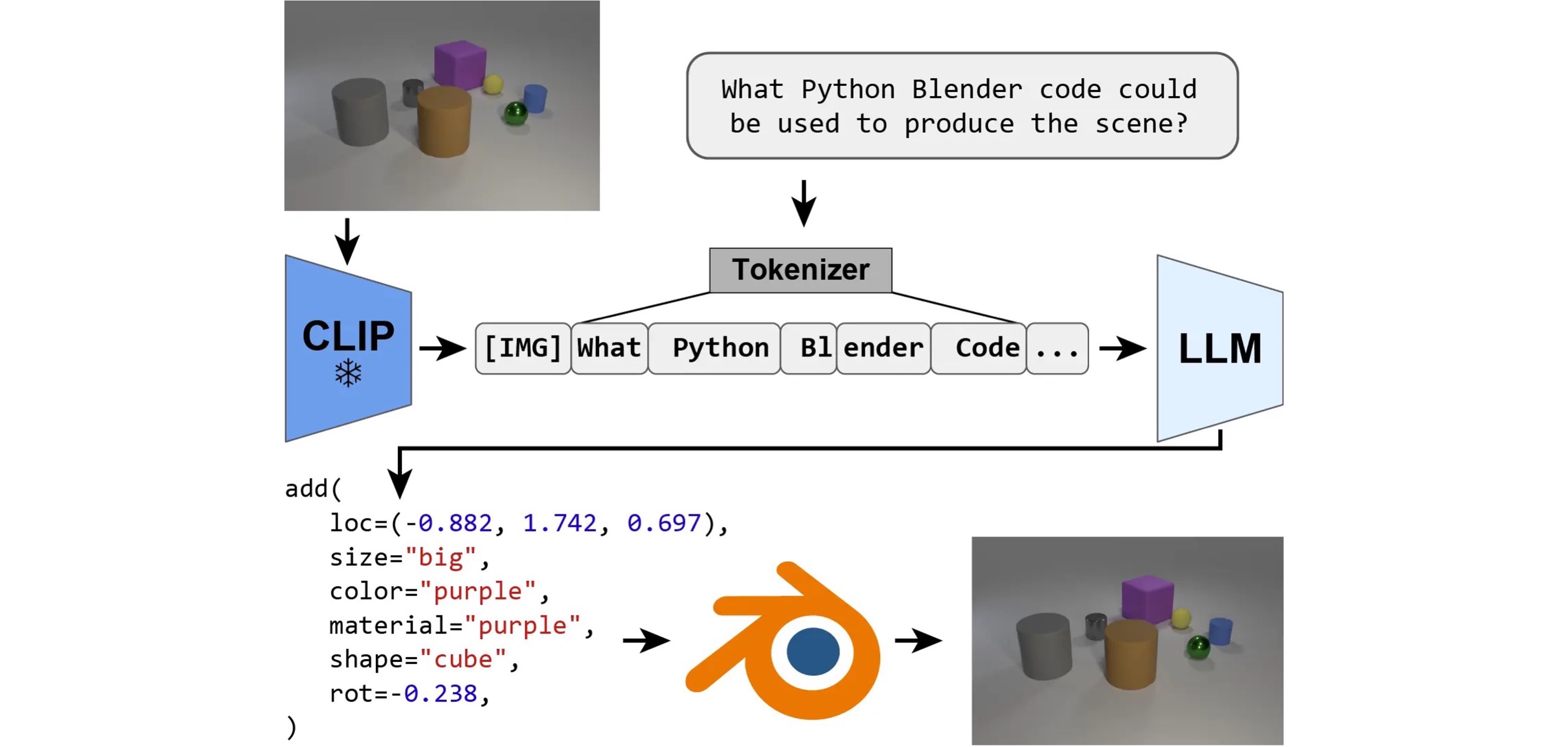
3D scenes: The classical problem of inverse graphics involves converting a 2D image into 3D graphics primitives. Instead of the classical ``analysis by synthesis" approach, we fine-tune an LLM to take an image and output a structured, compositional 3D-scene representation (i.e.~Blender code) []. We introduce a continuous numeric head, which is critical for 3D reasoning. We find that LLMs can perform inverse graphics through next-token prediction, without classical photometric supervision.
Video diffusion models go further and are able to generate realistic videos given an image or text as input. To do so, they must have a latent representation of the 3D world that we can exploit to solve tasks in computer vision. To explore this, we propose the task of bounded video generation, which requires generating all the video frames between a start and end frame. Using a frozen video diffusion model, we introduce a new Time Reversal Fusion sampling strategy, that fuses the temporally forward and backward denoising paths conditioned on the start and end frame []. We find video models are able to infer in-between frames that are consistent with rigid and articulated scenes.