Model-based Anthropometry: Predicting Measurements from 3D Human Scans in Multiple Poses
pdf


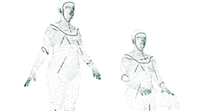
Extracting anthropometric or tailoring measurements from 3D human body scans is important for applications such as virtual try-on, custom clothing, and online sizing. Existing commercial solutions identify anatomical landmarks on high-resolution 3D scans and then compute distances or circumferences on the scan. Landmark detection is sensitive to acquisition noise (e.g. holes) and these methods require subjects to adopt a specific pose. In contrast, we propose a solution we call model-based anthropometry. We fit a deformable 3D body model to scan data in one or more poses; this model-based fitting is robust to scan noise. This brings the scan into registration with a database of registered body scans. Then, we extract features from the registered model (rather than from the scan); these include, limb lengths, circumferences, and statistical features of global shape. Finally, we learn a mapping from these features to measurements using regularized linear regression. We perform an extensive evaluation using the CAESAR dataset and demonstrate that the accuracy of our method outperforms state-of-the-art methods.
| Author(s): | Tsoli, Aggeliki and Loper, Matthew and Black, Michael J |
| Links: | |
| Book Title: | Proceedings Winter Conference on Applications of Computer Vision |
| Pages: | 83--90 |
| Year: | 2014 |
| Month: | March |
| Publisher: | IEEE |
| Project(s): |
|
| BibTeX Type: | Conference Paper (inproceedings) |
| DOI: | 10.1109/WACV.2014.6836115 |
| Event Name: | IEEE Winter Conference on Applications of Computer Vision (WACV) |
| Event Place: | Steamboat Springs, CO, USA |
| Electronic Archiving: | grant_archive |
BibTeX
@inproceedings{tsoliWACV14,
  title = {Model-based Anthropometry: Predicting Measurements from 3D Human Scans in Multiple Poses},
  booktitle = {Proceedings Winter Conference on Applications of Computer Vision},
  abstract = {Extracting anthropometric or tailoring measurements from 3D human body scans is important for applications such as virtual try-on, custom clothing, and online sizing. Existing commercial solutions identify anatomical landmarks on high-resolution 3D scans and then compute distances or circumferences on the scan. Landmark detection is sensitive to acquisition noise (e.g. holes) and these methods require subjects to adopt a specific pose. In contrast, we propose a solution we call model-based anthropometry. We fit a deformable 3D body model to scan data in one or more poses; this model-based fitting is robust to scan noise. This brings the scan into registration with a database of registered body scans. Then, we extract features from the registered model (rather than from the scan); these include, limb lengths, circumferences, and statistical features of global shape. Finally, we learn a mapping from these features to measurements using regularized linear regression. We perform an extensive evaluation using the CAESAR dataset and demonstrate that the accuracy of our method outperforms state-of-the-art methods.},
  pages = {83--90},
  publisher = {IEEE },
  month = mar,
  year = {2014},
  author = {Tsoli, Aggeliki and Loper, Matthew and Black, Michael J},
  doi = {10.1109/WACV.2014.6836115},
  month_numeric = {3}
}