Back

Perceiving Systems Members Publications

Capturing Contact

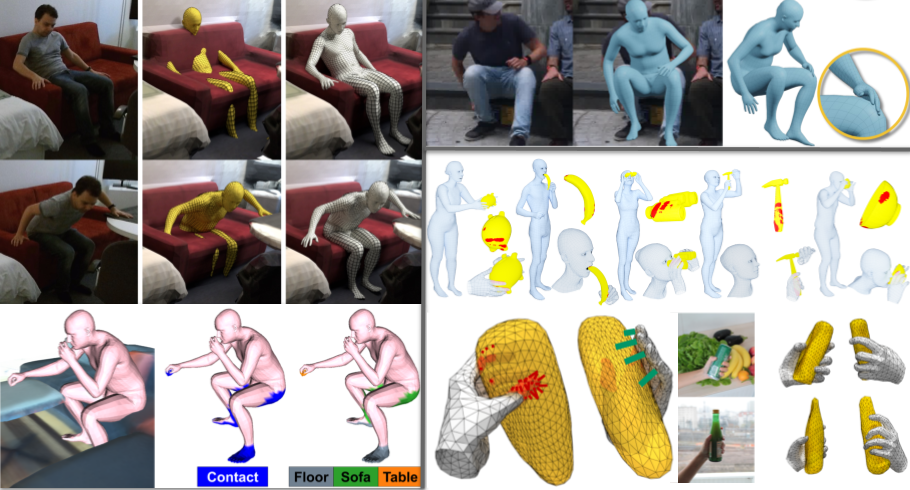
Contact plays an important role in understanding human-scene interactions and it takes many forms. Left: contact between the full body and furniture is used to improve monocular human pose and shape (HPS) estimation [File Icon] and to learn a body-centric representation for human-scene interaction [File Icon]. Top right: considering self-contact improves monocular HPS [File Icon]. Middle right: a dataset of whole-body grasps [File Icon]. Bottom right: contact between hands and hand-held objects helps reconstruct hands and objects jointly from images [File Icon].

Members

Perceiving Systems
Emeritus / Acting Director
Perceiving Systems
  • Guest Scientist
Perceiving Systems
  • Guest Scientist
Perceiving Systems
  • Guest Scientist
Perceiving Systems
Guest Scientist
Perceiving Systems
  • Postdoctoral Researcher
Perceiving Systems
Guest Scientist
Perceiving Systems
  • Guest Scientist
Perceiving Systems
Perceiving Systems
Ph.D. Student
Empirical Inference
  • Postdoctoral Researcher
Perceiving Systems
Software Engineer, Real-time Graphics (VR/MR)
Perceiving Systems
  • Guest Scientist
Perceiving Systems
Affiliated Researcher
Perceiving Systems
  • Guest Scientist

Publications

Perceiving Systems Optics and Sensing Laboratory Conference Paper Capturing and Inferring Dense Full-Body Human-Scene Contact Huang, C. P., Yi, H., Höschle, M., Safroshkin, M., Alexiadis, T., Polikovsky, S., Scharstein, D., Black, M. J. In 2022 IEEE/CVF Conference on Computer Vision and Pattern Recognition (CVPR 2022), 13264-13275, IEEE, Piscataway, NJ, IEEE/CVF Conference on Computer Vision and Pattern Recognition (CVPR 2022), June 2022 (Published)
Inferring human-scene contact (HSC) is the first step toward understanding how humans interact with their surroundings. While detecting 2D human-object interaction (HOI) and reconstructing 3D human pose and shape (HPS) have enjoyed significant progress, reasoning about 3D human-scene contact from a single image is still challenging. Existing HSC detection methods consider only a few types of predefined contact, often reduce body and scene to a small number of primitives, and even overlook image evidence. To predict human-scene contact from a single image, we address the limitations above from both data and algorithmic perspectives. We capture a new dataset called RICH for “Real scenes, Interaction, Contact and Humans.” RICH contains multiview outdoor/indoor video sequences at 4K resolution, ground-truth 3D human bodies captured using markerless motion capture, 3D body scans, and high resolution 3D scene scans. A key feature of RICH is that it also contains accurate vertex-level contact labels on the body. Using RICH, we train a network that predicts dense body-scene contacts from a single RGB image. Our key insight is that regions in contact are always occluded so the network needs the ability to explore the whole image for evidence. We use a transformer to learn such non-local relationships and propose a new Body-Scene contact TRansfOrmer (BSTRO). Very few methods explore 3D contact; those that do focus on the feet only, detect foot contact as a post-processing step, or infer contact from body pose without looking at the scene. To our knowledge, BSTRO is the first method to directly estimate 3D body-scene contact from a single image. We demonstrate that BSTRO significantly outperforms the prior art. The code and dataset are available at https://rich.is.tue.mpg.de.
project arXiv BSTRO code video DOI URL BibTeX

Perceiving Systems Neural Capture and Synthesis Conference Paper Human-Aware Object Placement for Visual Environment Reconstruction Yi, H., Huang, C. P., Tzionas, D., Kocabas, M., Hassan, M., Tang, S., Thies, J., Black, M. J. In 2022 IEEE/CVF Conference on Computer Vision and Pattern Recognition (CVPR 2022), 3949-3960, IEEE, Piscataway, NJ, IEEE/CVF Conference on Computer Vision and Pattern Recognition (CVPR 2022), June 2022 (Published)
Humans are in constant contact with the world as they move through it and interact with it. This contact is a vital source of information for understanding 3D humans, 3D scenes, and the interactions between them. In fact, we demonstrate that these human-scene interactions (HSIs) can be leveraged to improve the 3D reconstruction of a scene from a monocular RGB video. Our key idea is that, as a person moves through a scene and interacts with it, we accumulate HSIs across multiple input images, and optimize the 3D scene to reconstruct a consistent, physically plausible and functional 3D scene layout. Our optimization-based approach exploits three types of HSI constraints: (1) humans that move in a scene are occluded or occlude objects, thus, defining the depth ordering of the objects, (2) humans move through free space and do not interpenetrate objects, (3) when humans and objects are in contact, the contact surfaces occupy the same place in space. Using these constraints in an optimization formulation across all observations, we significantly improve the 3D scene layout reconstruction. Furthermore, we show that our scene reconstruction can be used to refine the initial 3D human pose and shape (HPS) estimation. We evaluate the 3D scene layout reconstruction and HPS estimation qualitatively and quantitatively using the PROX and PiGraphs datasets. The code and data are available for research purposes at https://mover.is.tue.mpg.de/.
project arXiv DOI URL BibTeX

Perceiving Systems Conference Paper GOAL: Generating 4D Whole-Body Motion for Hand-Object Grasping Taheri, O., Choutas, V., Black, M. J., Tzionas, D. In 2022 IEEE/CVF Conference on Computer Vision and Pattern Recognition (CVPR 2022), 13253-13263, IEEE, Piscataway, NJ, IEEE/CVF Conference on Computer Vision and Pattern Recognition (CVPR 2022), June 2022 (Published)
Generating digital humans that move realistically has many applications and is widely studied, but existing methods focus on the major limbs of the body, ignoring the hands and head. Hands have been separately studied but the focus has been on generating realistic static grasps of objects. To synthesize virtual characters that interact with the world, we need to generate full-body motions and realistic hand grasps simultaneously. Both sub-problems are challenging on their own and, together, the state-space of poses is significantly larger, the scales of hand and body motions differ, and the whole-body posture and the hand grasp must agree, satisfy physical constraints, and be plausible. Additionally, the head is involved because the avatar must look at the object to interact with it. For the first time, we address the problem of generating full-body, hand and head motions of an avatar grasping an unknown object. As input, our method, called GOAL, takes a 3D object, its position, and a starting 3D body pose and shape. GOAL outputs a sequence of whole-body poses using two novel networks. First, GNet generates a goal whole-body grasp with a realistic body, head, arm, and hand pose, as well as hand-object contact. Second, MNet generates the motion between the starting and goal pose. This is challenging, as it requires the avatar to walk towards the object with foot-ground contact, orient the head towards it, reach out, and grasp it with a realistic hand pose and hand-object contact. To achieve this the networks exploit a representation that combines SMPL-X body parameters and 3D vertex offsets. We train and evaluate GOAL, both qualitatively and quantitatively, on the GRAB dataset. Results show that GOAL generalizes well to unseen objects, outperforming baselines. A perceptual study shows that GOAL’s generated motions approach the realism of GRAB’s ground truth. GOAL takes a step towards synthesizing realistic full-body object grasping. Our models and code are available for research.
arXiv Sup. Mat Project YouTube Code Models DOI URL BibTeX

Perceiving Systems Conference Paper On Self-Contact and Human Pose Müller, L., Osman, A. A. A., Tang, S., Huang, C. P., Black, M. J. In 2021 IEEE/CVF Conference on Computer Vision and Pattern Recognition (CVPR 2021), 9985-9994, IEEE, Piscataway, NJ, IEEE/CVF Conference on Computer Vision and Pattern Recognition (CVPR 2021), June 2021 (Published)
People touch their face 23 times an hour, they cross their arms and legs, put their hands on their hips, etc. While many images of people contain some form of self-contact, current 3D human pose and shape (HPS) regression methods typically fail to estimate this contact. To address this, we develop new datasets and methods that significantly improve human pose estimation with self-contact. First, we create a dataset of 3D Contact Poses (3DCP) containing SMPL-X bodies fit to 3D scans as well as poses from AMASS, which we refine to ensure good contact. Second, we leverage this to create the Mimic-The-Pose (MTP) dataset of images, collected via Amazon Mechanical Turk, containing people mimicking the 3DCP poses with self-contact. Third, we develop a novel HPS optimization method, SMPLify-XMC, that includes contact constraints and uses the known 3DCP body pose during fitting to create near ground-truth poses for MTP images. Fourth, for more image variety, we label a dataset of in-the-wild images with Discrete Self-Contact (DSC) information and use another new optimization method, SMPLify-DC, that exploits discrete contacts during pose optimization. Finally, we use our datasets during SPIN training to learn a new 3D human pose regressor, called TUCH (Towards Understanding Contact in Humans). We show that the new self-contact training data significantly improves 3D human pose estimates on withheld test data and existing datasets like 3DPW. Not only does our method improve results for self-contact poses, but it also improves accuracy for non-contact poses. The code and data are available for research purposes at https://tuch.is.tue.mpg.de.
project arXiv poster video code DOI BibTeX

Perceiving Systems Conference Paper Populating 3D Scenes by Learning Human-Scene Interaction Hassan, M., Ghosh, P., Tesch, J., Tzionas, D., Black, M. J. In 2021 IEEE/CVF Conference on Computer Vision and Pattern Recognition (CVPR 2021), 14703-14713, IEEE, Piscataway, NJ, IEEE/CVF Conference on Computer Vision and Pattern Recognition (CVPR 2021), June 2021 (Published)
Humans live within a 3D space and constantly interact with it to perform tasks. Such interactions involve physical contact between surfaces that is semantically meaningful. Our goal is to learn how humans interact with scenes and leverage this to enable virtual characters to do the same. To that end, we introduce a novel Human-Scene Interaction (HSI) model that encodes proximal relationships, called POSA for “Pose with prOximitieS and contActs”. The representation of interaction is body-centric, which enables it to generalize to new scenes. Specifically, POSA augments the SMPL-X parametric human body model such that, for every mesh vertex, it encodes (a) the contact probability with the scene surface and (b) the corresponding semantic scene label. We learn POSA with a VAE conditioned on the SMPL-X vertices, and train on the PROX dataset, which contains SMPL-X meshes of people interacting with 3D scenes, and the corresponding scene semantics from the PROX-E dataset. We demonstrate the value of POSA with two applications. First, we automatically place 3D scans of people in scenes. We use a SMPL-X model fit to the scan as a proxy and then find its most likely placement in 3D. POSA provides an effective representation to search for “affordances” in the scene that match the likely contact relationships for that pose. We perform a perceptual study that shows significant improvement over the state of the art on this task. Second, we show that POSA’s learned representation of body-scene interaction supports monocular human pose estimation that is consistent with a 3D scene, improving on the state of the art. Our model and code are available for research purposes at https://posa.is.tue.mpg.de.
project pdf poster video DOI BibTeX

Perceiving Systems Conference Paper GRAB: A Dataset of Whole-Body Human Grasping of Objects Taheri, O., Ghorbani, N., Black, M. J., Tzionas, D. In Computer Vision – ECCV 2020, 4:581-600, Lecture Notes in Computer Science, 12349, (Editors: Vedaldi, Andrea and Bischof, Horst and Brox, Thomas and Frahm, Jan-Michael), Springer, Cham, 16th European Conference on Computer Vision (ECCV 2020), August 2020 (Published)
Training computers to understand, model, and synthesize human grasping requires a rich dataset containing complex 3D object shapes, detailed contact information, hand pose and shape, and the 3D body motion over time. While "grasping" is commonly thought of as a single hand stably lifting an object, we capture the motion of the entire body and adopt the generalized notion of "whole-body grasps". Thus, we collect a new dataset, called GRAB (GRasping Actions with Bodies), of whole-body grasps, containing full 3D shape and pose sequences of 10 subjects interacting with 51 everyday objects of varying shape and size. Given MoCap markers, we fit the full 3D body shape and pose, including the articulated face and hands, as well as the 3D object pose. This gives detailed 3D meshes over time, from which we compute contact between the body and object. This is a unique dataset, that goes well beyond existing ones for modeling and understanding how humans grasp and manipulate objects, how their full body is involved, and how interaction varies with the task. We illustrate the practical value of GRAB with an example application; we train GrabNet, a conditional generative network, to predict 3D hand grasps for unseen 3D object shapes. The dataset and code are available for research purposes at https://grab.is.tue.mpg.de.
pdf suppl video (long) video (short) DOI URL BibTeX

Perceiving Systems Conference Paper Resolving 3D Human Pose Ambiguities with 3D Scene Constraints Hassan, M., Choutas, V., Tzionas, D., Black, M. J. In International Conference on Computer Vision (ICCV), 2282-2292, October 2019 (Published)
To understand and analyze human behavior, we need to capture humans moving in, and interacting with, the world. Most existing methods perform 3D human pose estimation without explicitly considering the scene. We observe however that the world constrains the body and vice-versa. To motivate this, we show that current 3D human pose estimation methods produce results that are not consistent with the 3D scene. Our key contribution is to exploit static 3D scene structure to better estimate human pose from monocular images. The method enforces Proximal Relationships with Object eXclusion and is called PROX. To test this, we collect a new dataset composed of 12 different 3D scenes and RGB sequences of 20 subjects moving in and interacting with the scenes. We represent human pose using the 3D human body model SMPL-X and extend SMPLify-X to estimate body pose using scene constraints. We make use of the 3D scene information by formulating two main constraints. The interpenetration constraint penalizes intersection between the body model and the surrounding 3D scene. The contact constraint encourages specific parts of the body to be in contact with scene surfaces if they are close enough in distance and orientation. For quantitative evaluation we capture a separate dataset with 180 RGB frames in which the ground-truth body pose is estimated using a motion-capture system. We show quantitatively that introducing scene constraints significantly reduces 3D joint error and vertex error. Our code and data are available for research at https://prox.is.tue.mpg.de.
pdf poster DOI URL BibTeX

Perceiving Systems Conference Paper Learning Joint Reconstruction of Hands and Manipulated Objects Hasson, Y., Varol, G., Tzionas, D., Kalevatykh, I., Black, M. J., Laptev, I., Schmid, C. In IEEE/CVF Conf. on Computer Vision and Pattern Recognition (CVPR) , 11807-11816, IEEE International Conference on Computer Vision and Pattern Recognition (CVPR), June 2019
Estimating hand-object manipulations is essential for interpreting and imitating human actions. Previous work has made significant progress towards reconstruction of hand poses and object shapes in isolation. Yet, reconstructing hands and objects during manipulation is a more challenging task due to significant occlusions of both the hand and object. While presenting challenges, manipulations may also simplify the problem since the physics of contact restricts the space of valid hand-object configurations. For example, during manipulation, the hand and object should be in contact but not interpenetrate. In this work, we regularize the joint reconstruction of hands and objects with manipulation constraints. We present an end-to-end learnable model that exploits a novel contact loss that favors physically plausible hand-object constellations. Our approach improves grasp quality metrics over baselines, using RGB images as input. To train and evaluate the model, we also propose a new large-scale synthetic dataset, ObMan, with hand-object manipulations. We demonstrate the transferability of ObMan-trained models to real data.
pdf suppl poster DOI URL BibTeX