Ground truth optical flow is difficult to measure in real scenes with natural motion. As a result, optical flow data sets are restricted in terms of size, complexity, and diversity, making optical flow algorithms difficult to train and test on realistic data. We introduce a new optical flow data set derived from the open source 3D animated short film Sintel. This data set has important features not present in the popular Middlebury flow evaluation: long sequences, large motions, specular reflections, motion blur, defocus blur, and atmospheric effects. Because the graphics data that generated the movie is open source, we are able to render scenes under conditions of varying complexity to evaluate where existing flow algorithms fail. We evaluate several recent optical flow algorithms and find that current highly-ranked methods on the Middlebury evaluation have difficulty with this more complex data set suggesting further research on optical flow estimation is needed. To validate the use of synthetic data, we compare the image- and flow-statistics of Sintel to those of real films and videos and show that they are similar. The data set, metrics, and evaluation website are publicly available.
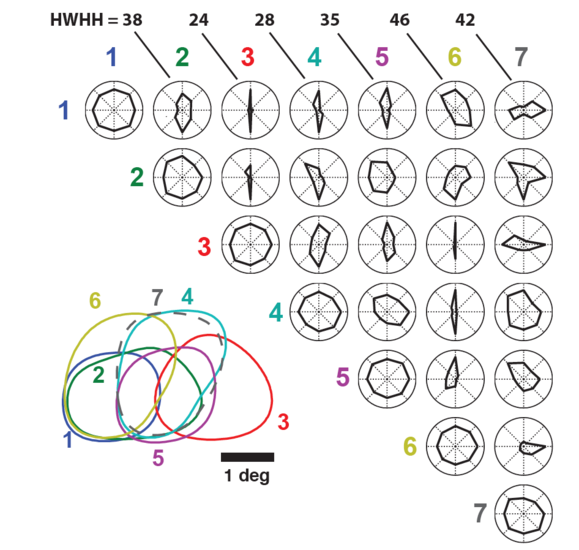
Thalamic neurons respond to visual scenes by generating synchronous spike trains on the timescale of 10–20 ms that are very effective at driving cortical targets. Here we demonstrate that this synchronous activity contains unexpectedly rich information about fundamental properties of visual stimuli. We report that the occurrence of synchronous firing of cat thalamic cells with highly overlapping receptive fields is strongly sensitive to the orientation and the direction of motion of the visual stimulus. We show that this stimulus selectivity is robust, remaining relatively unchanged under different contrasts and temporal frequencies (stimulus velocities). A computational analysis based on an integrate-and-fire model of the direct thalamic input to a layer 4 cortical cell reveals a strong correlation between the degree of thalamic synchrony and the nonlinear relationship between cortical membrane potential and the resultant firing rate. Together, these findings suggest a novel population code in the synchronous firing of neurons in the early visual pathway that could serve as the substrate for establishing cortical representations of the visual scene.