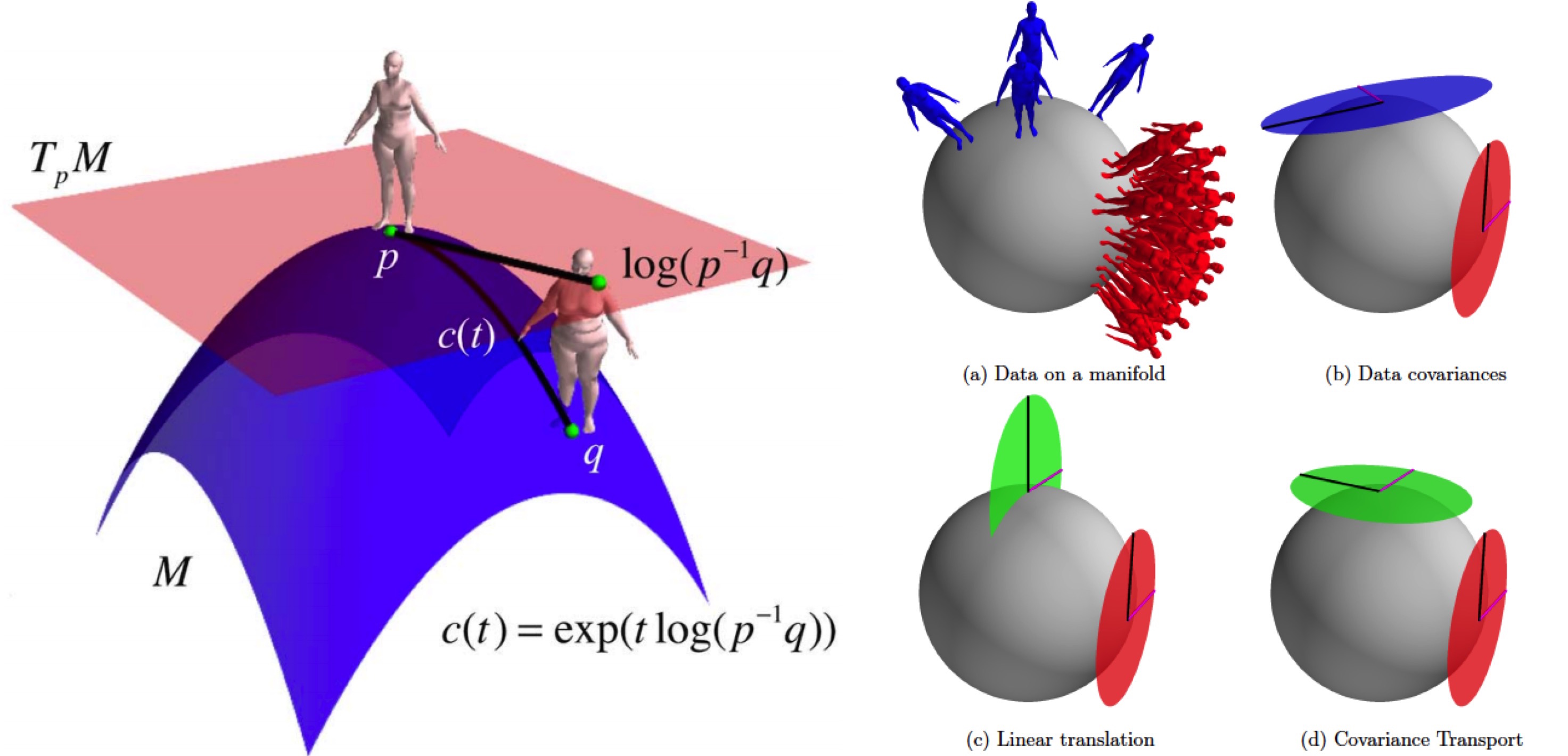
We consider the intersection of two research fields: transfer learning and statistics on manifolds. In particular, we consider, for manifold-valued data, transfer learning of tangent-space models such as Gaussians distributions, PCA, regression, or classifiers. Though one would hope to simply use ordinary Rn-transfer learning ideas, the manifold structure prevents it. We overcome this by basing our method on inner-product-preserving parallel transport, a well-known tool widely used in other problems of statistics on manifolds in computer vision. At first, this straightforward idea seems to suffer from an obvious shortcoming: Transporting large datasets is prohibitively expensive, hindering scalability. Fortunately, with our approach, we never transport data. Rather, we show how the statistical models themselves can be transported, and prove that for the tangent-space models above, the transport “commutes” with learning. Consequently, our compact framework, applicable to a large class of manifolds, is not restricted by the size of either the training or test sets. We demonstrate the approach by transferring PCA and logistic-regression models of real-world data involving 3D shapes and image descriptors.
Statistical models of non-rigid deformable shape have wide application in many fi elds,
including computer vision, computer graphics, and biometry. We show that shape deformations
are well represented through nonlinear manifolds that are also matrix Lie groups.
These pattern-theoretic representations lead to several advantages over other alternatives,
including a principled measure of shape dissimilarity and a natural way to compose deformations.
Moreover, they enable building models using statistics on manifolds. Consequently,
such models are superior to those based on Euclidean representations. We
demonstrate this by modeling 2D and 3D human body shape. Shape deformations are
only one example of manifold-valued data. More generally, in many computer-vision and
machine-learning problems, nonlinear manifold representations arise naturally and provide
a powerful alternative to Euclidean representations. Statistics is traditionally concerned
with data in a Euclidean space, relying on the linear structure and the distances associated
with such a space; this renders it inappropriate for nonlinear spaces. Statistics can,
however, be generalized to nonlinear manifolds. Moreover, by respecting the underlying
geometry, the statistical models result in not only more e ffective analysis but also consistent
synthesis. We go beyond previous work on statistics on manifolds by showing how,
even on these curved spaces, problems related to modeling a class from scarce data can be
dealt with by leveraging information from related classes residing in di fferent regions of the
space. We show the usefulness of our approach with 3D shape deformations. To summarize
our main contributions: 1) We de fine a new 2D articulated model -- more expressive than
traditional ones -- of deformable human shape that factors body-shape, pose, and camera
variations. Its high realism is obtained from training data generated from a detailed 3D
model. 2) We defi ne a new manifold-based representation of 3D shape deformations that
yields statistical deformable-template models that are better than the current state-of-the-
art. 3) We generalize a transfer learning idea from Euclidean spaces to Riemannian
manifolds. This work demonstrates the value of modeling manifold-valued data and their
statistics explicitly on the manifold. Specifi cally, the methods here provide new tools for
shape analysis.
Three-dimensional object shape is commonly represented in terms of deformations of a triangular mesh from an exemplar shape. Existing models, however, are based on a Euclidean representation of shape deformations. In contrast, we argue that shape has a manifold structure: For example, summing the shape deformations for two people does not necessarily yield a deformation corresponding to a valid human shape, nor does the Euclidean difference of these two deformations provide a meaningful measure of shape dissimilarity. Consequently, we define a
novel manifold for shape representation, with emphasis on body shapes, using a new Lie group of deformations. This has several advantages. First we define triangle deformations exactly, removing non-physical deformations
and redundant degrees of freedom common to previous methods. Second, the Riemannian structure of Lie Bodies enables a more meaningful definition of body shape similarity by measuring distance between bodies on the manifold of body shape deformations. Third, the group structure allows the valid composition of deformations. This is important for models that factor body shape deformations into multiple causes or represent shape as a linear combination of basis shapes. Finally, body shape variation is modeled using statistics on manifolds. Instead of modeling Euclidean shape variation with Principal Component Analysis we capture shape variation on the manifold using Principal Geodesic Analysis. Our experiments show consistent visual and quantitative advantages of Lie Bodies over traditional Euclidean models of shape deformation and our representation can be easily incorporated into existing methods.