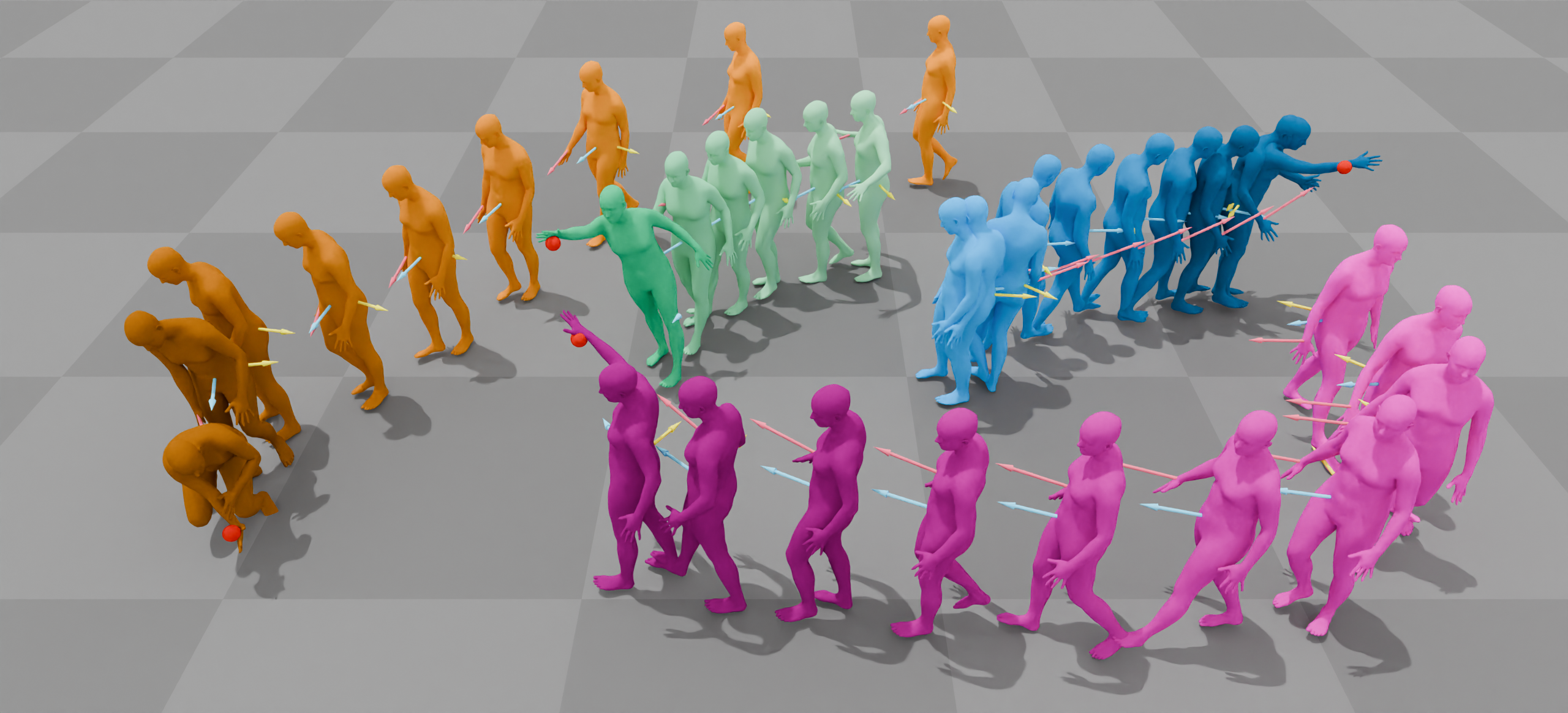
WANDR is a conditional Variational AutoEncoder that generates realistic motion of human avatars that navigate towards an arbitrary goal location and reach for it. Input to our method is the initial pose of the avatar, the goal location, and the desired motion duration. Output is a sequence of poses that guide the avatar from the initial pose to the goal location and place the wrist on it. WANDR is the first human motion generation model that is driven by an active feedback loop learned purely from data, without any extra steps of reinforcement learning.
Synthesizing natural human motions that enable a 3D human avatar to walk and reach for arbitrary goals in 3D space remains an unsolved problem with many applications. Existing methods (data-driven or using reinforcement learning) are limited in terms of generalization and motion naturalness. A primary obstacle is the scarcity of training data that combines locomotion with goal reaching. To address this, we introduce WANDR, a data-driven model that takes an avatar's initial pose and a goal's 3D position and generates natural human motions that place the end effector (wrist) on the goal location. To solve this, we introduce novel intention features that drive rich goal-oriented movement. Intention guides the agent to the goal, and interactively adapts the generation to novel situations without needing to define sub-goals or the entire motion path. Crucially, intention allows training on datasets that have goal-oriented motions as well as those that do not. WANDR is a conditional Variational Auto-Encoder (c-VAE), which we train using the AMASS and CIRCLE datasets. We evaluate our method extensively and demonstrate its ability to generate natural and long-term motions that reach 3D goals and generalize to unseen goal locations. Our models and code are available for research purposes at wandr.is.tue.mpg.de.
Synthesizing natural human motions that enable a 3D human avatar to walk and reach for arbitrary goals in 3D space remains an unsolved problem with many applications. Existing methods (data-driven or using reinforcement learning) are limited in terms of generalization and motion naturalness.A primary obstacle is the scarcity of training data that combines locomotion with goal reaching. To address this, we introduce WANDR, a data-driven model that takes an avatar's initial pose and a goal's 3D position and generates natural human motions that place the end effector (wrist) on the goal location. To solve this, we introduce novel \textit{intention} features that drive rich goal-oriented movement. \textit{Intention} guides the agent to the goal, and interactively adapts the generation to novel situations without needing to define sub-goals or the entire motion path. Crucially, intention allows training on datasets that have goal-oriented motions as well as those that do not. WANDR is a conditional Variational Auto-Encoder (c-VAE), which we train using the AMASS and CIRCLE datasets. We evaluate our method extensively and demonstrate its ability to generate natural and long-term motions that reach 3D goals and generalize to unseen goal locations.