Combining 3D meshes with 3D Gaussian splatting allows Gaussian Garments [] to represent both overall geometry and high-frequency details of human clothing. Exploiting HOOD [] and ContourCraft [], multi-layer garments can then be retargeted to novel human models, resized to fit novel body shapes, and simulated over moving bodies with novel motions.
We introduce Gaussian Garments, a novel approach for reconstructing realistic-looking, simulation-ready garment assets from multi-view videos. Our method represents garments with a combination of a 3D mesh and a Gaussian texture that encodes both the color and high-frequency surface details. This representation enables accurate registration of garment geometries to multi-view videos and helps disentangle albedo textures from lighting effects. Furthermore, we demonstrate how a pre-trained Graph Neural Network (GNN) can be fine-tuned to replicate the real behavior of each garment. The reconstructed Gaussian Garments can be automatically combined into multi-garment outfits and animated with the fine-tuned GNN.
We introduce Gaussian Garments, a novel approach for reconstructing realistic-looking, simulation-ready garment assets from multi-view videos.
Our method represents garments with a combination of a 3D mesh and a Gaussian texture that encodes both the color and high-frequency surface details.
This representation enables accurate registration of garment geometries to multi-view videos and helps disentangle albedo textures from lighting effects.
Furthermore, we demonstrate how a pre-trained Graph Neural Network (GNN) can be fine-tuned to replicate the real behavior of each garment.
The reconstructed Gaussian Garments can be automatically combined into multi-garment outfits and animated with the fine-tuned GNN.
Learning-based approaches to cloth simulation have started to show their potential in recent years. However, handling collisions and intersections in neural simulations remains a largely unsolved problem. In this work, we present ContourCraft, a learning-based solution for handling intersections in neural cloth simulations. Unlike conventional approaches that critically rely on intersection-free inputs, ContourCraft robustly recovers from intersections introduced through missed collisions, self-penetrating bodies, or errors in manually designed multi-layer outfits. The technical core of ContourCraft is a novel intersection contour loss that penalizes interpenetrations and encourages rapid resolution thereof. We integrate our intersection loss with a collision-avoiding repulsion objective into a neural cloth simulation method based on graph neural networks (GNNs). We demonstrate our method’s ability across a challenging set of diverse multi-layer outfits under dynamic human motions. Our extensive analysis indicates that ContourCraft significantly improves collision handling for learned simulation and produces visually compelling results.
We propose a method that leverages graph neural networks, multi-level message passing, and unsupervised training to enable real-time prediction of realistic clothing dynamics. Whereas existing methods based on linear blend skinning must be trained for specific garments, our method is agnostic to body shape and applies to tight-fitting garments as well as loose, free-flowing clothing. Our method furthermore handles changes in topology (e.g., garments with buttons or zippers) and material properties at inference time. As one key contribution, we propose a hierarchical message-passing scheme that efficiently propagates stiff stretching modes while preserving local detail. We empirically show that our method outperforms strong baselines quantitatively and that its results are perceived as more realistic than state-of-the-art methods.
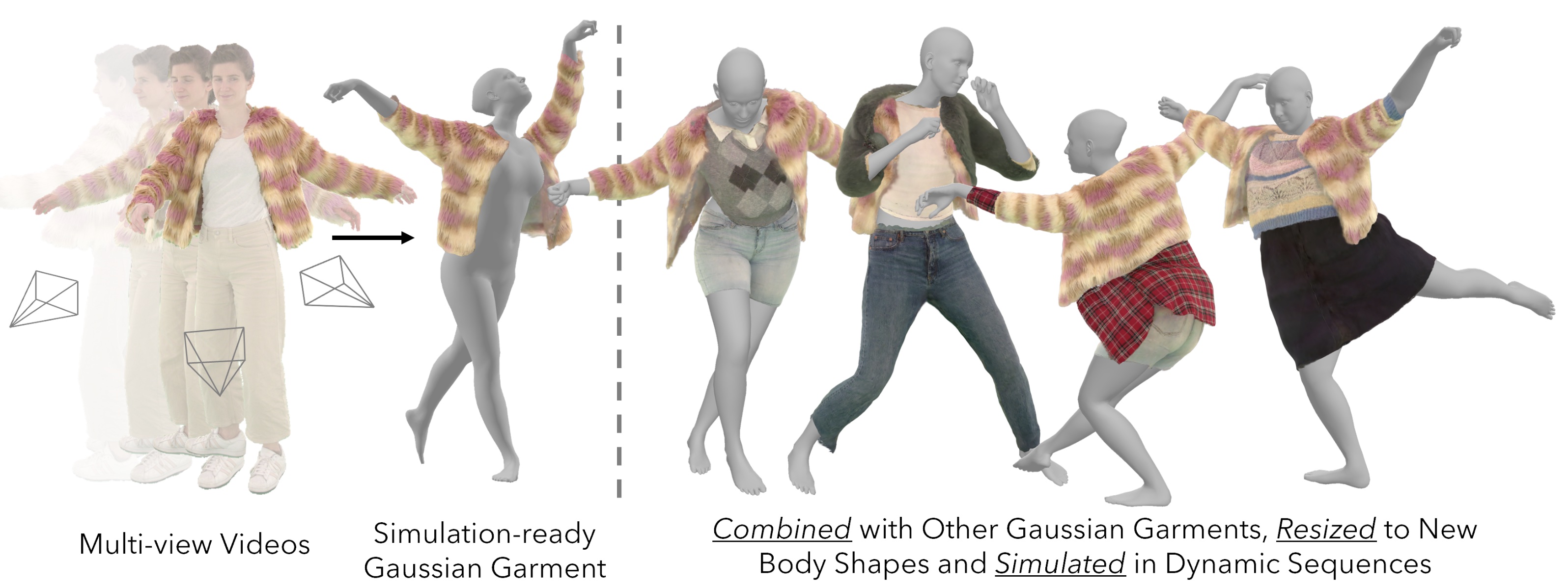
 ] to represent both overall geometry and high-frequency details of human clothing. Exploiting HOOD [