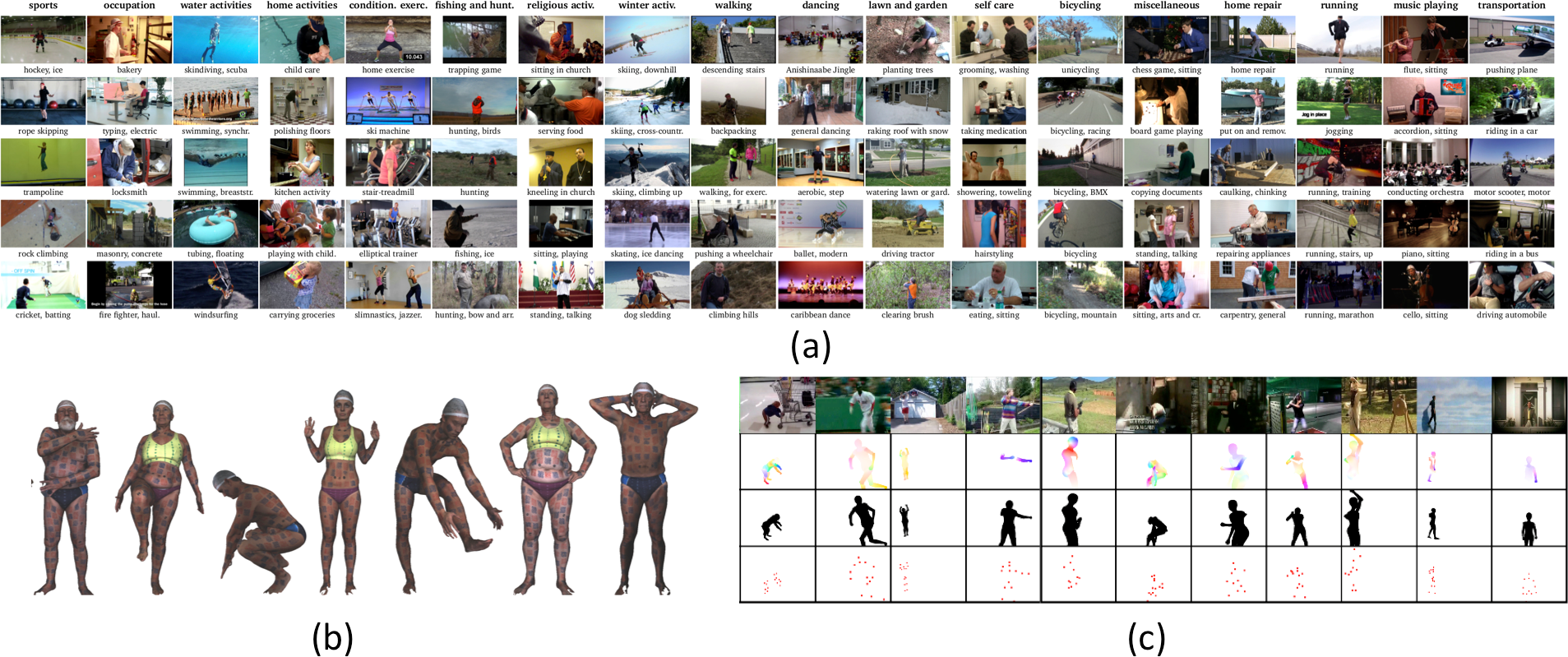
New scanning technologies are increasing the importance of 3D mesh data and the need for algorithms that can reliably align it. Surface registration is important for building full 3D models from partial scans, creating statistical shape models, shape retrieval, and tracking. The problem is particularly challenging for non-rigid and articulated objects like human bodies. While the challenges of real-world data registration are not present in existing synthetic datasets, establishing ground-truth correspondences for real 3D scans is difficult. We address this with a novel mesh registration technique that combines 3D shape and appearance information to produce high-quality alignments. We define a new dataset called FAUST that contains 300 scans of 10 people in a wide range of poses together with an evaluation methodology. To achieve accurate registration, we paint the subjects with high-frequency textures
and use an extensive validation process to ensure accurate ground truth. We find that current shape registration methods have trouble with this real-world data. The dataset and evaluation website are available for research purposes at http://faust.is.tue.mpg.de.
Although action recognition in videos is widely studied, current methods often fail on real-world datasets. Many recent approaches improve accuracy and robustness to cope with challenging video sequences, but it is often unclear
what affects the results most. This paper attempts to provide insights based on a systematic performance evaluation
using thoroughly-annotated data of human actions. We annotate human Joints for the HMDB dataset (J-HMDB). This annotation can be used to derive ground truth optical flow and segmentation. We evaluate current methods using
this dataset and systematically replace the output of various algorithms with ground truth. This enables us to discover what is important – for example, should we work on improving flow algorithms, estimating human bounding boxes, or enabling pose estimation? In summary, we find that highlevel pose features greatly outperform low/mid level features; in particular, pose over time is critical, but current pose estimation algorithms are not yet reliable enough to provide this information. We also find that the accuracy of a top-performing action recognition framework can be greatly increased by refining the underlying low/mid level features; this suggests it is important to improve optical flow and human detection algorithms. Our analysis and JHMDB dataset should facilitate a deeper understanding of action recognition algorithms.