Recognising a person's identity often relies on face and body information, and is tolerant to changes in low-level visual input (e.g., viewpoint changes). Previous studies have suggested that face identity is disentangled from low-level visual input in the anterior face-responsive regions. It remains unclear which regions disentangle body identity from variations in viewpoint, and whether face and body identity are encoded separately or combined into a coherent person identity representation. We trained participants to recognise three identities, and then recorded their brain activity using fMRI while they viewed face and body images of these three identities from different viewpoints. Participants' task was to respond to either the stimulus identity or viewpoint. We found consistent decoding of body identity across viewpoint in the fusiform body area, right anterior temporal cortex, middle frontal gyrus and right insula. This finding demonstrates a similar function of fusiform and anterior temporal cortex for bodies as has previously been shown for faces, suggesting these regions may play a general role in extracting high-level identity information. Moreover, we could decode identity across fMRI activity evoked by faces and bodies in the early visual cortex, right inferior occipital cortex, right parahippocampal cortex and right superior parietal cortex, revealing a distributed network that encodes person identity abstractly. Lastly, identity decoding was consistently better when participants attended to identity, indicating that attention to identity enhances its neural representation. These results offer new insights into how the brain develops an abstract neural coding of person identity, shared by faces and bodies.
Objective:
This study provides a comprehensive assessment of own body representation and linguistic representation of bodies in general in women with typical and atypical anorexia nervosa (AN).
Methods:
In a series of desktop experiments, participants rated a set of adjectives according to their match with a series of computer generated bodies varying in body mass index, and generated prototypic body shapes for the same set of adjectives. We analysed how body mass index of the bodies was associated with positive or negative valence of the adjectives in the different groups. Further, body image and own body perception were assessed.
Results:
In a German‐Italian sample comprising 39 women with AN, 20 women with atypical AN and 40 age matched control participants, we observed effects indicative of weight stigmatization, but no significant differences between the groups. Generally, positive adjectives were associated with lean bodies, whereas negative adjectives were associated with obese bodies.
Discussion:
Our observations suggest that patients with both typical and atypical AN affectively and visually represent body descriptions not differently from healthy women. We conclude that overvaluation of low body weight and fear of weight gain cannot be explained by generally distorted perception or cognition, but require individual consideration.
Purpose:
Body image has a significant impact on the outcome of obesity surgery. This study aims to perform a semantic evaluation of body shapes in obesity surgery patients and a group of controls.
Materials and Methods:
Thirty-four obesity surgery (OS) subjects, stable after weight loss (average 48.03 ± 18.60 kg), and 35 overweight/obese controls (MC), were enrolled in this study. Body dissatisfaction, self-esteem, and body perception were evaluated with self-reported tests, and semantic evaluation of body shapes was performed with three specific tasks constructed with realistic human body stimuli.
Results:
The OS showed a more positive body image compared to HC (p < 0.001), higher levels of depression (p < 0.019), and lower self-esteem (p < 0.000). OS patients and HC showed no difference in weight bias, but OS used a higher BMI than HC in the visualization of positive adjectives (p = 0.011). Both groups showed a mental underestimation of their body shapes.
Conclusion:
OS patients are more psychologically burdened and have more difficulties in judging their bodies than overweight/obese peers. Their mental body representations seem not to be linked to their own BMI. Our findings provide helpful insight for the design of specific interventions in body image in obese and overweight people, as well as in OS.
Animated virtual characters are essential to many applications. Little is known so far about biological and personality inferences made from a virtual character’s body shape and motion. Here, we investigated how sex-specific differences in walking style relate to the perceived attractiveness and confidence of male and female virtual characters. The characters were generated by reconstructing body shape and walking motion from optical motion capture data. The results suggest that sexual dimorphism in walking style plays a different role in attributing biological and personality traits to male and female virtual characters. This finding has important implications for virtual character animation.
Our visual system can easily categorize objects (e.g. faces vs. bodies) and further differentiate them into subcategories (e.g. male vs. female). This ability is particularly important for objects of social significance, such as human faces and bodies. While many studies have demonstrated category selectivity to faces and bodies in the brain, how subcategories of faces and bodies are represented remains unclear. Here, we investigated how the brain encodes two prominent subcategories shared by both faces and bodies, sex and weight, and whether neural responses to these subcategories rely on low-level visual, high-level visual or semantic similarity. We recorded brain activity with fMRI while participants viewed faces and bodies that varied in sex, weight, and image size. The results showed that the sex of bodies can be decoded from both body- and face-responsive brain areas, with the former exhibiting more consistent size-invariant decoding than the latter. Body weight could also be decoded in face-responsive areas and in distributed body-responsive areas, and this decoding was also invariant to image size. The weight of faces could be decoded from the fusiform body area (FBA), and weight could be decoded across face and body stimuli in the extrastriate body area (EBA) and a distributed body-responsive area. The sex of well-controlled faces (e.g. excluding hairstyles) could not be decoded from face- or body-responsive regions. These results demonstrate that both face- and body-responsive brain regions encode information that can distinguish the sex and weight of bodies. Moreover, the neural patterns corresponding to sex and weight were invariant to image size and could sometimes generalize across face and body stimuli, suggesting that such subcategorical information is encoded with a high-level visual or semantic code.
The creation of realistic self-avatars that users identify with is important for many virtual reality applications. However, current approaches for creating biometrically plausible avatars that represent a particular individual require expertise and are time-consuming. We investigated the visual perception of an avatar’s body dimensions by asking males and females to estimate their own body weight and shape on a virtual body using a virtual reality avatar creation tool. In a method of adjustment task, the virtual body was presented in an HTC Vive head-mounted display either co-located with (first-person perspective) or facing (third-person perspective) the participants. Participants adjusted the body weight and dimensions of various body parts to match their own body shape and size. Both males and females underestimated their weight by 10-20% in the virtual body, but the estimates of the other body dimensions were relatively accurate and within a range of ±6%. There was a stronger influence of visual perspective on the estimates for males, but this effect was dependent on the amount of control over the shape of the virtual body, indicating that the results might be caused by where in the body the weight changes expressed themselves. These results suggest that this avatar creation tool could be used to allow participants to make a relatively accurate self-avatar in terms of adjusting body part dimensions, but not weight, and that the influence of visual perspective and amount of control needed
over the body shape are likely gender-specific.
The individual shape of the human body, including the geometry of its articulated structure and the distribution of weight over that structure, influences the kinematics of a person’s movements. How sensitive is the visual system to inconsistencies between shape and motion introduced by retargeting motion from one person onto the shape of another? We used optical motion capture to record five pairs of male performers with large differences in body weight, while they pushed, lifted, and threw objects. From these data, we estimated both the kinematics of the actions as well as the performer’s individual body shape. To obtain consistent and inconsistent stimuli, we created animated avatars by combining the shape and motion estimates from either a single performer or from different performers. Using these stimuli we conducted three experiments in an immersive virtual reality environment. First, a group of participants detected which of two stimuli was inconsistent. Performance was very low, and results were only marginally significant. Next, a second group of participants rated perceived attractiveness, eeriness, and humanness of consistent and inconsistent stimuli, but these judgements of animation characteristics were not affected by consistency of the stimuli. Finally, a third group of participants rated properties of the objects rather than of the performers. Here, we found strong influences of shape-motion inconsistency on perceived weight and thrown distance of objects. This suggests that the visual system relies on its knowledge of shape and motion and that these components are assimilated into an altered perception of the action outcome. We propose that the visual system attempts to resist inconsistent interpretations of human animations. Actions involving object manipulations present an opportunity for the visual system to reinterpret the introduced inconsistencies as a change in the dynamics of an object rather than as an unexpected combination of body shape and body motion.
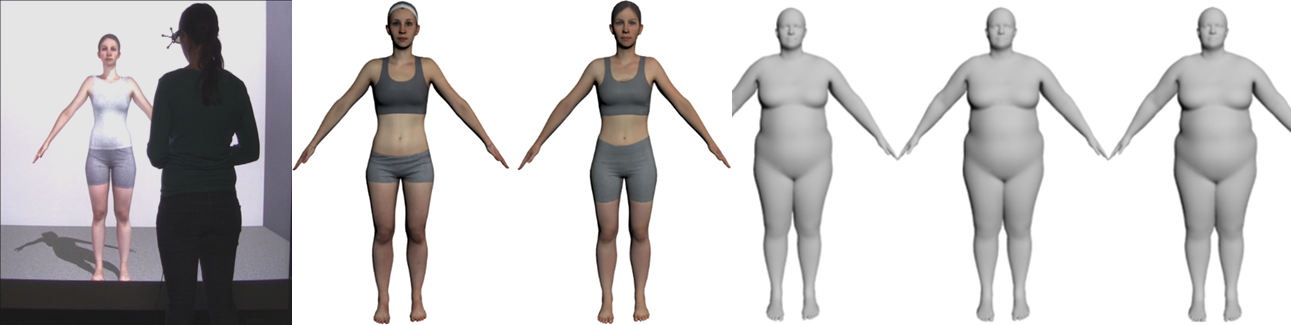
Background: Body image disturbance (BID) is a core symptom of anorexia nervosa (AN), but as yet distinctive features of BID are unknown. The present study aimed at disentangling perceptual and attitudinal components of BID in AN. Methods: We investigated n=24 women with AN and n=24 controls. Based on a 3D body scan, we created realistic virtual 3D bodies (avatars) for each participant that were varied through a range of ±20% of the participants' weights. Avatars were presented in a virtual reality mirror scenario. Using different psychophysical tasks, participants identified and adjusted their actual and their desired body weight. To test for general perceptual biases in estimating body weight, a second experiment investigated perception of weight and shape matched avatars with another identity.
Results: Women with AN and controls underestimated their weight, with a trend that women with AN underestimated more. The average desired body of controls had normal weight while the average desired weight of women with AN corresponded to extreme AN (DSM-5). Correlation analyses revealed that desired body weight, but not accuracy of weight estimation, was associated with eating disorder symptoms. In the second experiment, both groups estimated accurately while the most attractive body
was similar to Experiment 1.
Conclusions: Our results contradict the widespread assumption that patients with AN overestimate their body weight due to visual distortions. Rather, they illustrate that BID might be driven by distorted attitudes with regard to the desired body. Clinical interventions should aim at helping patients with AN to change their desired weight.
Previous literature suggests that a disturbed ability to accurately identify own body size may
contribute to overweight. Here, we investigated the influence of personal body size, indexed
by body mass index (BMI), on body size estimation in a non-clinical population of females
varying in BMI. We attempted to disentangle general biases in body size estimates and attitudinal
influences by manipulating whether participants believed the body stimuli (personalized
avatars with realistic weight variations) represented their own body or that of another
person. Our results show that the accuracy of own body size estimation is predicted by personal
BMI, such that participants with lower BMI underestimated their body size and participants
with higher BMI overestimated their body size. Further, participants with higher BMI
were less likely to notice the same percentage of weight gain than participants with lower
BMI. Importantly, these results were only apparent when participants were judging a virtual
body that was their own identity (Experiment 1), but not when they estimated the size of a
body with another identity and the same underlying body shape (Experiment 2a). The different
influences of BMI on accuracy of body size estimation and sensitivity to weight change
for self and other identity suggests that effects of BMI on visual body size estimation are
self-specific and not generalizable to other bodies.
This study uses novel biometric figure rating scales (FRS) spanning body mass index (BMI) 13.8 to 32.2 kg/m2 and BMI 18 to 42 kg/m2. The aims of the study were (i) to compare FRS body weight dissatisfaction and perceptual distortion of women with anorexia nervosa (AN) to a community sample; (ii) how FRS parameters are associated with questionnaire body dissatisfaction, eating disorder symptoms and appearance comparison habits; and (iii) whether the weight spectrum of the FRS matters. Women with AN (n = 24) and a community sample of women (n = 104) selected their current and ideal body on the FRS and completed additional questionnaires. Women with AN accurately picked the body that aligned best with their actual weight in both FRS. Controls underestimated their BMI in the FRS 14–32 and were accurate in the FRS 18–42. In both FRS, women with AN desired a body close to their actual BMI and controls desired a thinner body. Our observations suggest that body image disturbance in AN is unlikely to be characterized by a visual perceptual disturbance, but rather by an idealization of underweight in conjunction with high body dissatisfaction. The weight spectrum of FRS can influence the accuracy of BMI estimation.