Back

Perceiving Systems Members Publications

Language and Movement
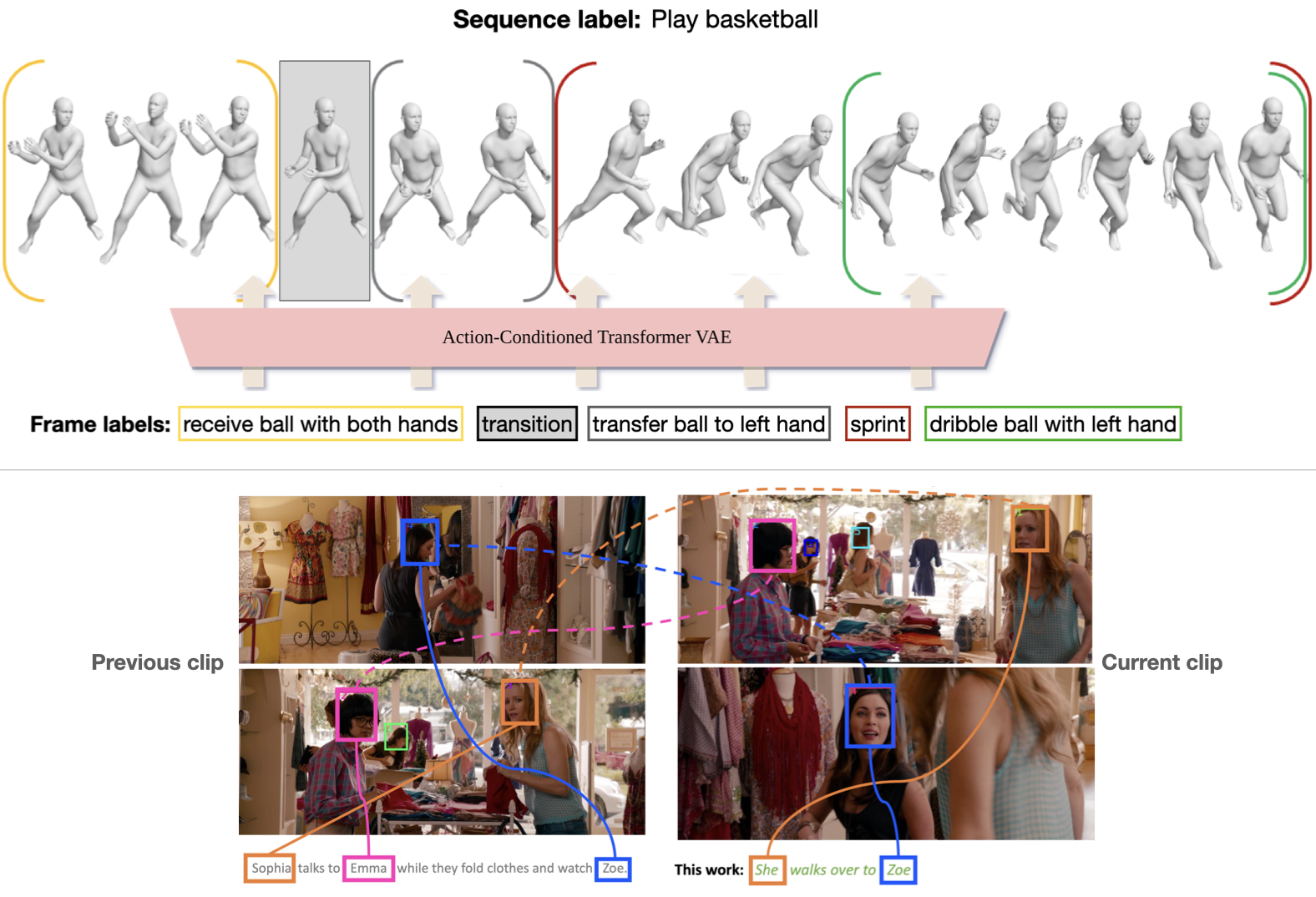
Top: Our goal is to generate 3D human movements that are grounded in actions using the BABEL dataset [File Icon], which consists of dense frame-level action labels that correspond to 3D human movements. Bottom: We identify individual actors in a movie clip and synthesize natural language descriptions of their actions and interactions [File Icon].

Members

Perceiving Systems, Software Workshop
  • Guest Scientist
Perceiving Systems
  • Guest Scientist
Perceiving Systems
Guest Scientist
Perceiving Systems
  • Guest Scientist
Perceiving Systems
Guest Scientist
Perceiving Systems
  • Doctoral Researcher
Perceiving Systems
  • Guest Scientist
Perceiving Systems
Emeritus / Acting Director

Publications

Perceiving Systems Conference Paper MotionFix: Text-Driven 3D Human Motion Editing Athanasiou, N., Cseke, A., Diomataris, M., Black, M. J., Varol, G. In SIGGRAPH Asia 2024 Conference Proceedings, ACM, SIGGRAPH Asia , December 2024 (Published)
The focus of this paper is 3D motion editing. Given a 3D human motion and a textual description of the desired modification, our goal is to generate an edited motion as described by the text. The challenges include the lack of training data and the design of a model that faithfully edits the source motion. In this paper, we address both these challenges. We build a methodology to semi-automatically collect a dataset of triplets in the form of (i) a source motion, (ii) a target motion, and (iii) an edit text, and create the new dataset. Having access to such data allows us to train a conditional diffusion model that takes both the source motion and the edit text as input. We further build various baselines trained only on text-motion pairs datasets and show superior performance of our model trained on triplets. We introduce new retrieval-based metrics for motion editing and establish a new benchmark on the evaluation set. Our results are encouraging, paving the way for further research on fine-grained motion generation. Code and models will be made publicly available.
Code (GitHub) Website Data Exploration ArXiv URL BibTeX

Perceiving Systems Conference Paper SINC: Spatial Composition of 3D Human Motions for Simultaneous Action Generation Athanasiou, N., Petrovich, M., Black, M. J., Varol, G. In Proc. International Conference on Computer Vision (ICCV), 9984-9995, International Conference on Computer Vision, October 2023 (Published)
Our goal is to synthesize 3D human motions given textual inputs describing multiple simultaneous actions, for example ‘waving hand’ while ‘walking’ at the same time. We refer to generating such simultaneous movements as performing ‘spatial compositions’. In contrast to ‘temporal compositions’ that seek to transition from one action to another in a sequence, spatial compositing requires understanding which body parts are involved with which action. Motivated by the observation that the correspondence between actions and body parts is encoded in powerful language models, we extract this knowledge by prompting GPT-3 with text such as “what parts of the body are moving when someone is doing the action <action name>?”. Given this action-part mapping, we automatically create new training data by artificially combining body parts from multiple text-motion pairs together. We extend previous work on text-to-motions synthesis to train on spatial compositions, and introduce SINC (“SImultaneous actioN Compositions for 3D human motions”). We experimentally validate that our additional GPT-guided data helps to better learn compositionality compared to training only on existing real data of simultaneous actions, which is limited in quantity.
website code paper-arxiv video BibTeX

Perceiving Systems Conference Paper TEACH: Temporal Action Composition for 3D Humans Athanasiou, N., Petrovich, M., Black, M. J., Varol, G. In 2022 International Conference on 3D Vision (3DV), 414-423, 3DV'22, September 2022 (Published)
Given a series of natural language descriptions, our task is to generate 3D human motions that correspond semantically to the text, and follow the temporal order of the instructions. In particular, our goal is to enable the synthesis of a series of actions, which we refer to as temporal action composition. The current state of the art in text-conditioned motion synthesis only takes a single action or a single sentence as input. This is partially due to lack of suitable training data containing action sequences, but also due to the computational complexity of their non-autoregressive model formulation, which does not scale well to long sequences. In this work, we address both issues. First, we exploit the recent BABEL motion-text collection, which has a wide range of labeled actions, many of which occur in a sequence with transitions between them. Next, we design a Transformer-based approach that operates non-autoregressively within an action, but autoregressively within the sequence of actions. This hierarchical formulation proves effective in our experiments when compared with multiple baselines. Our approach, called TEACH for “TEmporal Action Compositions for Human motions”, produces realistic human motions for a wide variety of actions and temporal compositions from language descriptions. To encourage work on this new task, we make our code available for research purposes at teach.is.tue.mpg.de.
code arXiv website video camera-ready DOI URL BibTeX

Perceiving Systems Conference Paper Action-Conditioned 3D Human Motion Synthesis with Transformer VAE Petrovich, M., Black, M. J., Varol, G. In Proc. International Conference on Computer Vision (ICCV), 10965-10975, IEEE, Piscataway, NJ, International Conference on Computer Vision, October 2021 (Published)
We tackle the problem of action-conditioned generation of realistic and diverse human motion sequences. In contrast to methods that complete, or extend, motion sequences, this task does not require an initial pose or sequence. Here we learn an action-aware latent representation for human motions by training a generative variational autoencoder (VAE). By sampling from this latent space and querying a certain duration through a series of positional encodings, we synthesize variable-length motion sequences conditioned on a categorical action. Specifically, we design a Transformer-based architecture, ACTOR, for encoding and decoding a sequence of parametric SMPL human body models estimated from action recognition datasets. We evaluate our approach on the NTU RGB+D, HumanAct12 and UESTC datasets and show improvements over the state of the art. Furthermore, we present two use cases: improving action recognition through adding our synthesized data to training, and motion denoising. Code and models are available on our project page.
website code paper-arxiv video DOI BibTeX

Perceiving Systems Conference Paper BABEL: Bodies, Action and Behavior with English Labels Punnakkal, A. R., Chandrasekaran, A., Athanasiou, N., Quiros-Ramirez, M. A., Black, M. J. In 2021 IEEE/CVF Conference on Computer Vision and Pattern Recognition (CVPR 2021), 722-731, IEEE, Piscataway, NJ, IEEE/CVF Conference on Computer Vision and Pattern Recognition (CVPR 2021) , June 2021 (Published)
Understanding the semantics of human movement -- the what, how and why of the movement -- is an important problem that requires datasets of human actions with semantic labels. Existing datasets take one of two approaches. Large-scale video datasets contain many action labels but do not contain ground-truth 3D human motion. Alternatively, motion-capture (mocap) datasets have precise body motions but are limited to a small number of actions. To address this, we present BABEL, a large dataset with language labels describing the actions being performed in mocap sequences. BABEL consists of action labels for about 43.5 hours of mocap sequences from AMASS. Action labels are at two levels of abstraction -- sequence labels which describe the overall action in the sequence, and frame labels which describe all actions in every frame of the sequence. Each frame label is precisely aligned with the duration of the corresponding action in the mocap sequence, and multiple actions can overlap. There are over 28k sequence labels, and 63k frame labels in BABEL, which belong to over 250 unique action categories. Labels from BABEL can be leveraged for tasks like action recognition, temporal action localization, motion synthesis, etc. To demonstrate the value of BABEL as a benchmark, we evaluate the performance of models on 3D action recognition. We demonstrate that BABEL poses interesting learning challenges that are applicable to real-world scenarios, and can serve as a useful benchmark of progress in 3D action recognition. The dataset, baseline method, and evaluation code is made available, and supported for academic research purposes at https://babel.is.tue.mpg.de/.
dataset poster pdf sup mat video code DOI BibTeX

Perceiving Systems Conference Paper Generating Descriptions with Grounded and Co-Referenced People Rohrbach, A., Rohrbach, M., Tang, S., Oh, S. J., Schiele, B. In 2017 IEEE Conference on Computer Vision and Pattern Recognition (CVPR), 4196-4206, IEEE, Piscataway, NJ, USA, IEEE Conference on Computer Vision and Pattern Recognition (CVPR), July 2017 PDF DOI BibTeX