Back

Perzeptive Systeme Members Publications

Bodies in Medicine

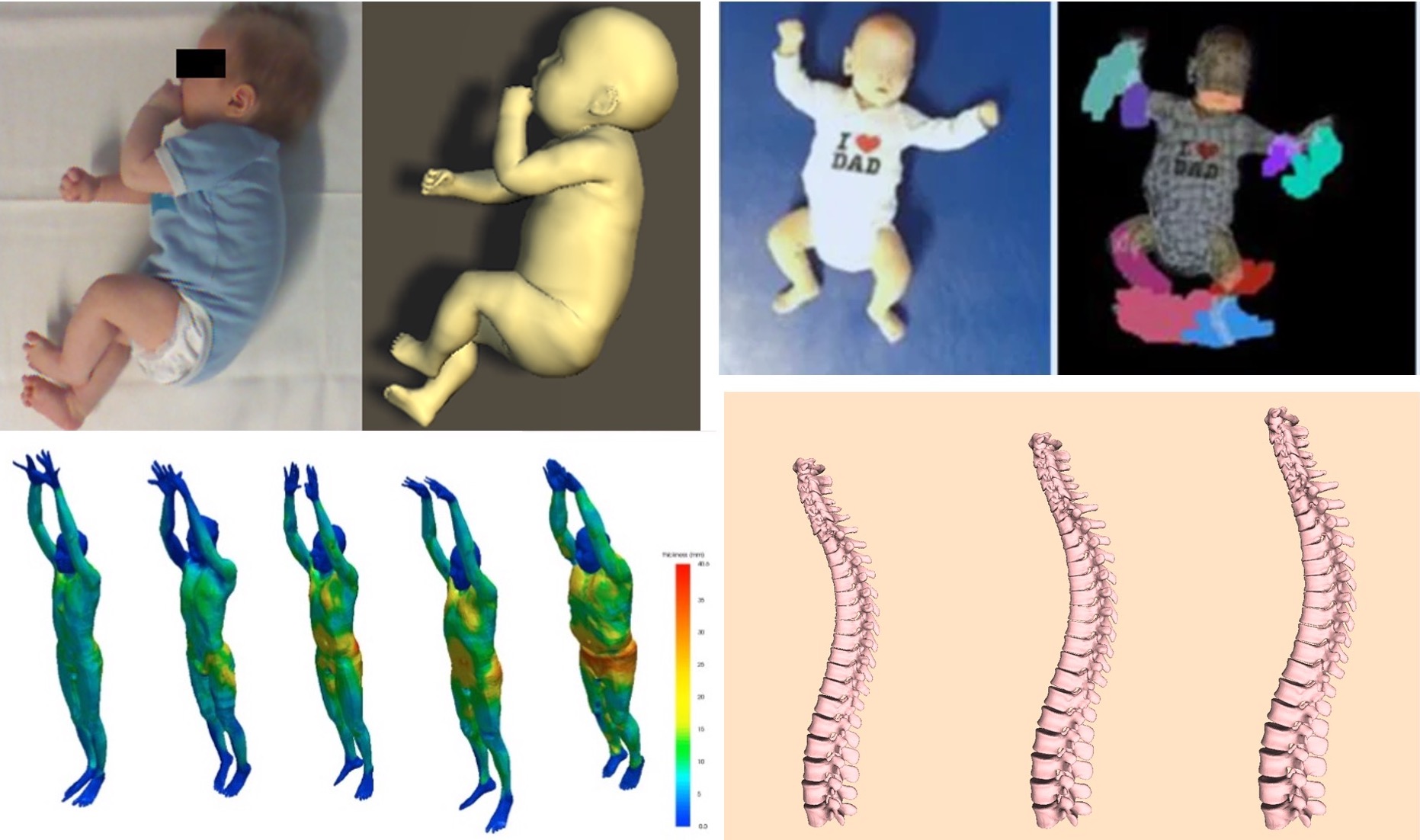
Top left: We learn an infant body model called SMIL from RGB-D sequences and use this to recover the shape and pose of freely moving infants. Top right: We use SMIL to track infant motion to assist with early diagnosis of cerebral palsy. Bottom right: Looking inside the body, we learn a model of spine shape and curvature. Bottle left: We align 3D bodies to MRI, segment the subcutaneous adipose tissue, and illustrate its thickness with a color code.

Members

Perzeptive Systeme
Emeritiertes Wissenschaftliches Mitglied / Kommissarischer Direktor
Perzeptive Systeme
Guest Scientist
Perzeptive Systeme
Affiliated Researcher
Perzeptive Systeme
  • Guest Scientist

Publications

Perceiving Systems Article A pose-independent method for accurate and precise body composition from 3D optical scans Wong, M. C., Ng, B. K., Tian, I., Sobhiyeh, S., Pagano, I., Dechenaud, M., Kennedy, S. F., Liu, Y. E., Kelly, N., Chow, D., Garber, A. K., Maskarinec, G., Pujades, S., Black, M. J., Curless, B., Heymsfield, S. B., Shepherd, J. A. Obesity, 29(11):1835-1847, Wiley, November 2021 (Published)
Objective: The aim of this study was to investigate whether digitally re-posing three-dimensional optical (3DO) whole-body scans to a standardized pose would improve body composition accuracy and precision regardless of the initial pose. Methods: Healthy adults (n = 540), stratified by sex, BMI, and age, completed whole-body 3DO and dual-energy X-ray absorptiometry (DXA) scans in the Shape Up! Adults study. The 3DO mesh vertices were represented with standardized templates and a low-dimensional space by principal component analysis (stratified by sex). The total sample was split into a training (80%) and test (20%) set for both males and females. Stepwise linear regression was used to build prediction models for body composition and anthropometry outputs using 3DO principal components (PCs). Results: The analysis included 472 participants after exclusions. After re-posing, three PCs described 95% of the shape variance in the male and female training sets. 3DO body composition accuracy compared with DXA was as follows: fat mass R2 = 0.91 male, 0.94 female; fat-free mass R2 = 0.95 male, 0.92 female; visceral fat mass R2 = 0.77 male, 0.79 female. Conclusions: Re-posed 3DO body shape PCs produced more accurate and precise body composition models that may be used in clinical or nonclinical settings when DXA is unavailable or when frequent ionizing radiation exposure is unwanted.
Wiley online adress Author Version DOI BibTeX

Perceiving Systems Conference Paper Learning a statistical full spine model from partial observations Meng, D., Keller, M., Boyer, E., Black, M., Pujades, S. In Shape in Medical Imaging, 122-133, Lecture Notes in Computer Science, 12474, (Editors: Reuter, Martin and Wachinger, Christian and Lombaert, Hervé and Paniagua, Beatriz and Goksel, Orcun and Rekik, Islem), Springer, Cham, International Workshop on Shape in Medical Imaging (ShapeMI 2020), October 2020 (Published)
The study of the morphology of the human spine has attracted research attention for its many potential applications, such as image segmentation, bio-mechanics or pathology detection. However, as of today there is no publicly available statistical model of the 3D surface of the full spine. This is mainly due to the lack of openly available 3D data where the full spine is imaged and segmented. In this paper we propose to learn a statistical surface model of the full-spine (7 cervical, 12 thoracic and 5 lumbar vertebrae) from partial and incomplete views of the spine. In order to deal with the partial observations we use probabilistic principal component analysis (PPCA) to learn a surface shape model of the full spine. Quantitative evaluation demonstrates that the obtained model faithfully captures the shape of the population in a low dimensional space and generalizes to left out data. Furthermore, we show that the model faithfully captures the global correlations among the vertebrae shape. Given a partial observation of the spine, i.e. a few vertebrae, the model can predict the shape of unseen vertebrae with a mean error under 3 mm. The full-spine statistical model is trained on the VerSe 2019 public dataset and is publicly made available to the community for non-commercial purposes. (https://gitlab.inria.fr/spine/spine_model)
Gitlab Code PDF DOI BibTeX

Perceiving Systems Article Analysis of motor development within the first year of life: 3-D motion tracking without markers for early detection of developmental disorders Parisi, C., Hesse, N., Tacke, U., Rocamora, S. P., Blaschek, A., Hadders-Algra, M., Black, M. J., Heinen, F., Müller-Felber, W., Schroeder, A. S. Bundesgesundheitsblatt - Gesundheitsforschung - Gesundheitsschutz, 63(7):881–890, July 2020 (Published)
Children with motor development disorders benefit greatly from early interventions. An early diagnosis in pediatric preventive care (U2–U5) can be improved by automated screening. Current approaches to automated motion analysis, however, are expensive, require lots of technical support, and cannot be used in broad clinical application. Here we present an inexpensive, marker-free video analysis tool (KineMAT) for infants, which digitizes 3‑D movements of the entire body over time allowing automated analysis in the future. Three-minute video sequences of spontaneously moving infants were recorded with a commercially available depth-imaging camera and aligned with a virtual infant body model (SMIL model). The virtual image generated allows any measurements to be carried out in 3‑D with high precision. We demonstrate seven infants with different diagnoses. A selection of possible movement parameters was quantified and aligned with diagnosis-specific movement characteristics. KineMAT and the SMIL model allow reliable, three-dimensional measurements of spontaneous activity in infants with a very low error rate. Based on machine-learning algorithms, KineMAT can be trained to automatically recognize pathological spontaneous motor skills. It is inexpensive and easy to use and can be developed into a screening tool for preventive care for children.
pdf on-line w/ sup mat DOI BibTeX

Perceiving Systems Article Learning and Tracking the 3D Body Shape of Freely Moving Infants from RGB-D sequences Hesse, N., Pujades, S., Black, M., Arens, M., Hofmann, U., Schroeder, S. IEEE Transactions on Pattern Analysis and Machine Intelligence (TPAMI), 42(10):2540-2551, June 2020
Statistical models of the human body surface are generally learned from thousands of high-quality 3D scans in predefined poses to cover the wide variety of human body shapes and articulations. Acquisition of such data requires expensive equipment, calibration procedures, and is limited to cooperative subjects who can understand and follow instructions, such as adults. We present a method for learning a statistical 3D Skinned Multi-Infant Linear body model (SMIL) from incomplete, low-quality RGB-D sequences of freely moving infants. Quantitative experiments show that SMIL faithfully represents the RGB-D data and properly factorizes the shape and pose of the infants. To demonstrate the applicability of SMIL, we fit the model to RGB-D sequences of freely moving infants and show, with a case study, that our method captures enough motion detail for General Movements Assessment (GMA), a method used in clinical practice for early detection of neurodevelopmental disorders in infants. SMIL provides a new tool for analyzing infant shape and movement and is a step towards an automated system for GMA.
pdf Journal DOI BibTeX

Perceiving Systems Conference Paper GENTEL: GENerating Training data Efficiently for Learning to segment medical images Thakur, R. P., Pujades, S., Goel, L., Pohmann, R., Machann, J., Black, M. J. RFIAP 2020 - Congrés Reconnaissance des Formes, Image, Apprentissage et Perception , Congrès Reconnaissance des Formes, Image, Apprentissage et Perception (RFAIP 2020) , June 2020 (Published)
Accurately segmenting MRI images is crucial for many clinical applications. However, manually segmenting images with accurate pixel precision is a tedious and time consuming task. In this paper we present a simple, yet effective method to improve the efficiency of the image segmentation process. We propose to transform the image annotation task into a binary choice task. We start by using classical image processing algorithms with different parameter values to generate multiple, different segmentation masks for each input MRI image. Then, instead of segmenting the pixels of the images, the user only needs to decide whether a segmentation is acceptable or not. This method allows us to efficiently obtain high quality segmentations with minor human intervention. With the selected segmentations, we train a state-of-the-art neural network model. For the evaluation, we use a second MRI dataset (1.5T Dataset), acquired with a different protocol and containing annotations. We show that the trained network i) is able to automatically segment cases where none of the classical methods obtain a high quality result ; ii) generalizes to the second MRI dataset, which was acquired with a different protocol and was never seen at training time ; and iii) enables detection of miss-annotations in this second dataset. Quantitatively, the trained network obtains very good results: DICE score - mean 0.98, median 0.99- and Hausdorff distance (in pixels) - mean 4.7, median 2.0-.
Project Page PDF URL BibTeX

Perceiving Systems Article General Movement Assessment from videos of computed 3D infant body models is equally effective compared to conventional RGB Video rating Schroeder, S., Hesse, N., Weinberger, R., Tacke, U., Gerstl, L., Hilgendorff, A., Heinen, F., Arens, M., Bodensteiner, C., Dijkstra, L. J., Pujades, S., Black, M., Hadders-Algra, M. Early Human Development, 144:104967, May 2020
Background: General Movement Assessment (GMA) is a powerful tool to predict Cerebral Palsy (CP). Yet, GMA requires substantial training hampering its implementation in clinical routine. This inspired a world-wide quest for automated GMA. Aim: To test whether a low-cost, marker-less system for three-dimensional motion capture from RGB depth sequences using a whole body infant model may serve as the basis for automated GMA. Study design: Clinical case study at an academic neurodevelopmental outpatient clinic. Subjects: Twenty-nine high-risk infants were recruited and assessed at their clinical follow-up at 2-4 month corrected age (CA). Their neurodevelopmental outcome was assessed regularly up to 12-31 months CA. Outcome measures: GMA according to Hadders-Algra by a masked GMA-expert of conventional and computed 3D body model (“SMIL motion”) videos of the same GMs. Agreement between both GMAs was assessed, and sensitivity and specificity of both methods to predict CP at ≥12 months CA. Results: The agreement of the two GMA ratings was substantial, with κ=0.66 for the classification of definitely abnormal (DA) GMs and an ICC of 0.887 (95% CI 0.762;0.947) for a more detailed GM-scoring. Five children were diagnosed with CP (four bilateral, one unilateral CP). The GMs of the child with unilateral CP were twice rated as mildly abnormal. DA-ratings of both videos predicted bilateral CP well: sensitivity 75% and 100%, specificity 88% and 92% for conventional and SMIL motion videos, respectively. Conclusions: Our computed infant 3D full body model is an attractive starting point for automated GMA in infants at risk of CP.
DOI BibTeX

Perceiving Systems Conference Paper Learning an Infant Body Model from RGB-D Data for Accurate Full Body Motion Analysis Hesse, N., Pujades, S., Romero, J., Black, M. J., Bodensteiner, C., Arens, M., Hofmann, U. G., Tacke, U., Hadders-Algra, M., Weinberger, R., Muller-Felber, W., Schroeder, A. S. In Int. Conf. on Medical Image Computing and Computer Assisted Intervention (MICCAI), September 2018
Infant motion analysis enables early detection of neurodevelopmental disorders like cerebral palsy (CP). Diagnosis, however, is challenging, requiring expert human judgement. An automated solution would be beneficial but requires the accurate capture of 3D full-body movements. To that end, we develop a non-intrusive, low-cost, lightweight acquisition system that captures the shape and motion of infants. Going beyond work on modeling adult body shape, we learn a 3D Skinned Multi-Infant Linear body model (SMIL) from noisy, low-quality, and incomplete RGB-D data. We demonstrate the capture of shape and motion with 37 infants in a clinical environment. Quantitative experiments show that SMIL faithfully represents the data and properly factorizes the shape and pose of the infants. With a case study based on general movement assessment (GMA), we demonstrate that SMIL captures enough information to allow medical assessment. SMIL provides a new tool and a step towards a fully automatic system for GMA.
pdf Project page video extended arXiv version DOI BibTeX