Back

Haptic Intelligence Members Publications

Enhancing HRI through Responsive Multimodal Feedback
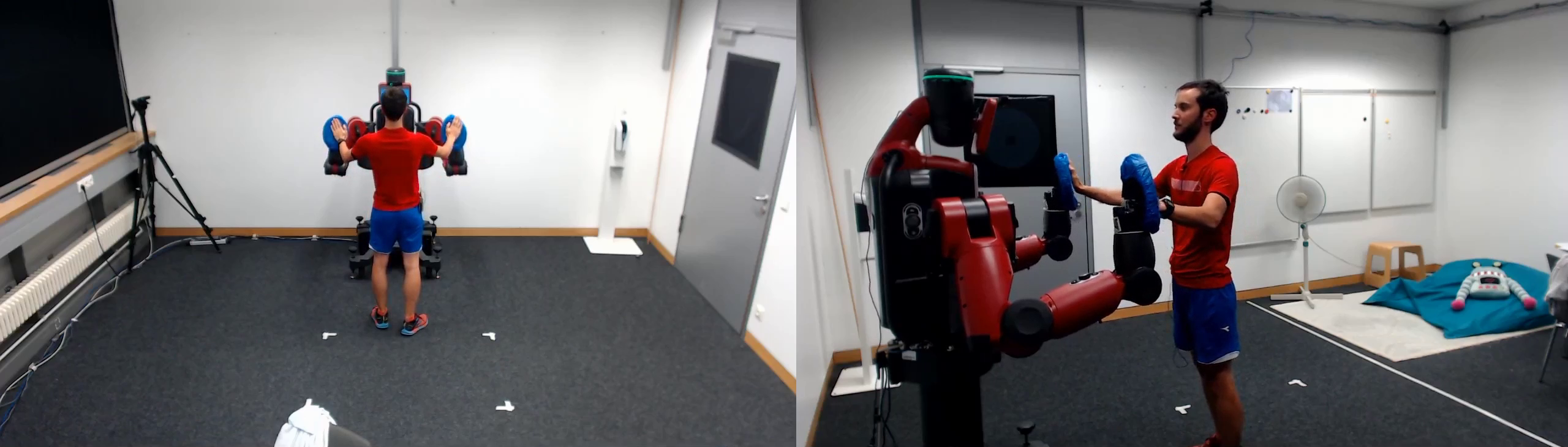
The robot in one of our studies sought to communicate three movement tasks: the depicted task required the user to walk to the robot and make contact with both of its end effectors. The robot provided half of the users with real-time formative feedback, which greatly enhanced their task performance and comprehension.

Members

Haptic Intelligence
  • Research Scientist
Haptic Intelligence
  • Visitor
Haptic Intelligence
Director

Publications

Haptic Intelligence Article Closing the Loop in Minimally Supervised Human-Robot Interaction: Formative and Summative Feedback Mohan, M., Nunez, C. M., Kuchenbecker, K. J. Scientific Reports, 14(1):10564, May 2024 (Published)
Human instructors fluidly communicate with hand gestures, head and body movements, and facial expressions, but robots rarely leverage these complementary cues. A minimally supervised social robot with such skills could help people exercise and learn new activities. Thus, we investigated how nonverbal feedback from a humanoid robot affects human behavior. Inspired by the education literature, we evaluated formative feedback (real-time corrections) and summative feedback (post-task scores) for three distinct tasks: positioning in the room, mimicking the robot's arm pose, and contacting the robot's hands. Twenty-eight adults completed seventy-five 30-second-long trials with no explicit instructions or experimenter help. Motion-capture data analysis shows that both formative and summative feedback from the robot significantly aided user performance. Additionally, formative feedback improved task understanding. These results show the power of nonverbal cues based on human movement and the utility of viewing feedback through formative and summative lenses.
DOI BibTeX

Haptic Intelligence Article How Should Robots Exercise with People? Robot-Mediated Exergames Win with Music, Social Analogues, and Gameplay Clarity Fitter, N. T., Mohan, M., Preston, R. C., Johnson, M. J., Kuchenbecker, K. J. Frontiers in Robotics and AI, 10(1155837):1-18, January 2024 (Published)
The modern worldwide trend toward sedentary behavior comes with significant health risks. An accompanying wave of health technologies has tried to encourage physical activity, but these approaches often yield limited use and retention. Due to their unique ability to serve as both a health-promoting technology and a social peer, we propose robots as a game-changing solution for encouraging physical activity. This article analyzes the eight exergames we previously created for the Rethink Baxter Research Robot in terms of four key components that are grounded in the video-game literature: repetition, pattern matching, music, and social design. We use these four game facets to assess gameplay data from 40 adult users who each experienced the games in balanced random order. In agreement with prior research, our results show that relevant musical cultural references, recognizable social analogues, and gameplay clarity are good strategies for taking an otherwise highly repetitive physical activity and making it engaging and popular among users. Others who study socially assistive robots and rehabilitation robotics can benefit from this work by considering the presented design attributes to generate future hypotheses and by using our eight open-source games to pursue follow-up work on social-physical exercise with robots.
DOI BibTeX

Haptic Intelligence Ph.D. Thesis Gesture-Based Nonverbal Interaction for Exercise Robots Mohan, M. University of Tübingen, Tübingen, Germany, October 2023, Department of Computer Science (Published)
When teaching or coaching, humans augment their words with carefully timed hand gestures, head and body movements, and facial expressions to provide feedback to their students. Robots, however, rarely utilize these nuanced cues. A minimally supervised social robot equipped with these abilities could support people in exercising, physical therapy, and learning new activities. This thesis examines how the intuitive power of human gestures can be harnessed to enhance human-robot interaction. To address this question, this research explores gesture-based interactions to expand the capabilities of a socially assistive robotic exercise coach, investigating the perspectives of both novice users and exercise-therapy experts. This thesis begins by concentrating on the user's engagement with the robot, analyzing the feasibility of minimally supervised gesture-based interactions. This exploration seeks to establish a framework in which robots can interact with users in a more intuitive and responsive manner. The investigation then shifts its focus toward the professionals who are integral to the success of these innovative technologies: the exercise-therapy experts. Roboticists face the challenge of translating the knowledge of these experts into robotic interactions. We address this challenge by developing a teleoperation algorithm that can enable exercise therapists to create customized gesture-based interactions for a robot. Thus, this thesis lays the groundwork for dynamic gesture-based interactions in minimally supervised environments, with implications for not only exercise-coach robots but also broader applications in human-robot interaction.
BibTeX

Haptic Intelligence Conference Paper Robot Interaction Studio: A Platform for Unsupervised HRI Mohan, M., Nunez, C. M., Kuchenbecker, K. J. In Proceedings of the IEEE International Conference on Robotics and Automation (ICRA), 3330-3336, Xi’an, China, May 2021 (Published)
Robots hold great potential for supporting exercise and physical therapy, but such systems are often cumbersome to set up and require expert supervision. We aim to solve these concerns by combining Captury Live, a real-time markerless motion-capture system, with a Rethink Robotics Baxter Research Robot to create the Robot Interaction Studio. We evaluated this platform for unsupervised human-robot interaction (HRI) through a 75-minute-long user study with seven adults who were given minimal instructions and no feedback about their actions. The robot used sounds, facial expressions, facial colors, head motions, and arm motions to sequentially present three categories of cues in randomized order while constantly rotating its face screen to look at the user. Analysis of the captured user motions shows that the cue type significantly affected the distance subjects traveled and the amount of time they spent within the robot’s reachable workspace, in alignment with the design of the cues. Heat map visualizations of the recorded user hand positions confirm that users tended to mimic the robot’s arm poses. Despite some initial frustration, taking part in this study did not significantly change user opinions of the robot. We reflect on the advantages of the proposed approach to unsupervised HRI as well as the limitations and possible future extensions of our system.
DOI BibTeX

Haptic Intelligence Miscellaneous How Does Real-Time Feedback Affect Communicative Actions in Social-Physical Human-Robot Interaction? Mohan, M., Nunez, C. M., Kuchenbecker, K. J. Workshop paper (2 pages) presented at the ROMAN Workshop on Quality of Interaction in Socially Assistive Robots (QISAR), Virtual, August 2020 (Published)
Social robots are becoming more common, especially to motivate older adults to exercise and stay healthy. To increase the effectiveness of such robots, researchers need to develop autonomous interactions that are understandable to the user without help from a human operator. Motivated by this requirement, we have programmed a Baxter robot to play an exercise game via multi-modal non-verbal communication. When the user is confused or makes a mistake, the robot can optionally provide corrective feedback based on real-time measurements of user actions. We hypothesize feedback will improve both the user's physical performance and the user's opinion of the robot's social skills during a planned experiment.
BibTeX

Haptic Intelligence Article Exercising with Baxter: Preliminary Support for Assistive Social-Physical Human-Robot Interaction Fitter, N. T., Mohan, M., Kuchenbecker, K. J., Johnson, M. J. Journal of NeuroEngineering and Rehabilitation, 17:1-22, February 2020 (Published)
Background: The worldwide population of older adults will soon exceed the capacity of assisted living facilities. Accordingly, we aim to understand whether appropriately designed robots could help older adults stay active at home. Methods: Building on related literature as well as guidance from experts in game design, rehabilitation, and physical and occupational therapy, we developed eight human-robot exercise games for the Baxter Research Robot, six of which involve physical human-robot contact. After extensive iteration, these games were tested in an exploratory user study including 20 younger adult and 20 older adult users. Results: Only socially and physically interactive games fell in the highest ranges for pleasantness, enjoyment, engagement, cognitive challenge, and energy level. Our games successfully spanned three different physical, cognitive, and temporal challenge levels. User trust and confidence in Baxter increased significantly between pre- and post-study assessments. Older adults experienced higher exercise, energy, and engagement levels than younger adults, and women rated the robot more highly than men on several survey questions. Conclusions: The results indicate that social-physical exercise with a robot is more pleasant, enjoyable, engaging, cognitively challenging, and energetic than similar interactions that lack physical touch. In addition to this main finding, researchers working in similar areas can build on our design practices, our open-source resources, and the age-group and gender differences that we found.
DOI BibTeX

Haptic Intelligence Miscellaneous Exercising with Baxter: Design and Evaluation of Assistive Social-Physical Human-Robot Interaction Fitter, N. T., Mohan, M., Kuchenbecker, K. J., Johnson, M. J. Workshop paper (6 pages) presented at the HRI Workshop on Personal Robots for Exercising and Coaching, Chicago, USA, March 2018 (Published)
The worldwide population of older adults is steadily increasing and will soon exceed the capacity of assisted living facilities. Accordingly, we aim to understand whether appropriately designed robots could help older adults stay active and engaged while living at home. We developed eight human-robot exercise games for the Baxter Research Robot with the guidance of experts in game design, therapy, and rehabilitation. After extensive iteration, these games were employed in a user study that tested their viability with 20 younger and 20 older adult users. All participants were willing to enter Baxter’s workspace and physically interact with the robot. User trust and confidence in Baxter increased significantly between pre- and post-experiment assessments, and one individual from the target user population supplied us with abundant positive feedback about her experience. The preliminary results presented in this paper indicate potential for the use of two-armed human-scale robots for social-physical exercise interaction.
URL BibTeX

Haptic Intelligence Miscellaneous Physically Interactive Exercise Games with a Baxter Robot Fitter, N. T., Kuchenbecker, K. J. Hands-on demonstration presented at the IEEE World Haptics Conference (WHC), Munich, Germany, June 2017 (Published) BibTeX

Haptic Intelligence Miscellaneous Hand-Clapping Games with a Baxter Robot Fitter, N. T., Kuchenbecker, K. J. Hands-on demonstration presented at the ACM/IEEE International Conference on Human-Robot Interaction (HRI), Vienna, Austria, March 2017 (Published)
Robots that work alongside humans might be more effective if they could forge a strong social bond with their human partners. Hand-clapping games and other forms of rhythmic social-physical interaction may foster human-robot teamwork, but the design of such interactions has scarcely been explored. At the HRI 2017 conference, we will showcase several such interactions taken from our recent work with the Rethink Robotics Baxter Research Robot, including tempo-matching, Simon says, and Pat-a-cake-like games. We believe conference attendees will be both entertained and intrigued by this novel demonstration of social-physical HRI.
BibTeX

Haptic Intelligence Miscellaneous Designing Human-Robot Exercise Games for Baxter Fitter, N. T., Hawkes, D. T., Johnson, M. J., Kuchenbecker, K. J. Daejeon, South Korea, October 2016, Late-breaking results report presented at the IEEE/RSJ International Conference on Intelligent Robots and Systems (IROS) (Published) BibTeX