Back

Autonomous Learning Members Publications

Super-resolution Sensing for Haptics
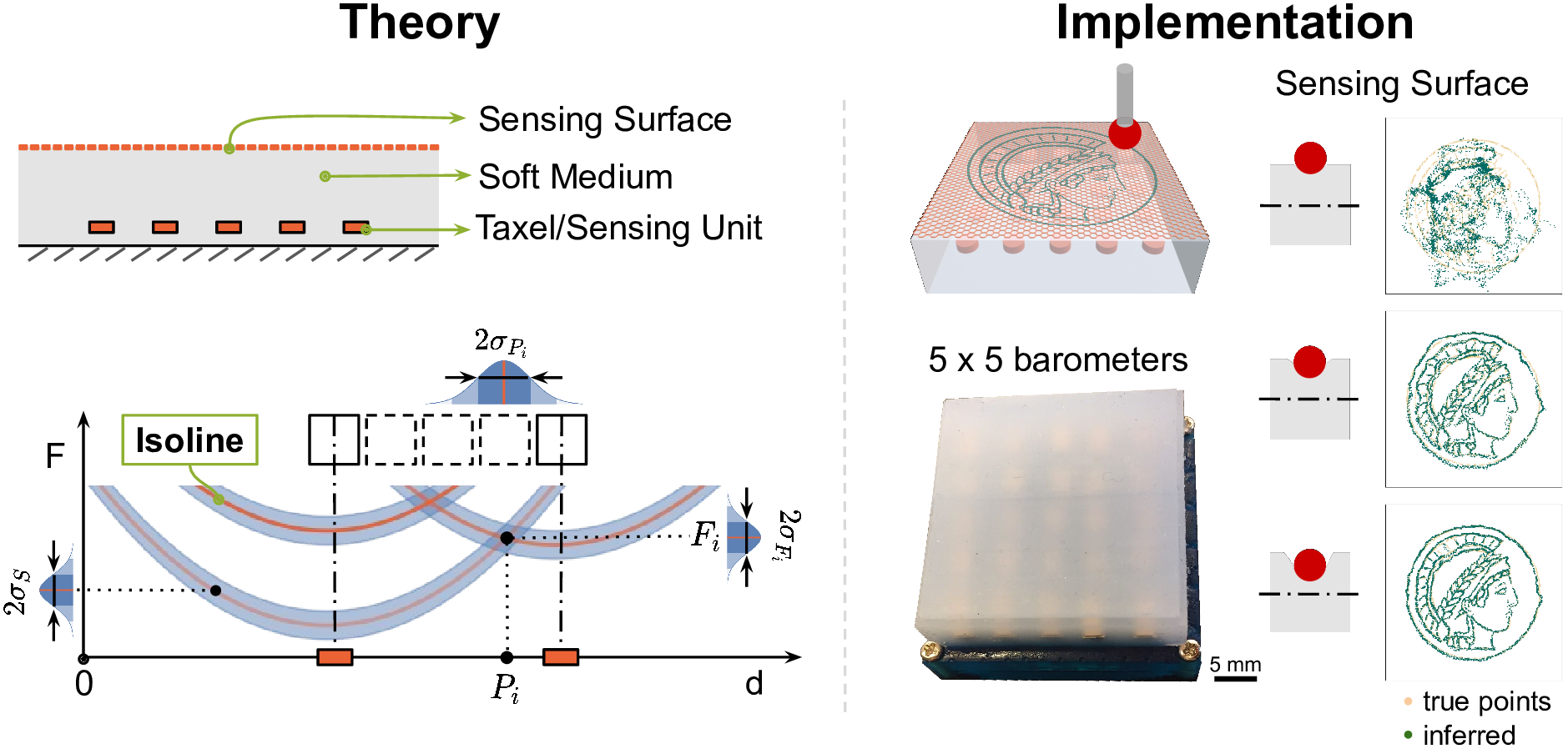
We introduce a theory to characterize, analyze, and predict force sensation at super-resolution for haptic sensors. Our theory is based on sensor isolines that directly assess the uniqueness of contact position reconstruction. A sensor design guided by this theory achieves a super-resolution factor of over 1200.

Members

Autonomous Learning
  • Doctoral Researcher
Empirical Inference, Autonomous Learning
Senior Research Scientist

Publications

Autonomous Learning Article Guiding the Design of Superresolution Tactile Skins with Taxel Value Isolines Theory Sun, H., Martius, G. Science Robotics, 7(63):eabm0608, February 2022 (Published)
Tactile feedback is essential to make robots more agile and effective in unstructured environments. However, high-resolution tactile skins are not widely available; this is due to the large size of robust sensing units and because many units typically lead to fragility in wiring and to high costs. One route toward high-resolution and robust tactile skins involves the embedding of a few sensor units (taxels) into a flexible surface material and the use of signal processing to achieve sensing with superresolution accuracy. Here, we propose a theory for geometric superresolution to guide the development of tactile sensors of this kind and link it to machine learning techniques for signal processing. This theory is based on sensor isolines and allows us to compute the possible force sensitivity and accuracy in contact position and force magnitude as a spatial quantity before building a sensor. We evaluate the influence of different factors, such as elastic properties of the material, structure design, and transduction methods, using finite element simulations and by implementing real sensors. We empirically determine sensor isolines and validate the theory in two custom-built sensors with 1D and 2D measurement surfaces that use barometric units. Using machine learning methods to infer contact information, our sensors obtain an average superresolution factor of over 100 and 1200, respectively. Our theory can guide future tactile sensor designs and inform various design choices. We propose a theory using taxel value isolines to guide superresolution tactile sensor design and evaluate it empirically.
Authors copy DOI URL BibTeX

Autonomous Learning Haptic Intelligence Robotics Patent Method for Force Inference of a Sensor Arrangement, Methods for Training Networks, Force Inference Module and Sensor Arrangement Sun, H., Martius, G., Lee, H., Spiers, A., Fiene, J. (PCT/EP2020/083261), Max Planck Institute for Intelligent Systems, Max Planck Ring 4, November 2020
The present invention relates to a method for force inference of a sensor arrangement, to related methods for training of networks, to a force inference module for performing such methods, and to a sensor arrangement for sensing forces. When developing applications such as robots, sensing of forces applied on a robot hand or another part of a robot such as a leg or a manipulation device is crucial in giving robots increased capabilities to move around and/or manipulate objects. Known implementations for sensor arrangements that can be used in robotic applications in order to have feedback with regard to applied forces are quite expensive and do not have sufficient resolution. Sensor arrangements may be used to measure forces. However, known sensor arrangements need a high density of sensors to provide for a high special resolution. It is thus an object of the present invention to provide for a method for force inference of a sensor arrangement and related methods that are different or optimized with regard to the prior art. It is a further object to provide for a force inference module to perform such methods. It is a further object to provide for a sensor arrangement for sensing forces with such a force inference module.
BibTeX

Autonomous Learning Article Machine Learning for Haptics: Inferring Multi-Contact Stimulation From Sparse Sensor Configuration Sun, H., Martius, G. Frontiers in Neurorobotics, 13:51, 2019
Robust haptic sensation systems are essential for obtaining dexterous robots. Currently, we have solutions for small surface areas such as fingers, but affordable and robust techniques for covering large areas of an arbitrary 3D surface are still missing. Here, we introduce a general machine learning framework to infer multi-contact haptic forces on a 3D robot’s limb surface from internal deformation measured by only a few physical sensors. The general idea of this framework is to predict first the whole surface deformation pattern from the sparsely placed sensors and then to infer number, locations and force magnitudes of unknown contact points. We show how this can be done even if training data can only be obtained for single-contact points using transfer learning at the example of a modified limb of the Poppy robot. With only 10 strain-gauge sensors we obtain a high accuracy also for multiple-contact points. The method can be applied to arbitrarily shaped surfaces and physical sensor types, as long as training data can be obtained.
DOI URL BibTeX

Autonomous Learning Conference Paper Robust Affordable 3D Haptic Sensation via Learning Deformation Patterns Sun, H., Martius, G. Proceedings International Conference on Humanoid Robots, 846-853, IEEE, New York, NY, USA, 2018 IEEE-RAS International Conference on Humanoid Robots, 2018, Oral Presentation
Haptic sensation is an important modality for interacting with the real world. This paper proposes a general framework of inferring haptic forces on the surface of a 3D structure from internal deformations using a small number of physical sensors instead of employing dense sensor arrays. Using machine learning techniques, we optimize the sensor number and their placement and are able to obtain high-precision force inference for a robotic limb using as few as 9 sensors. For the optimal and sparse placement of the measurement units (strain gauges), we employ data-driven methods based on data obtained by finite element simulation. We compare data-driven approaches with model-based methods relying on geometric distance and information criteria such as Entropy and Mutual Information. We validate our approach on a modified limb of the “Poppy” robot [1] and obtain 8 mm localization precision.
DOI BibTeX