Reinforcement Learning and Control
Model-based Reinforcement Learning and Planning
Causal Reasoning in RL
Intrinsically Motivated Hierarchical Learner
Regularity as Intrinsic Reward for Free Play
Curious Exploration via Structured World Models Yields Zero-Shot Object Manipulation
Natural and Robust Walking from Generic Rewards
Goal-conditioned Offline Planning
Offline Diversity Under Imitation Constraints
Learning Diverse Skills for Local Navigation
Learning Agile Skills via Adversarial Imitation of Rough Partial Demonstrations
Learning with Muscles
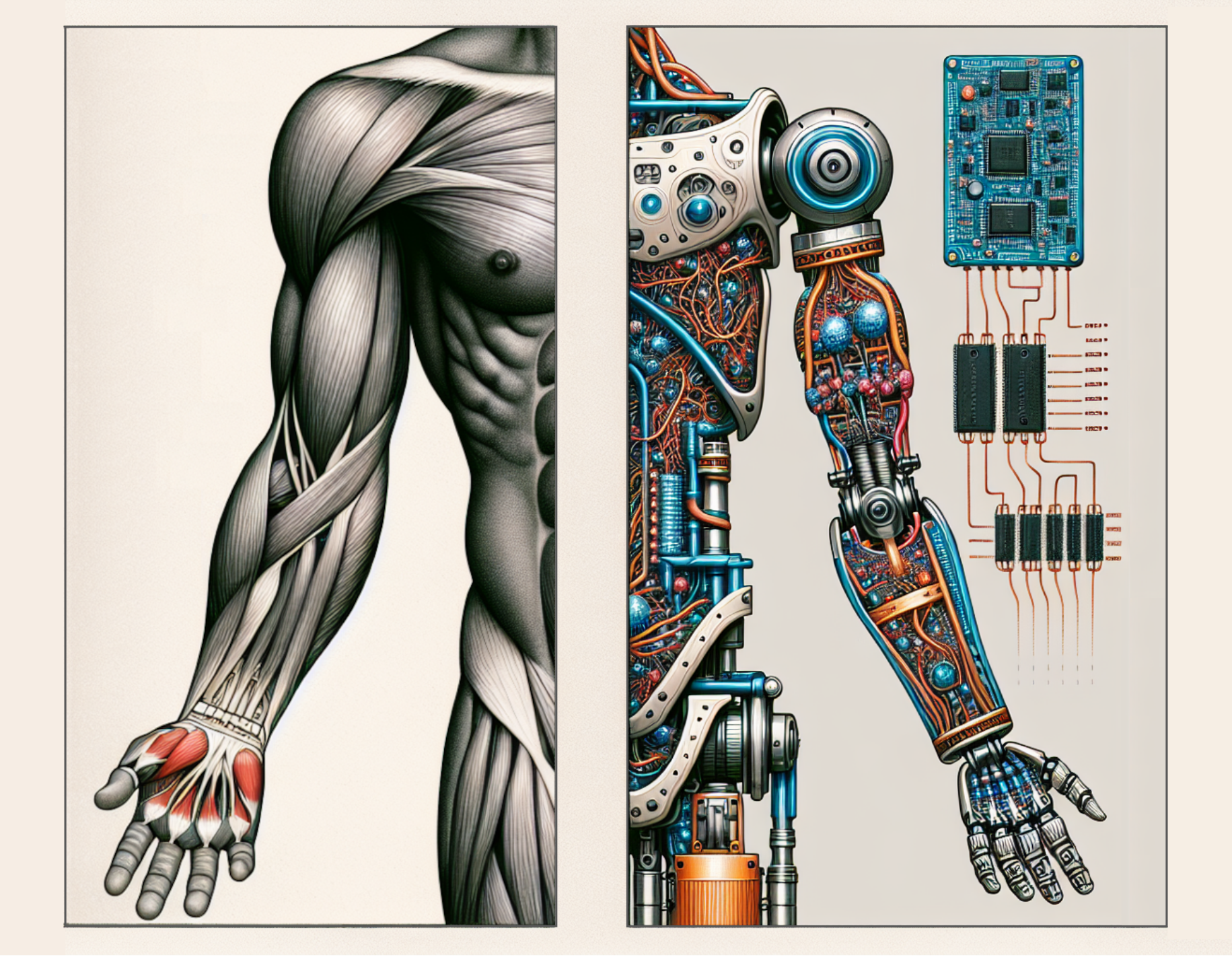
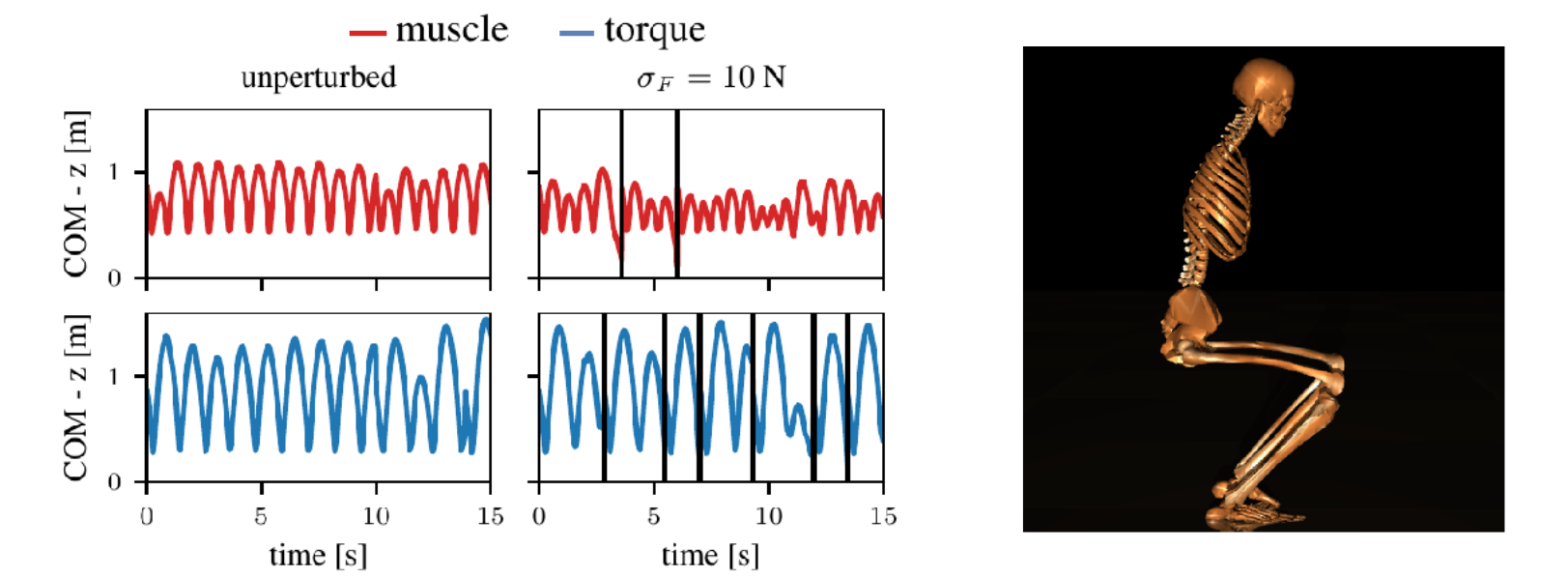
Biological systems rely on muscles for actuation. Do muscles offer advantages over electric motors when viewed through the lens of learning and closed-loop control of behavior? We explored this question and found that muscles can enhance learning speed and robustness, as demonstrated in [ ]. This research highlighted the significant potential of leveraging muscle actuator morphology for natural and robust motion, so far only validated in simulation.
How can these findings be applied to real robots? Currently, physical muscles are not mature or easy to integrate into robotic systems. In this study, we simulated muscle actuator properties in real time using affordable modern electric motors, allowing us to emulate a simplified muscle model on a real robot controlled by a learned policy. Our results suggest that artificial muscles could serve as highly advantageous actuators for future generations of robust legged robots. We continue to investigate which muscle properties are most critical for improving learning speed and behavioral robustness.
Understanding muscle control is critical not only for robotics, but also for advancing our understanding of human motor control. This has promising implications for the development of assistive devices and improved therapies for patients. Learning to control systems with the large number of degrees of freedom present in biological systems has been based primarily on imitation learning, which involves mimicking recorded biological data.
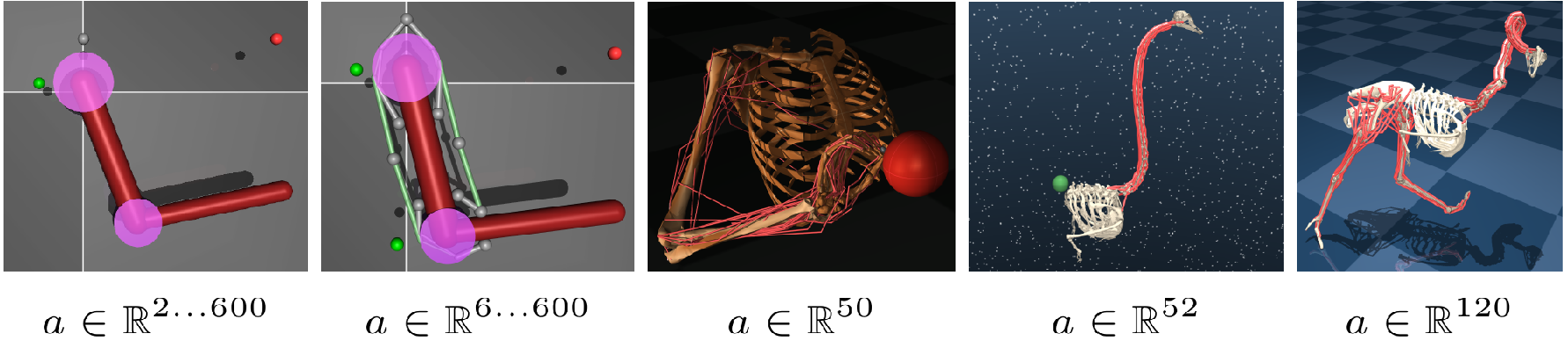
Developing exploration methods and reinforcement learning (RL) algorithms capable of scaling to simulated systems with many muscles was a major challenge we addressed. Our method was first applied to an ostrich and a simple humanoid model []. The effort paid off, as we can now achieve human-like walking in several high-dimensional muscle-driven models using only generic reward terms []. This paves the way for the analysis of muscle patterns in patients with deficits and for the joint optimization of assistive devices such as exoskeletons.