Back

Physical Intelligence Members Publications

Magnetically steerable bacterial microrobots moving in 3D biological matrices for stimuli-responsive cargo delivery
Members

Scientific Coordination Office
Robotics Institute Germany (RIG) Coordinator
Physical Intelligence
Post-doc at ETH Zurich, Switzerland
Physical Intelligence
Senior Research Scientist at Aselsan, Turkey
Scientific Coordination Office
Robotics Institute Germany (RIG) Coordinator
Physical Intelligence
  • Doctoral Researcher
Physical Intelligence

Publications

Physical Intelligence Article Motility and chemotaxis of bacteria-driven microswimmers fabricated using antigen 43-mediated biotin display Schauer, O., Mostaghaci, B., Colin, R., Hürtgen, D., Kraus, D., Sitti, M., Sourjik, V. Scientific Reports, 8(1):9801, Nature Publishing Group, June 2018
Bacteria-driven biohybrid microswimmers (bacteriabots) combine synthetic cargo with motile living bacteria that enable propulsion and steering. Although fabrication and potential use of such bacteriabots have attracted much attention, existing methods of fabrication require an extensive sample preparation that can drastically decrease the viability and motility of bacteria. Moreover, chemotactic behavior of bacteriabots in a liquid medium with chemical gradients has remained largely unclear. To overcome these shortcomings, we designed Escherichia coli to autonomously display biotin on its cell surface via the engineered autotransporter antigen 43 and thus to bind streptavidin-coated cargo. We show that the cargo attachment to these bacteria is greatly enhanced by motility and occurs predominantly at the cell poles, which is greatly beneficial for the fabrication of motile bacteriabots. We further performed a systemic study to understand and optimize the ability of these bacteriabots to follow chemical gradients. We demonstrate that the chemotaxis of bacteriabots is primarily limited by the cargo-dependent reduction of swimming speed and show that the fabrication of bacteriabots using elongated E. coli cells can be used to overcome this limitation.
DOI URL BibTeX

Physical Intelligence Article Soft erythrocyte-based bacterial microswimmers for cargo delivery Alapan, Y., Yasa, O., Schauer, O., Giltinan, J., Tabak, A. F., Sourjik, V., Sitti, M. Science Robotics, 3(17):eaar4423, Science Robotics, April 2018
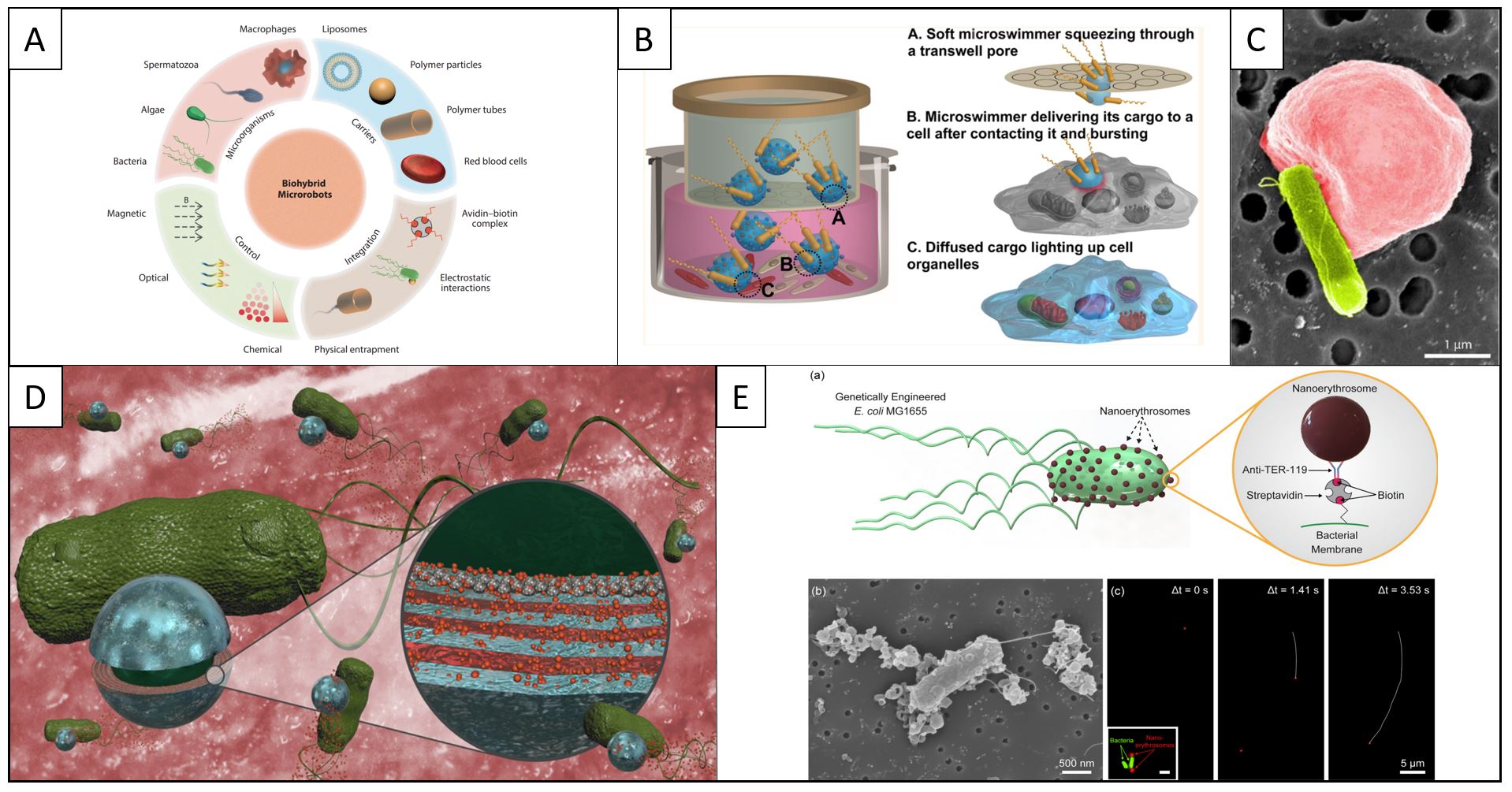
Bacteria-propelled biohybrid microswimmers have recently shown to be able to actively transport and deliver cargos encapsulated into their synthetic constructs to specific regions locally. However, usage of synthetic materials as cargo carriers can result in inferior performance in load-carrying efficiency, biocompatibility, and biodegradability, impeding clinical translation of biohybrid microswimmers. Here, we report construction and external guidance of bacteria-driven microswimmers using red blood cells (RBCs; erythrocytes) as autologous cargo carriers for active and guided drug delivery. Multifunctional biohybrid microswimmers were fabricated by attachment of RBCs [loaded with anticancer doxorubicin drug molecules and superparamagnetic iron oxide nanoparticles (SPIONs)] to bioengineered motile bacteria, Escherichia coli MG1655, via biotin-avidin-biotin binding complex. Autonomous and on-board propulsion of biohybrid microswimmers was provided by bacteria, and their external magnetic guidance was enabled by SPIONs loaded into the RBCs. Furthermore, bacteria-driven RBC microswimmers displayed preserved deformability and attachment stability even after squeezing in microchannels smaller than their sizes, as in the case of bare RBCs. In addition, an on-demand light-activated hyperthermia termination switch was engineered for RBC microswimmers to control bacteria population after operations. RBCs, as biological and autologous cargo carriers in the biohybrid microswimmers, offer notable advantages in stability, deformability, biocompatibility, and biodegradability over synthetic cargo-carrier materials. The biohybrid microswimmer design presented here transforms RBCs from passive cargo carriers into active and guidable cargo carriers toward targeted drug and other cargo delivery applications in medicine.
DOI URL BibTeX

Physical Intelligence Theory of Inhomogeneous Condensed Matter Article Magnetotactic bacteria powered biohybrids target e. coli biofilms Stanton, M. M., Park, B., Vilela, D., Bente, K., Faivre, D., Sitti, M., Sánchez, S. ACS Nano, 11(10):9968-9978, September 2017
Biofilm colonies are typically resistant to general antibiotic treatment and require targeted methods for their removal. One of these methods includes the use of nanoparticles as carriers for antibiotic delivery, where they randomly circulate in fluid until they make contact with the infected areas. However, the required proximity of the particles to the biofilm results in only moderate efficacy. We demonstrate here that the nonpathogenic magnetotactic bacteria Magnetosopirrillum gryphiswalense (MSR-1) can be integrated with drug-loaded mesoporous silica microtubes to build controllable microswimmers (biohybrids) capable of antibiotic delivery to target an infectious biofilm. Applying external magnetic guidance capability and swimming power of the MSR-1 cells, the biohybrids are directed to and forcefully pushed into matured Escherichia coli (E. coli) biofilms. Release of the antibiotic, ciprofloxacin, is triggered by the acidic microenvironment of the biofilm, ensuring an efficient drug delivery system. The results reveal the capabilities of a nonpathogenic bacteria species to target and dismantle harmful biofilms, indicating biohybrid systems have great potential for antibiofilm applications.
DOI BibTeX

Physical Intelligence Article Multifunctional bacteria-driven microswimmers for targeted active drug delivery Park, B., Zhuang, J., Yasa, O., Sitti, M. ACS Nano, 11(9):8910-8923, September 2017
High-performance, multifunctional bacteria-driven microswimmers are introduced using an optimized design and fabrication method for targeted drug delivery applications. These microswimmers are made of mostly single Escherichia coli bacterium attached to the surface of drug-loaded polyelectrolyte multilayer (PEM) microparticles with embedded magnetic nanoparticles. The PEM drug carriers are 1 μm in diameter and are intentionally fabricated with a more viscoelastic material than the particles previously studied in the literature. The resulting stochastic microswimmers are able to swim at mean speeds of up to 22.5 μm/s. They can be guided and targeted to specific cells, because they exhibit biased and directional motion under a chemoattractant gradient and a magnetic field, respectively. Moreover, we demonstrate the microswimmers delivering doxorubicin anticancer drug molecules, encapsulated in the polyelectrolyte multilayers, to 4T1 breast cancer cells under magnetic guidance in vitro. The results reveal the feasibility of using these active multifunctional bacteria-driven microswimmers to perform targeted drug delivery with significantly enhanced drug transfer, when compared with the passive PEM microparticles.
DOI BibTeX

Physical Intelligence Article Bioadhesive Bacterial Microswimmers for Targeted Drug Delivery in the Urinary and Gastrointestinal Tracts Mostaghaci, B., Yasa, O., Zhuang, J., Sitti, M. Advanced Science, 4(6):1700058, May 2017
Bacteria-driven biohybrid microswimmers (bacteriabots), which integrate motile bacterial cells and functional synthetic cargo parts (e.g., microparticles encapsulating drug), are recently studied for targeted drug delivery. However, adhesion of such bacteriabots to the tissues on the site of a disease (which can increase the drug delivery efficiency) is not studied yet. Here, this paper proposes an approach to attach bacteriabots to certain types of epithelial cells (expressing mannose on the membrane), based on the affinity between lectin molecules on the tip of bacterial type I pili and mannose molecules on the epithelial cells. It is shown that the bacteria can anchor their cargo particles to mannose-functionalized surfaces and mannose-expressing cells (ATCC HTB-9) using the lectin–mannose bond. The attachment mechanism is confirmed by comparing the adhesion of bacteriabots fabricated from bacterial strains with or without type I pili to mannose-covered surfaces and cells. The proposed bioadhesive motile system can be further improved by expressing more specific adhesion moieties on the membrane of the bacteria.
DOI BibTeX

Physical Intelligence Article Propulsion and Chemotaxis in Bacteria-Driven Microswimmers Zhuang, J., Park, B., Sitti, M. Advanced Science, 4(9):1700109, May 2017
Despite the large body of experimental work recently on biohybrid microsystems, few studies have focused on theoretical modeling of such systems, which is essential to understand their underlying functioning mechanisms and hence design them optimally for a given application task. Therefore, this study focuses on developing a mathematical model to describe the 3D motion and chemotaxis of a type of widely studied biohybrid microswimmer, where spherical microbeads are driven by multiple attached bacteria. The model is developed based on the biophysical observations of the experimental system and is validated by comparing the model simulation with experimental 3D swimming trajectories and other motility characteristics, including mean squared displacement, speed, diffusivity, and turn angle. The chemotaxis modeling results of the microswimmers also agree well with the experiments, where a collective chemotactic behavior among multiple bacteria is observed. The simulation result implies that such collective chemotaxis behavior is due to a synchronized signaling pathway across the bacteria attached to the same microswimmer. Furthermore, the dependencies of the motility and chemotaxis of the microswimmers on certain system parameters, such as the chemoattractant concentration gradient, swimmer body size, and number of attached bacteria, toward an optimized design of such biohybrid system are studied. The optimized microswimmers would be used in targeted cargo, e.g., drug, imaging agent, gene, and RNA, transport and delivery inside the stagnant or low-velocity fluids of the human body as one of their potential biomedical applications.
DOI BibTeX

Physical Intelligence Theory of Inhomogeneous Condensed Matter Article Biohybrid microtube swimmers driven by single captured bacteria Stanton, M. M., Park, B., Miguel-López, A., Ma, X., Sitti, M., Sánchez, S. Small, 13(19):1603679, March 2017
Bacteria biohybrids employ the motility and power of swimming bacteria to carry and maneuver microscale particles. They have the potential to perform microdrug and cargo delivery in vivo, but have been limited by poor design, reduced swimming capabilities, and impeded functionality. To address these challenge, motile Escherichia coli are captured inside electropolymerized microtubes, exhibiting the first report of a bacteria microswimmer that does not utilize a spherical particle chassis. Single bacterium becomes partially trapped within the tube and becomes a bioengine to push the microtube though biological media. Microtubes are modified with “smart” material properties for motion control, including a bacteria-attractant polydopamine inner layer, addition of magnetic components for external guidance, and a biochemical kill trigger to cease bacterium swimming on demand. Swimming dynamics of the bacteria biohybrid are quantified by comparing “length of protrusion” of bacteria from the microtubes with respect to changes in angular autocorrelation and swimmer mean squared displacement. The multifunctional microtubular swimmers present a new generation of biocompatible micromotors toward future microbiorobots and minimally invasive medical applications.
DOI BibTeX

Physical Intelligence Article Microemulsion-Based Soft Bacteria-Driven Microswimmers for Active Cargo Delivery Singh, A. V., Hosseinidoust, Z., Park, B., Yasa, O., Sitti, M. ACS Nano, 11(10):9759-9769, 2017
Biohybrid cell-driven microsystems offer unparalleled possibilities for realization of soft microrobots at the micron scale. Here, we introduce a bacteria-driven microswimmer that combines the active locomotion and sensing capabilities of bacteria with the desirable encapsulation and viscoelastic properties of a soft double-micelle microemulsion for active transport and delivery of cargo (e.g., imaging agents, genes, and drugs) to living cells. Quasi-monodisperse double emulsions were synthesized with an aqueous core that encapsulated the fluorescence imaging agents, as a proof-of-concept cargo in this study, and an outer oil shell that was functionalized with streptavidin for specific and stable attachment of biotin-conjugated Escherichia coli. Motile bacteria effectively propelled the soft microswimmers across a Transwell membrane, actively delivering imaging agents (i.e., dyes) encapsulated inside of the micelles to a monolayer of cultured MCF7 breast cancer and J744A.1 macrophage cells, which enabled real-time, live-cell imaging of cell organelles, namely mitochondria, endoplasmic reticulum, and Golgi body. This in vitro model demonstrates the proof-of-concept feasibility of the proposed soft microswimmers and offers promise for potential biomedical applications in active and/or targeted transport and delivery of imaging agents, drugs, stem cells, siRNA, and therapeutic genes to live tissue in in vitro disease models (e.g., organ-on-a-chip devices) and stagnant or low-flow-velocity fluidic regions of the human body.
DOI BibTeX

Physical Intelligence Article Bacteria-Driven Particles: Patterned and Specific Attachment of Bacteria on Biohybrid Bacteria-Driven Microswimmers (Adv. Healthcare Mater. 18/2016) Singh, A. V., Sitti, M. Advanced Healthcare Materials, 5(18):2306-2306, September 2016
On page 2325, Ajay Vikram Singh and Metin Sitti propose a facile surface patterning technique and a specific, strong biotin–streptavidin bonding of bacteria on patterned surfaces to fabricate Janus particles that are propelled by the attached bacteria. Such bacteria-driven Janus microswimmers could be used for future medicine in targeted drug delivery and environmental remediation.
DOI BibTeX

Physical Intelligence Article Chemotaxis of bio-hybrid multiple bacteria-driven microswimmers Zhuang, J., Sitti, M. Scientific reports, 6(1):1-10, March 2016
In this study, in a bio-hybrid microswimmer system driven by multiple Serratia marcescens bacteria, we quantify the chemotactic drift of a large number of microswimmers towards L-serine and elucidate the associated collective chemotaxis behavior by statistical analysis of over a thousand swimming trajectories of the microswimmers. The results show that the microswimmers have a strong heading preference for moving up the L-serine gradient, while their speed does not change considerably when moving up and down the gradient; therefore, the heading bias constitutes the major factor that produces the chemotactic drift. The heading direction of a microswimmer is found to be significantly more persistent when it moves up the L-serine gradient than when it travels down the gradient; this effect causes the apparent heading preference of the microswimmers and is the crucial reason that enables the seemingly cooperative chemotaxis of multiple bacteria on a microswimmer. In addition, we find that their chemotactic drift velocity increases superquadratically with their mean swimming speed, suggesting that chemotaxis of bio-hybrid microsystems can be enhanced by designing and building faster microswimmers. Such bio-hybrid microswimmers with chemotactic steering capability may find future applications in targeted drug delivery, bioengineering, and lab-on-a-chip devices.
DOI BibTeX

Physical Intelligence Article pH-taxis of biohybrid microsystems Zhuang, J., Carlsen, R. W., Sitti, M. Scientific reports, 5, Nature Publishing Group, June 2015
The last decade has seen an increasing number of studies developing bacteria and other cell-integrated biohybrid microsystems. However, the highly stochastic motion of these microsystems severely limits their potential use. Here, we present a method that exploits the pH sensing of flagellated bacteria to realize robust drift control of multi-bacteria propelled microrobots. Under three specifically configured pH gradients, we demonstrate that the microrobots exhibit both unidirectional and bidirectional pH-tactic behaviors, which are also observed in free-swimming bacteria. From trajectory analysis, we find that the swimming direction and speed biases are two major factors that contribute to their tactic drift motion. The motion analysis of microrobots also sheds light on the propulsion dynamics of the flagellated bacteria as bioactuators. It is expected that similar driving mechanisms are shared among pH-taxis, chemotaxis, and thermotaxis. By identifying the mechanism that drives the tactic behavior of bacteria-propelled microsystems, this study opens up an avenue towards improving the control of biohybrid microsystems. Furthermore, assuming that it is possible to tune the preferred pH of bioactuators by genetic engineering, these biohybrid microsystems could potentially be applied to sense the pH gradient induced by cancerous cells in stagnant fluids inside human body and realize targeted drug delivery.
DOI BibTeX

Physical Intelligence Article Analytical modeling and experimental characterization of chemotaxis in serratia marcescens Zhuang, J., Wei, G., Carlsen, R. W., Edwards, M. R., Marculescu, R., Bogdan, P., Sitti, M. Physical Review E, 89(5):052704, American Physical Society, 2014 BibTeX

Physical Intelligence Article Bio-Hybrid Cell-Based Actuators for Microsystems Carlsen, R. W., Sitti, M. Small, 10(19):3831-3851, 2014
As we move towards the miniaturization of devices to perform tasks at the nano and microscale, it has become increasingly important to develop new methods for actuation, sensing, and control. Over the past decade, bio-hybrid methods have been investigated as a promising new approach to overcome the challenges of scaling down robotic and other functional devices. These methods integrate biological cells with artificial components and therefore, can take advantage of the intrinsic actuation and sensing functionalities of biological cells. Here, the recent advancements in bio-hybrid actuation are reviewed, and the challenges associated with the design, fabrication, and control of bio-hybrid microsystems are discussed. As a case study, focus is put on the development of bacteria-driven microswimmers, which has been investigated as a targeted drug delivery carrier. Finally, a future outlook for the development of these systems is provided. The continued integration of biological and artificial components is envisioned to enable the performance of tasks at a smaller and smaller scale in the future, leading to the parallel and distributed operation of functional systems at the microscale.
DOI URL BibTeX

Physical Intelligence Article Magnetic steering control of multi-cellular bio-hybrid microswimmers Carlsen, R. W., Edwards, M. R., Zhuang, J., Pacoret, C., Sitti, M. Lab on a Chip, 14(19):3850-3859, Royal Society of Chemistry, 2014 BibTeX

Physical Intelligence Article Near and far-wall effects on the three-dimensional motion of bacteria-driven microbeads Edwards, M. R., Wright Carlsen, R., Sitti, M. Applied Physics Letters, 102(14):143701, AIP, 2013 BibTeX

Physical Intelligence Article Chemotactic steering of bacteria propelled microbeads Kim, D., Liu, A., Diller, E., Sitti, M. Biomedical microdevices, 14(6):1009-1017, Springer US, 2012 BibTeX

Physical Intelligence Conference Paper Chemotactic behavior and dynamics of bacteria propelled microbeads Kim, D., Liu, A., Stitti, M. In Intelligent Robots and Systems (IROS), 2011 IEEE/RSJ International Conference on, 1674-1679, 2011 BibTeX

Physical Intelligence Conference Paper Micro-scale propulsion using multiple flexible artificial flagella Singleton, J., Diller, E., Andersen, T., Regnier, S., Sitti, M. In Intelligent Robots and Systems (IROS), 2011 IEEE/RSJ International Conference on, 1687-1692, 2011 BibTeX

Physical Intelligence Article Modeling of stochastic motion of bacteria propelled spherical microbeads Arabagi, V., Behkam, B., Cheung, E., Sitti, M. Journal of Applied Physics, 109(11):114702, AIP, 2011 BibTeX

Physical Intelligence Conference Paper Bacterial flagella assisted propulsion of patterned latex particles: Effect of particle size Behkam, B., Sitti, M. In Nanotechnology, 2007. IEEE-NANO 2007. 7th IEEE Conference on, 723-727, 2007 BibTeX

Physical Intelligence Article Design methodology for biomimetic propulsion of miniature swimming robots Behkam, B., Sitti, M. Trans.-ASME Journal of Dynamic Systems Measurement and Control, 128(1):36, ASME, 2006 BibTeX

Physical Intelligence Conference Paper Towards hybrid swimming microrobots: bacteria assisted propulsion of polystyrene beads Behkam, B., Sitti, M. In Engineering in Medicine and Biology Society, 2006. EMBS’06. 28th Annual International Conference of the IEEE, 2421-2424, 2006 BibTeX

Physical Intelligence Conference Paper E. coli inspired propulsion for swimming microrobots Behkam, B., Sitti, M. In ASME 2004 International Mechanical Engineering Congress and Exposition, 1037-1041, 2004 BibTeX

Physical Intelligence Conference Paper Biomimetic propulsion for a swimming surgical micro-robot Edd, J., Payen, S., Rubinsky, B., Stoller, M. L., Sitti, M. In Intelligent Robots and Systems, 2003.(IROS 2003). Proceedings. 2003 IEEE/RSJ International Conference on, 3:2583-2588, 2003 BibTeX