Reinforcement Learning and Control
Model-based Reinforcement Learning and Planning
Causal Reasoning in RL
Intrinsically Motivated Hierarchical Learner
Regularity as Intrinsic Reward for Free Play
Curious Exploration via Structured World Models Yields Zero-Shot Object Manipulation
Natural and Robust Walking from Generic Rewards
Goal-conditioned Offline Planning
Offline Diversity Under Imitation Constraints
Learning Diverse Skills for Local Navigation
Learning Agile Skills via Adversarial Imitation of Rough Partial Demonstrations
Representation Learning
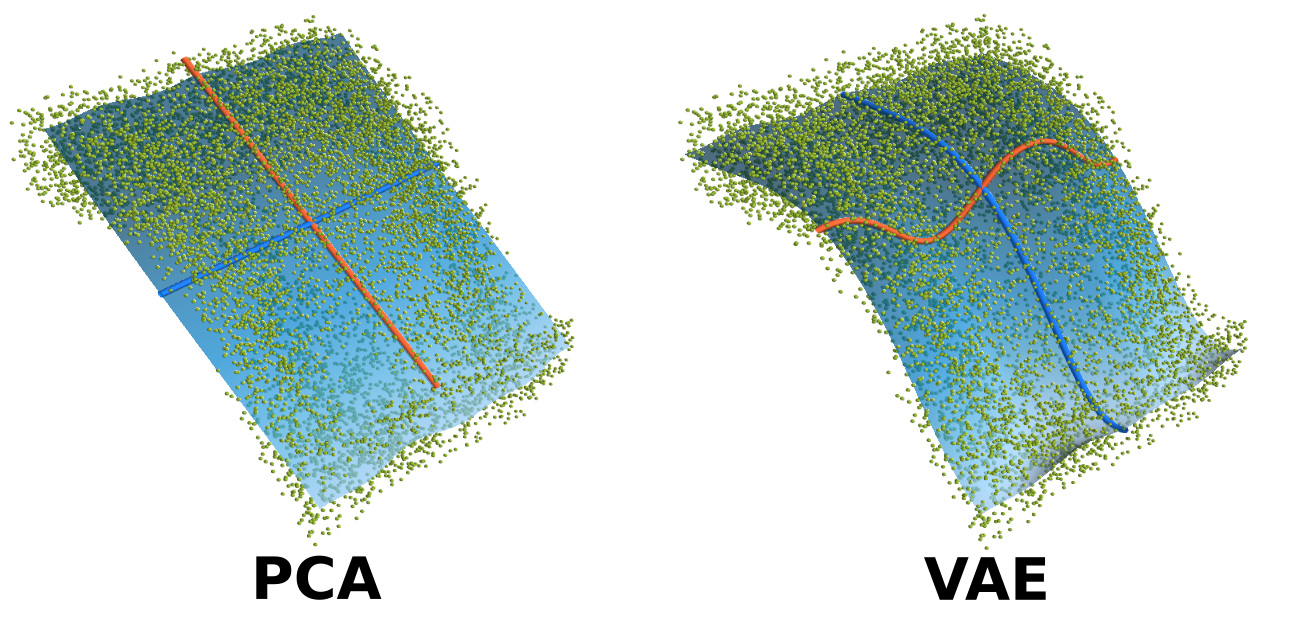
Learning meaningful, low-dimensional representations of data is a challenging problem. Particularly for an autonomously learning system, representations learned from observations can play a crucial role. Consider for example a system that receives many images of faces and is capable of finding out that there are common factors explaining most of the visible characteristics, such as gender, or hair color. Variational Autoencoders (VAEs) can do this to an astonishing extent, but it was unclear why VAEs actually have this ability. We found that the reason is a byproduct of simplifying the learning objective to make the method tractable and suitable for applications [ ]. Interestingly, this insight allowed us to connect VAEs to the classical method of principle component analysis. Furthermore, we then used this understanding to demonstrate that VAEs solely rely on the consistency of local structures in the datasets. In particular, we show that adding small elaborate perturbations to existing datasets prevent the VAE on picking up such convenient structures, yielding new insights into which types of inductive biases and weak supervisions can reliably improve the quality of learned representations []. In the future, we hope to utilize this knowledge for further advances in general data analysis.
Members



Publications