Lawma: The Power of Specialization for Legal Tasks
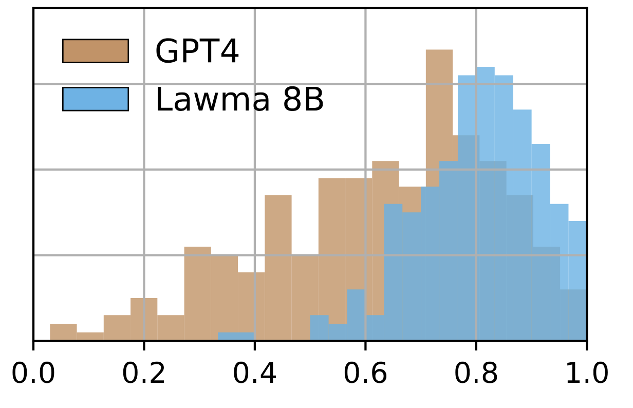
Caption: Distribution of accuracy across all tasks for GPT4 and Lawma. Lawma achieves mean accuracy of 82%, whereas GPT-4 achieves mean accuracy 62%.

A lightly finetuned Llama-3 model vastly outperforms GPT-4 on more than 100 annotation tasks take from the U.S. Supreme Court and U.S. Appeals Courts database.
Members
Empirical Inference, Social Foundations of Computation
Annotation and classification of legal text are central components of empirical legal research. Traditionally, these tasks are often delegated to trained research assistants. Motivated by the advances in language modeling, empirical legal scholars are increasingly turning to prompting commercial models, hoping that it will alleviate the significant cost of human annotation. Despite growing use, our understanding of how to best utilize large language models for legal tasks remains limited. We conduct a comprehensive study of 260 legal text classification tasks, nearly all new to the machine learning community. Starting from GPT-4 as a baseline, we show that it has non-trivial but highly varied zero-shot accuracy, often exhibiting performance that may be insufficient for legal work. We then demonstrate that a lightly fine-tuned Llama 3 model vastly outperforms GPT-4 on almost all tasks, typically by double-digit percentage points. We find that larger models respond better to fine-tuning than smaller models. A few tens to hundreds of examples suffice to achieve high classification accuracy. Notably, we can fine-tune a single model on all 260 tasks simultaneously at a small loss in accuracy relative to having a separate model for each task. Our work points to a viable alternative to the predominant practice of prompting commercial models. For concrete legal tasks with some available labeled data, researchers are better off using a fine-tuned open-source model.