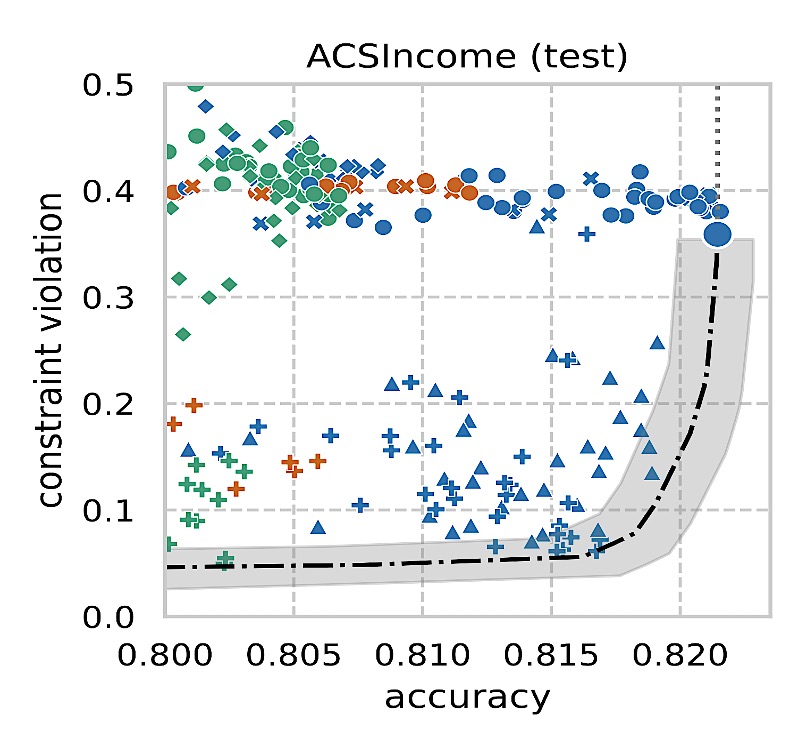
Example result showing the accuracy-fairness Pareto frontier achieved by postprocessing (dashed black line) contains all other methods.
This work takes a look at numerous algorithmic fairness methods published since 2016. After introducing a methodology, called unprocessing, that puts different methods on a level playing field, this computationally intensive meta study bears out a clear result: The simple “postprocessing” method of setting group specific thresholds works best.
Seven years ago, researchers proposed a postprocessing method to equalize the error rates of a model across different demographic groups. The work launched hundreds of papers purporting to improve over the postprocessing baseline. We empirically evaluate these claims through thousands of model evaluations on several tabular datasets. We find that the fairness-accuracy Pareto frontier achieved by postprocessing contains all other methods we were feasibly able to evaluate. In doing so, we address two common methodological errors that have confounded previous observations. One relates to the comparison of methods with different unconstrained base models. The other concerns methods achieving different levels of constraint relaxation. At the heart of our study is a simple idea we call unprocessing that roughly corresponds to the inverse of postprocessing. Unprocessing allows for a direct comparison of methods using different underlying models and levels of relaxation. Interpreting our findings, we recall a widely overlooked theoretical argument, present seven years ago, that accurately predicted what we observe.