Publications

DEPARTMENTS

Emperical Interference

Haptic Intelligence

Modern Magnetic Systems

Perceiving Systems

Physical Intelligence

Robotic Materials

Social Foundations of Computation


Research Groups

Autonomous Vision

Autonomous Learning

Bioinspired Autonomous Miniature Robots

Dynamic Locomotion

Embodied Vision

Human Aspects of Machine Learning

Intelligent Control Systems

Learning and Dynamical Systems

Locomotion in Biorobotic and Somatic Systems

Micro, Nano, and Molecular Systems

Movement Generation and Control

Neural Capture and Synthesis

Physics for Inference and Optimization

Organizational Leadership and Diversity

Probabilistic Learning Group


Topics

Robot Learning

Conference Paper

2022

Autonomous Learning

Robotics

AI

Career

Award

Perceiving Systems Ph.D. Thesis Whole-Body Motion Capture and Beyond: From Model-Based Inference to Learning-Based Regression Huang, Y. University of Tübingen, December 2022 (Published)
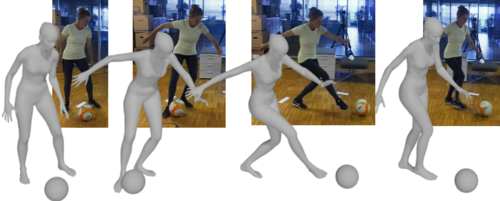
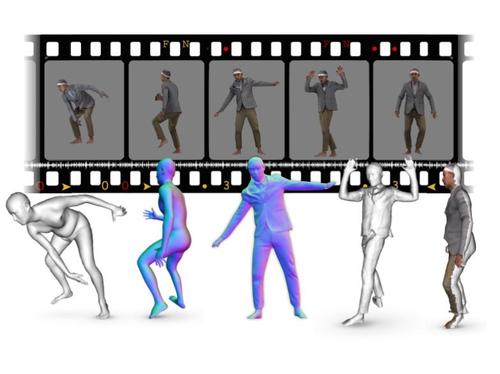
Though effective and successful, traditional marker-less Motion Capture (MoCap) methods suffer from several limitations: 1) they presume a character-specific body model, thus they do not permit a fully automatic pipeline and generalization over diverse body shapes; 2) no objects humans interact with are tracked, while in reality interaction between humans and objects is ubiquitous; 3) they heavily rely on a sophisticated optimization process, which needs a good initialization and strong priors. This process can be slow. We address all the aforementioned issues in this thesis, as described below. Firstly we propose a fully automatic method to accurately reconstruct a 3D human body from multi-view RGB videos, the typical setup for MoCap systems. We pre-process all RGB videos to obtain 2D keypoints and silhouettes. Then we fit the SMPL body model into the 2D measurements in two successive stages. In the first stage, the shape and pose parameters of SMPL are estimated frame-wise sequentially. In the second stage, a batch of frames are refined jointly with an extra DCT prior. Our method can naturally handle different body shapes and challenging poses without human intervention. Then we extend this system to support tracking of rigid objects the subjects interact with. Our setup consists of 6 Azure Kinect cameras. Firstly we pre-process all the videos by segmenting humans and objects and detecting 2D body joints. We adopt the SMPL-X model here to capture body and hand pose. The model is fitted to 2D keypoints and point clouds. Then the body poses and object poses are jointly updated with contact and interpenetration constraints. With this approach, we capture a novel human-object interaction dataset with natural RGB images and plausible body and object motion information. Lastly, we present the first practical and lightweight MoCap system that needs only 6 IMUs. Our approach is based on Bi-directional RNNs. The network can make use of temporal information by jointly reasoning about past and future IMU measurements. To handle the data scarcity issue, we create synthetic data from archival MoCap data. Overall, our system runs ten times faster than traditional optimization-based methods, and is numerically more accurate. We also show it is feasible to estimate which activity the subject is doing by only observing the IMU measurement from a smartwatch worn by the subject. This not only can be useful for a high-level semantic understanding of the human behavior, but also alarms the public of potential privacy concerns. In summary, we advance marker-less MoCap by contributing the first automatic yet accurate system, extending the MoCap methods to support rigid object tracking, and proposing a practical and lightweight algorithm via 6 IMUs. We believe our work makes marker-less and IMUs-based MoCap cheaper and more practical, thus closer to end-users for daily usage.
download Thesis DOI BibTeX
Thumb ticker lg huang thesis

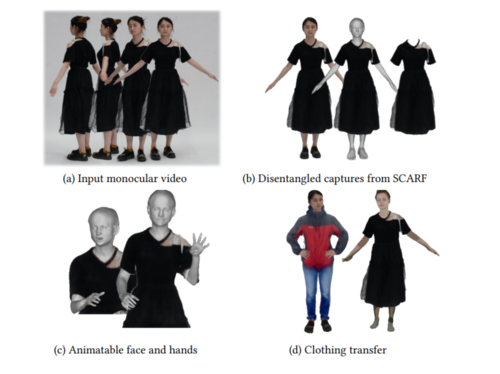
Perceiving Systems Conference Paper Capturing and Animation of Body and Clothing from Monocular Video Feng, Y., Yang, J., Pollefeys, M., Black, M. J., Bolkart, T. In Proceedings SIGGRAPH Asia 2022 Conference Papers Proceedings (SA ’22 2022) , Association for Computing Machinery, New York, NY, SIGGRAPH Asia 2022 (SA '22) , December 2022 (Published)
We propose SCARF (Segmented Clothed Avatar Radiance Field), a hybrid model combining a mesh-based body with a neural radiance field. Integrating the mesh into the volumetric rendering in combination with a differentiable rasterizer enables us to optimize SCARF directly from monocular videos, without any 3D supervision. The hybrid modeling enables SCARF to (i) animate the clothed body avatar by changing body poses (including hand articulation and facial expressions), (ii) synthesize novel views of the avatar, and (iii) transfer clothing between avatars in virtual try-on applications. We demonstrate that SCARF reconstructs clothing with higher visual quality than existing methods, that the clothing deforms with changing body pose and body shape, and that clothing can be successfully transferred between avatars of different subjects.
project code pdf DOI URL BibTeX
Thumb ticker lg teaser 2col

Perceiving Systems Ph.D. Thesis Reconstructing Expressive 3D Humans from RGB Images Choutas, V. ETH Zurich, Max Planck Institute for Intelligent Systems and ETH Zurich, December 2022 (Published)
To interact with our environment, we need to adapt our body posture and grasp objects with our hands. During a conversation our facial expressions and hand gestures convey important non-verbal cues about our emotional state and intentions towards our fellow speakers. Thus, modeling and capturing 3D full-body shape and pose, hand articulation and facial expressions are necessary to create realistic human avatars for augmented and virtual reality. This is a complex task, due to the large number of degrees of freedom for articulation, body shape variance, occlusions from objects and self-occlusions from body parts, e.g. crossing our hands, and subject appearance. The community has thus far relied on expensive and cumbersome equipment, such as multi-view cameras or motion capture markers, to capture the 3D human body. While this approach is effective, it is limited to a small number of subjects and indoor scenarios. Using monocular RGB cameras would greatly simplify the avatar creation process, thanks to their lower cost and ease of use. These advantages come at a price though, since RGB capture methods need to deal with occlusions, perspective ambiguity and large variations in subject appearance, in addition to all the challenges posed by full-body capture. In an attempt to simplify the problem, researchers generally adopt a divide-and-conquer strategy, estimating the body, face and hands with distinct methods using part-specific datasets and benchmarks. However, the hands and face constrain the body and vice-versa, e.g. the position of the wrist depends on the elbow, shoulder, etc.; the divide-and-conquer approach can not utilize this constraint. In this thesis, we aim to reconstruct the full 3D human body, using only readily accessible monocular RGB images. In a first step, we introduce a parametric 3D body model, called SMPL-X, that can represent full-body shape and pose, hand articulation and facial expression. Next, we present an iterative optimization method, named SMPLify-X, that fits SMPL-X to 2D image keypoints. While SMPLify-X can produce plausible results if the 2D observations are sufficiently reliable, it is slow and susceptible to initialization. To overcome these limitations, we introduce ExPose, a neural network regressor, that predicts SMPL-X parameters from an image using body-driven attention, i.e. by zooming in on the hands and face, after predicting the body. From the zoomed-in part images, dedicated part networks predict the hand and face parameters. ExPose combines the independent body, hand, and face estimates by trusting them equally. This approach though does not fully exploit the correlation between parts and fails in the presence of challenges such as occlusion or motion blur. Thus, we need a better mechanism to aggregate information from the full body and part images. PIXIE uses neural networks called moderators that learn to fuse information from these two image sets before predicting the final part parameters. Overall, the addition of the hands and face leads to noticeably more natural and expressive reconstructions. Creating high fidelity avatars from RGB images requires accurate estimation of 3D body shape. Although existing methods are effective at predicting body pose, they struggle with body shape. We identify the lack of proper training data as the cause. To overcome this obstacle, we propose to collect internet images from fashion models websites, together with anthropometric measurements. At the same time, we ask human annotators to rate images and meshes according to a pre-defined set of linguistic attributes. We then define mappings between measurements, linguistic shape attributes and 3D body shape. Equipped with these mappings, we train a neural network regressor, SHAPY, that predicts accurate 3D body shapes from a single RGB image. We observe that existing 3D shape benchmarks lack subject variety and/or ground-truth shape. Thus, we introduce a new benchmark, Human Bodies in the Wild (HBW), which contains images of humans and their corresponding 3D ground-truth body shape. SHAPY shows how we can overcome the lack of in-the-wild images with 3D shape annotations through easy-to-obtain anthropometric measurements and linguistic shape attributes. Regressors that estimate 3D model parameters are robust and accurate, but often fail to tightly fit the observations. Optimization-based approaches tightly fit the data, by minimizing an energy function composed of a data term that penalizes deviations from the observations and priors that encode our knowledge of the problem. Finding the balance between these terms and implementing a performant version of the solver is a time-consuming and non-trivial task. Machine-learned continuous optimizers combine the benefits of both regression and optimization approaches. They learn the priors directly from data, avoiding the need for hand-crafted heuristics and loss term balancing, and benefit from optimized neural network frameworks for fast inference. Inspired from the classic Levenberg-Marquardt algorithm, we propose a neural optimizer that outperforms classic optimization, regression and hybrid optimization-regression approaches. Our proposed update rule uses a weighted combination of gradient descent and a network-predicted update. To show the versatility of the proposed method, we apply it on three other problems, namely full body estimation from (i) 2D keypoints, (ii) head and hand location from a head-mounted device and (iii) face tracking from dense 2D landmarks. Our method can easily be applied to new model fitting problems and offers a competitive alternative to well-tuned traditional model fitting pipelines, both in terms of accuracy and speed. To summarize, we propose a new and richer representation of the human body, SMPL-X, that is able to jointly model the 3D human body pose and shape, facial expressions and hand articulation. We propose methods, SMPLify-X, ExPose and PIXIE that estimate SMPL-X parameters from monocular RGB images, progressively improving the accuracy and realism of the predictions. To further improve reconstruction fidelity, we demonstrate how we can use easy-to-collect internet data and human annotations to overcome the lack of 3D shape data and train a model, SHAPY, that predicts accurate 3D body shape from a single RGB image. Finally, we propose a flexible learnable update rule for parametric human model fitting that outperforms both classic optimization and neural network approaches. This approach is easily applicable to a variety of problems, unlocking new applications in AR/VR scenarios.
pdf DOI BibTeX
Thumb ticker lg vasileios choutas phd teaser

Perceiving Systems Article How immersive virtual reality can become a key tool to advance research and psychotherapy of eating and weight disorders Behrens, S. C., Streuber, S., Keizer, A., Giel, K. E. Frontiers in Psychiatry, 13:1011620, November 2022 (Published)
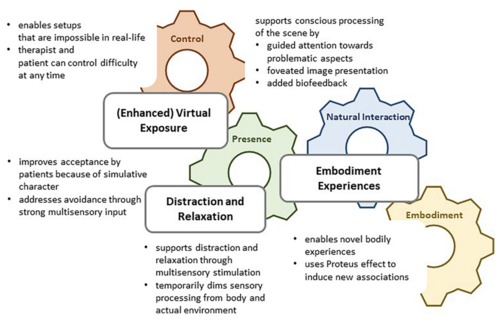
Immersive virtual reality technology (VR) still waits for its wide dissemination in research and psychotherapy of eating and weight disorders. Given the comparably high efforts in producing a VR setup, we outline that the technology’s breakthrough needs tailored exploitation of specific features of VR and user-centered design of setups. In this paper, we introduce VR hardware and review the specific properties of immersive VR versus real-world setups providing examples how they improved existing setups. We then summarize current approaches to make VR a tool for psychotherapy of eating and weight disorders and introduce user-centered design of VR environments as a solution to support their further development. Overall, we argue that exploitation of the specific properties of VR can substantially improve existing approaches for research and therapy of eating and weight disorders. To produce more than pilot setups, iterative development of VR setups within a user-centered design approach is needed.
DOI BibTeX
Thumb ticker lg behrens23

Perceiving Systems Conference Paper DART: Articulated Hand Model with Diverse Accessories and Rich Textures Gao, D., Xiu, Y., Li, K., Yang, L., Wang, F., Zhang, P., Zhang, B., Lu, C., Tan, P. Thirty-sixth Conference on Neural Information Processing Systems (NeurIPS), NeurIPS 2022-Datasets and Benchmarks Track, November 2022 (Published)
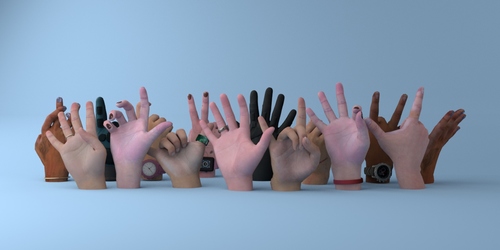
Hand, the bearer of human productivity and intelligence, is receiving much attention due to the recent fever of 3D digital avatars. Among different hand morphable models, MANO has been widely used in various vision & graphics tasks. However, MANO disregards textures and accessories, which largely limits its power to synthesize photorealistic & lifestyle hand data. In this paper, we extend MANO with more Diverse Accessories and Rich Textures, namely DART. DART is comprised of 325 exquisite hand-crafted texture maps which vary in appearance and cover different kinds of blemishes, make-ups, and accessories. We also provide the Unity GUI which allows people to render hands with user-specific settings, e.g. pose, camera, background, lighting, and DART textures. In this way, we generate large-scale (800K), diverse, and high-fidelity hand images, paired with perfect-aligned 3D labels, called DARTset. Experiments demonstrate its superiority in generalization and diversity. As a great complement to existing datasets, DARTset could boost hand pose estimation & surface reconstruction tasks. DART and Unity software will be publicly available for research purposes.
Home Code Video BibTeX
Thumb ticker lg teaser

Perceiving Systems Conference Paper Deep Residual Reinforcement Learning based Autonomous Blimp Control Liu, Y. T., Price, E., Black, M. J., Ahmad, A. 2022 IEEE/RSJ International Conference on Intelligent Robots and Systems (IROS 2022), 12566-12573, IEEE, Piscataway, NJ, IEEE/RSJ International Conference on Intelligent Robots and Systems (IROS 2022) , October 2022 (Published)
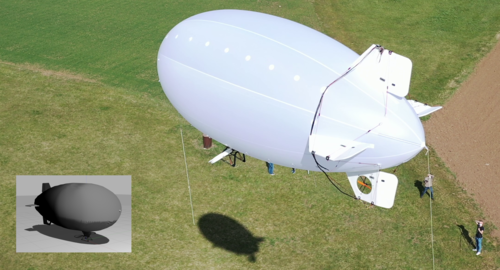
Blimps are well suited to perform long-duration aerial tasks as they are energy efficient, relatively silent and safe. To address the blimp navigation and control task, in previous work we developed a hardware and software-in-the-loop framework and a PID-based controller for large blimps in the presence of wind disturbance. However, blimps have a deformable structure and their dynamics are inherently non-linear and time-delayed, making PID controllers difficult to tune. Thus, often resulting in large tracking errors. Moreover, the buoyancy of a blimp is constantly changing due to variations in ambient temperature and pressure. To address these issues, in this paper we present a learning-based framework based on deep residual reinforcement learning (DRRL), for the blimp control task. Within this framework, we first employ a PID controller to provide baseline performance. Subsequently, the DRRL agent learns to modify the PID decisions by interaction with the environment. We demonstrate in simulation that DRRL agent consistently improves the PID performance. Through rigorous simulation experiments, we show that the agent is robust to changes in wind speed and buoyancy. In real-world experiments, we demonstrate that the agent, trained only in simulation, is sufficiently robust to control an actual blimp in windy conditions. We openly provide the source code of our approach at https://github.com/robot-perception-group/AutonomousBlimpDRL .
DOI BibTeX
Thumb ticker lg blimp rl cover new

Perceiving Systems Conference Paper Learning to Fit Morphable Models Choutas, V., Bogo, F., Shen, J., Valentin, J. In Computer Vision – ECCV 2022, 6:160-179, Lecture Notes in Computer Science, 13666, (Editors: Avidan, Shai and Brostow, Gabriel and Cissé, Moustapha and Farinella, Giovanni Maria and Hassner, Tal), Springer, Cham, 17th European Conference on Computer Vision (ECCV 2022), October 2022 (Published)
Fitting parametric models of human bodies, hands or faces to sparse input signals in an accurate, robust, and fast manner has the promise of significantly improving immersion in AR and VR scenarios. A common first step in systems that tackle these problems is to regress the parameters of the parametric model directly from the input data. This approach is fast, robust, and is a good starting point for an iterative minimization algorithm. The latter searches for the minimum of an energy function, typically composed of a data term and priors that encode our knowledge about the problem's structure. While this is undoubtedly a very successful recipe, priors are often hand defined heuristics and finding the right balance between the different terms to achieve high quality results is a non-trivial task. Furthermore, converting and optimizing these systems to run in a performant way requires custom implementations that demand significant time investments from both engineers and domain experts. In this work, we build upon recent advances in learned optimization and propose an update rule inspired by the classic Levenberg-Marquardt algorithm. We show the effectiveness of the proposed neural optimizer on three problems, 3D body estimation from a head-mounted device, 3D body estimation from sparse 2D keypoints and face surface estimation from dense 2D landmarks. Our method can easily be applied to new model fitting problems and offers a competitive alternative to well-tuned 'traditional' model fitting pipelines, both in terms of accuracy and speed.
Project page Video PDF Poster DOI BibTeX
Thumb ticker lg teaser composition

Neural Capture and Synthesis Perceiving Systems Conference Paper Towards Metrical Reconstruction of Human Faces Zielonka, W., Bolkart, T., Thies, J. In Computer Vision – ECCV 2022, 13:250-269, Lecture Notes in Computer Science, 13673, (Editors: Avidan, Shai and Brostow, Gabriel and Cissé, Moustapha and Farinella, Giovanni Maria and Hassner, Tal), Springer, Cham, 17th European Conference on Computer Vision (ECCV 2022), October 2022 (Published)
Face reconstruction and tracking is a building block of numerous applications in AR/VR, human-machine interaction, as well as medical applications. Most of these applications rely on a metrically correct prediction of the shape, especially, when the reconstructed subject is put into a metrical context (i.e., when there is a reference object of known size). A metrical reconstruction is also needed for any application that measures distances and dimensions of the subject (e.g., to virtually fit a glasses frame). State-of-the-art methods for face reconstruction from a single image are trained on large 2D image datasets in a self-supervised fashion. However, due to the nature of a perspective projection they are not able to reconstruct the actual face dimensions, and even predicting the average human face outperforms some of these methods in a metrical sense. To learn the actual shape of a face, we argue for a supervised training scheme. Since there exists no large-scale 3D dataset for this task, we annotated and unified small- and medium-scale databases. The resulting unified dataset is still a medium-scale dataset with more than 2k identities and training purely on it would lead to overfitting. To this end, we take advantage of a face recognition network pretrained on a large-scale 2D image dataset, which provides distinct features for different faces and is robust to expression, illumination, and camera changes. Using these features, we train our face shape estimator in a supervised fashion, inheriting the robustness and generalization of the face recognition network. Our method, which we call MICA (MetrIC fAce), outperforms the state-of-the-art reconstruction methods by a large margin, both on current non-metric benchmarks as well as on our metric benchmarks (15\%\/ and 24\%\/ lower average error on NoW, respectively). Project website: \url{https://zielon.github.io/mica/}.
pdf project video code DOI URL BibTeX
Thumb ticker lg mica

Perceiving Systems Conference Paper Towards Racially Unbiased Skin Tone Estimation via Scene Disambiguation Feng, H., Bolkart, T., Tesch, J., Black, M. J., Fernandez Abrevaya, V. In Computer Vision – ECCV 2022, 13:72-90, Lecture Notes in Computer Science, 13673, (Editors: Avidan, Shai and Brostow, Gabriel and Cissé, Moustapha and Farinella, Giovanni Maria and Hassner, Tal), Springer, Cham, 17th European Conference on Computer Vision (ECCV 2022), October 2022 (Published)
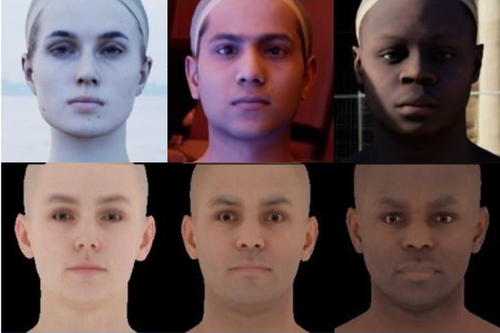
Virtual facial avatars will play an increasingly important role in immersive communication, games and the metaverse, and it is therefore critical that they be inclusive. This requires accurate recovery of the albedo, regardless of age, sex, or ethnicity. While significant progress has been made on estimating 3D facial geometry, appearance estimation has received less attention. The task is fundamentally ambiguous because the observed color is a function of albedo and lighting, both of which are unknown. We find that current methods are biased towards light skin tones due to (1) strongly biased priors that prefer lighter pigmentation and (2) algorithmic solutions that disregard the light/albedo ambiguity. To address this, we propose a new evaluation dataset (FAIR) and an algorithm (TRUST) to improve albedo estimation and, hence, fairness. Specifically, we create the first facial albedo evaluation benchmark where subjects are balanced in terms of skin color, and measure accuracy using the Individual Typology Angle (ITA) metric. We then address the light/albedo ambiguity by building on a key observation: the image of the full scene –as opposed to a cropped image of the face– contains important information about lighting that can be used for disambiguation. TRUST regresses facial albedo by conditioning on both the face region and a global illumination signal obtained from the scene image. Our experimental results show significant improvement compared to state- of-the-art methods on albedo estimation, both in terms of accuracy and fairness. The evaluation benchmark and code are available for research purposes at https://trust.is.tue.mpg.de.
pdf project code DOI URL BibTeX
Thumb ticker lg trust

Perceiving Systems Conference Paper SUPR: A Sparse Unified Part-Based Human Representation Osman, A. A. A., Bolkart, T., Tzionas, D., Black, M. J. In Computer Vision – ECCV 2022, 2:568-585, Lecture Notes in Computer Science, 13662, (Editors: Avidan, Shai and Brostow, Gabriel and Cissé, Moustapha and Farinella, Giovanni Maria and Hassner, Tal), Springer, Cham, 17th European Conference on Computer Vision (ECCV 2022), October 2022 (Published)
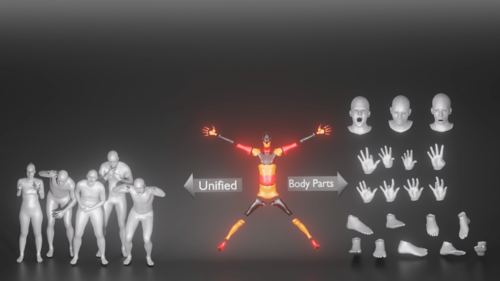
Statistical 3D shape models of the head, hands, and fullbody are widely used in computer vision and graphics. Despite their wide use, we show that existing models of the head and hands fail to capture the full range of motion for these parts. Moreover, existing work largely ignores the feet, which are crucial for modeling human movement and have applications in biomechanics, animation, and the footwear industry. The problem is that previous body part models are trained using 3D scans that are isolated to the individual parts. Such data does not capture the full range of motion for such parts, e.g. the motion of head relative to the neck. Our observation is that full-body scans provide important in- formation about the motion of the body parts. Consequently, we propose a new learning scheme that jointly trains a full-body model and specific part models using a federated dataset of full-body and body-part scans. Specifically, we train an expressive human body model called SUPR (Sparse Unified Part-Based Representation), where each joint strictly influences a sparse set of model vertices. The factorized representation enables separating SUPR into an entire suite of body part models: an expressive head (SUPR-Head), an articulated hand (SUPR-Hand), and a novel foot (SUPR-Foot). Note that feet have received little attention and existing 3D body models have highly under-actuated feet. Using novel 4D scans of feet, we train a model with an extended kinematic tree that captures the range of motion of the toes. Additionally, feet de- form due to ground contact. To model this, we include a novel non-linear deformation function that predicts foot deformation conditioned on the foot pose, shape, and ground contact. We train SUPR on an unprecedented number of scans: 1.2 million body, head, hand and foot scans. We quantitatively compare SUPR and the separate body parts to existing expressive human body models and body-part models and find that our suite of models generalizes better and captures the body parts’ full range of motion. SUPR is publicly available for research purposes.
Project website Code Main Paper Supp. Mat. Poster DOI BibTeX
Thumb ticker lg fig 1  1

Perceiving Systems Conference Paper TEMOS: Generating Diverse Human Motions from Textual Descriptions Petrovich, M., Black, M. J., Varol, G. In European Conference on Computer Vision (ECCV 2022), Springer International Publishing, ECCV, October 2022 (Published)
We address the problem of generating diverse 3D human motions from textual descriptions. This challenging task requires joint modeling of both modalities: understanding and extracting useful human-centric information from the text, and then generating plausible and realistic sequences of human poses. In contrast to most previous work which focuses on generating a single, deterministic, motion from a textual description, we design a variational approach that can produce multiple diverse human motions. We propose TEMOS, a text-conditioned generative model leveraging variational autoencoder (VAE) training with human motion data, in combination with a text encoder that produces distribution parameters compatible with the VAE latent space. We show the TEMOS framework can produce both skeleton-based animations as in prior work, as well more expressive SMPL body motions. We evaluate our approach on the KIT Motion-Language benchmark and, despite being relatively straightforward, demonstrate significant improvements over the state of the art. Code and models are available on our webpage.
website code paper-arxiv video DOI URL BibTeX
Thumb ticker lg small white

Perceiving Systems Conference Paper Neural Point-based Shape Modeling of Humans in Challenging Clothing Ma, Q., Yang, J., Black, M. J., Tang, S. In 2022 International Conference on 3D Vision (3DV 2022), 679-689, IEEE, Piscataway, NJ, International Conference on 3D Vision (3DV 2022), September 2022 (Published)
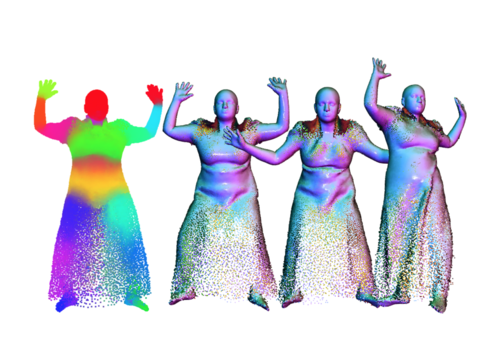
Parametric 3D body models like SMPL only represent minimally-clothed people and are hard to extend to cloth- ing because they have a fixed mesh topology and resolution. To address this limitation, recent work uses implicit surfaces or point clouds to model clothed bodies. While not limited by topology, such methods still struggle to model clothing that deviates significantly from the body, such as skirts and dresses. This is because they rely on the body to canonicalize the clothed surface by reposing it to a reference shape. Unfortunately, this process is poorly defined when clothing is far from the body. Additionally, they use linear blend skinning to pose the body and the skinning weights are tied to the underlying body parts. In contrast, we model the clothing deformation in a local coordinate space without canonicalization. We also relax the skinning weights to let multiple body parts influence the surface. Specifically, we extend point-based methods with a coarse stage, that replaces canonicalization with a learned pose- independent “coarse shape” that can capture the rough surface geometry of clothing like skirts. We then refine this using a network that infers the linear blend skinning weights and pose dependent displacements from the coarse representation. The approach works well for garments that both conform to, and deviate from, the body. We demonstrate the usefulness of our approach by learning person- specific avatars from examples and then show how they can be animated in new poses and motions. We also show that the method can learn directly from raw scans with missing data, greatly simplifying the process of creating realistic avatars. Code is available for research purposes.
Project page Code arXiv Paper Supp Poster DOI URL BibTeX
Thumb ticker lg skirt small teaser website

Perceiving Systems Conference Paper Reconstructing Action-Conditioned Human-Object Interactions Using Commonsense Knowledge Priors Wang, X., Li, G., Kuo, Y., Kocabas, M., Aksan, E., Hilliges, O. In 2022 International Conference on 3D Vision (3DV 2022), 353-362, IEEE, Piscataway, NJ, International Conference on 3D Vision (3DV 2022), September 2022 (Published)
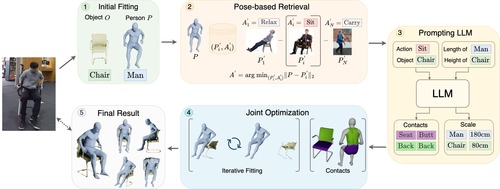
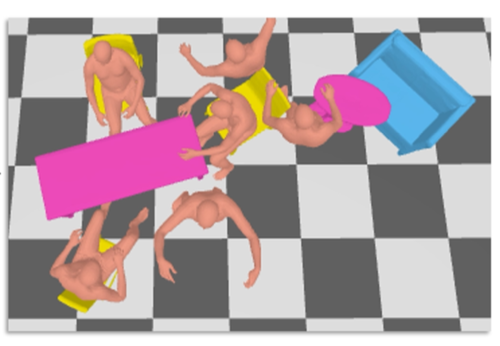
We present a method for inferring diverse 3D models of human-object interactions from images. Reasoning about how humans interact with objects in complex scenes from a single 2D image is a challenging task given ambiguities arising from the loss of information through projection. In addition, modeling 3D interactions requires the generalization ability towards diverse object categories and interaction types. We propose an action-conditioned modeling of interactions that allows us to infer diverse 3D arrangements of humans and objects without supervision on contact regions or 3D scene geometry. Our method extracts high-level commonsense knowledge from large language models (such as GPT-3), and applies them to perform 3D reasoning of human-object interactions. Our key insight is priors extracted from large language models can help in reasoning about human-object contacts from textural prompts only. We quantitatively evaluate the inferred 3D models on a large human-object interaction dataset and show how our method leads to better 3D reconstructions. We further qualitatively evaluate the effectiveness of our method on real images and demonstrate its generalizability towards interaction types and object categories.
Project Page Video Arxiv DOI BibTeX
Thumb ticker lg rhoi overview

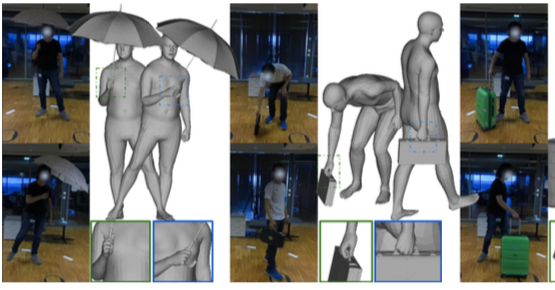
Perceiving Systems Conference Paper InterCap: Joint Markerless 3D Tracking of Humans and Objects in Interaction Huang, Y., Taheri, O., Black, M. J., Tzionas, D. In Pattern Recognition, 281-299, Lecture Notes in Computer Science, 13485, (Editors: Andres, Björn and Bernard, Florian and Cremers, Daniel and Frintrop, Simone and Goldlücke, Bastian and Ihrke, Ivo), Springer, Cham, 44th DAGM German Conference on Pattern Recognition (DAGM GCPR 2022), September 2022 (Published)
Humans constantly interact with daily objects to accomplish tasks. To understand such interactions, computers need to reconstruct these from cameras observing whole-body interaction with scenes. This is challenging due to occlusion between the body and objects, motion blur, depth/scale ambiguities, and the low image resolution of hands and graspable object parts. To make the problem tractable, the community focuses either on interacting hands, ignoring the body, or on interacting bodies, ignoring hands. The GRAB dataset addresses dexterous whole-body interaction but uses marker-based MoCap and lacks images, while BEHAVE captures video of body object interaction but lacks hand detail. We address the limitations of prior work with InterCap, a novel method that reconstructs interacting whole-bodies and objects from multi-view RGB-D data, using the parametric whole-body model SMPL-X and known object meshes. To tackle the above challenges, InterCap uses two key observations: (i) Contact between the hand and object can be used to improve the pose estimation of both. (ii) Azure Kinect sensors allow us to set up a simple multi-view RGB-D capture system that minimizes the effect of occlusion while providing reasonable inter-camera synchronization. With this method we capture the InterCap dataset, which contains 10 subjects (5 males and 5 females) interacting with 10 objects of various sizes and affordances, including contact with the hands or feet. In total, InterCap has 223 RGB-D videos, resulting in 67,357 multi-view frames, each containing 6 RGB-D images. Our method provides pseudo ground-truth body meshes and objects for each video frame. Our InterCap method and dataset fill an important gap in the literature and support many research directions. Our data and code are areavailable for research purposes.
Code Data YouTube Video pdf DOI URL BibTeX
Thumb ticker lg img

Perceiving Systems Autonomous Learning Conference Paper InvGAN: Invertible GANs Ghosh, P., Zietlow, D., Black, M. J., Davis, L. S., Hu, X. In Pattern Recognition, 3-19, Lecture Notes in Computer Science, 13485, (Editors: Andres, Björn and Bernard, Florian and Cremers, Daniel and Frintrop, Simone and Goldlücke, Bastian and Ihrke, Ivo), Springer, Cham, 44th DAGM German Conference on Pattern Recognition (DAGM GCPR 2022), September 2022 (Published)
Generation of photo-realistic images, semantic editing and representation learning are only a few of many applications of high-resolution generative models. Recent progress in GANs have established them as an excellent choice for such tasks. However, since they do not provide an inference model, downstream tasks such as classification cannot be easily applied on real images using the GAN latent space. Despite numerous efforts to train an inference model or design an iterative method to invert a pre-trained generator, previous methods are dataset (e.g. human face images) and architecture (e.g. StyleGAN) specific. These methods are nontrivial to extend to novel datasets or architectures. We propose a general framework that is agnostic to architecture and datasets. Our key insight is that, by training the inference and the generative model together, we allow them to adapt to each other and to converge to a better quality model. Our InvGAN, short for Invertible GAN, successfully embeds real images in the latent space of a high quality generative model. This allows us to perform image inpainting, merging, interpolation and online data augmentation. We demonstrate this with extensive qualitative and quantitative experiments.
pdf DOI BibTeX
Thumb ticker lg invgan

Perceiving Systems Conference Paper TEACH: Temporal Action Composition for 3D Humans Athanasiou, N., Petrovich, M., Black, M. J., Varol, G. In 2022 International Conference on 3D Vision (3DV), 414-423, 3DV'22, September 2022 (Published)
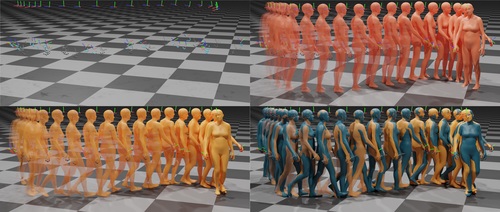
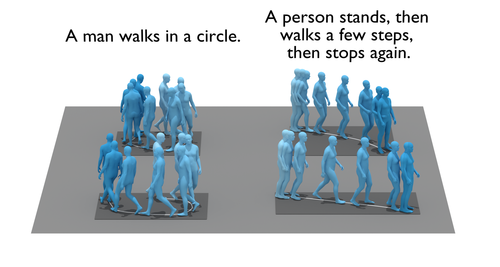
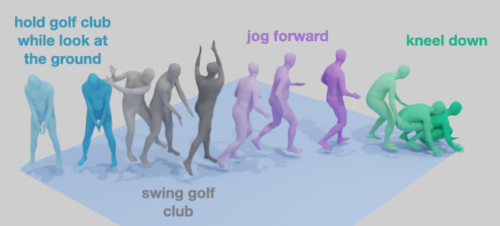
Given a series of natural language descriptions, our task is to generate 3D human motions that correspond semantically to the text, and follow the temporal order of the instructions. In particular, our goal is to enable the synthesis of a series of actions, which we refer to as temporal action composition. The current state of the art in text-conditioned motion synthesis only takes a single action or a single sentence as input. This is partially due to lack of suitable training data containing action sequences, but also due to the computational complexity of their non-autoregressive model formulation, which does not scale well to long sequences. In this work, we address both issues. First, we exploit the recent BABEL motion-text collection, which has a wide range of labeled actions, many of which occur in a sequence with transitions between them. Next, we design a Transformer-based approach that operates non-autoregressively within an action, but autoregressively within the sequence of actions. This hierarchical formulation proves effective in our experiments when compared with multiple baselines. Our approach, called TEACH for “TEmporal Action Compositions for Human motions”, produces realistic human motions for a wide variety of actions and temporal compositions from language descriptions. To encourage work on this new task, we make our code available for research purposes at teach.is.tue.mpg.de.
code arXiv website video camera-ready DOI URL BibTeX
Thumb ticker lg teach

Perceiving Systems Conference Paper TempCLR: Reconstructing Hands via Time-Coherent Contrastive Learning Ziani, A., Fan, Z., Kocabas, M., Christen, S., Hilliges, O. In 2022 International Conference on 3D Vision (3DV 2022), 627-636, IEEE, Piscataway, NJ, International Conference on 3D Vision (3DV 2022), September 2022 (Published)
We introduce TempCLR, a new time-coherent contrastive learning approach for the structured regression task of 3D hand reconstruction. Unlike previous time-contrastive methods for hand pose estimation, our framework considers temporal consistency in its augmentation scheme, and accounts for the differences of hand poses along the temporal direction. Our data-driven method leverages unlabelled videos and a standard CNN, without relying on synthetic data, pseudo-labels, or specialized architectures. Our approach improves the performance of fully-supervised hand reconstruction methods by 15.9% and 7.6% in PA-V2V on the HO-3D and FreiHAND datasets respectively, thus establishing new state-of-the-art performance. Finally, we demonstrate that our approach produces smoother hand reconstructions through time, and is more robust to heavy occlusions compared to the previous state-of-the-art which we show quantitatively and qualitatively.
Project Page Code Arxiv Video DOI URL BibTeX
Thumb ticker lg thumbnail

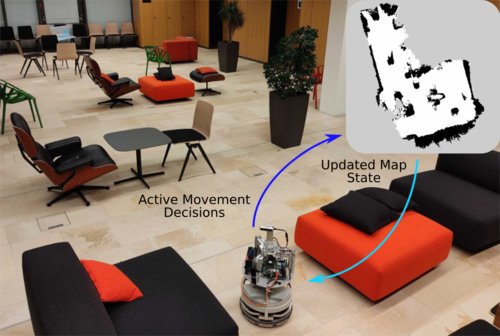
Perceiving Systems Article iRotate: Active visual SLAM for omnidirectional robots Bonetto, E., Goldschmid, P., Pabst, M., Black, M. J., Ahmad, A. Robotics and Autonomous Systems, 154:104102, Elsevier, August 2022 (Published)
In this paper, we present an active visual SLAM approach for omnidirectional robots. The goal is to generate control commands that allow such a robot to simultaneously localize itself and map an unknown environment while maximizing the amount of information gained and consuming as low energy as possible. Leveraging the robot’s independent translation and rotation control, we introduce a multi-layered approach for active V-SLAM. The top layer decides on informative goal locations and generates highly informative paths to them. The second and third layers actively re-plan and execute the path, exploiting the continuously updated map and local features information. Moreover, we introduce two utility formulations to account for the presence of obstacles in the field of view and the robot’s location. Through rigorous simulations, real robot experiments, and comparisons with state-of-the-art methods, we demonstrate that our approach achieves similar coverage results with lesser overall map entropy. This is obtained while keeping the traversed distance up to 39% shorter than the other methods and without increasing the wheels’ total rotation amount. Code and implementation details are provided as open-source and all the generated data is available online for consultation.
Code Data iRotate Data Independent Camera experiments DOI URL BibTeX
Thumb ticker lg cover lres

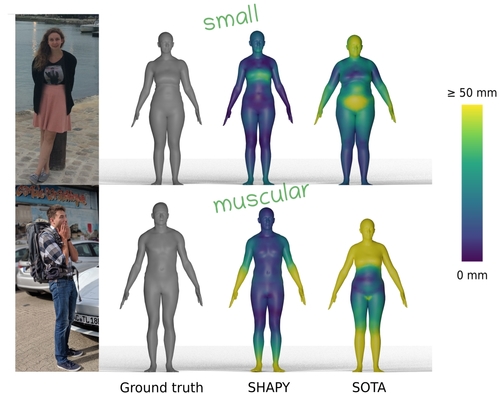
Perceiving Systems Conference Paper Accurate 3D Body Shape Regression using Metric and Semantic Attributes Choutas, V., Müller, L., Huang, C. P., Tang, S., Tzionas, D., Black, M. J. In 2022 IEEE/CVF Conference on Computer Vision and Pattern Recognition (CVPR 2022), 2708-2718, IEEE, Piscataway, NJ, IEEE/CVF Conference on Computer Vision and Pattern Recognition (CVPR 2022), June 2022 (Published)
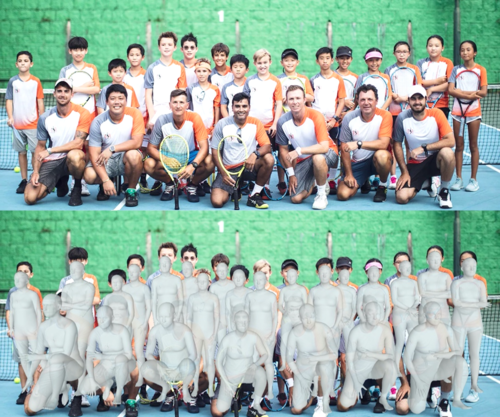
While methods that regress 3D human meshes from images have progressed rapidly, the estimated body shapes often do not capture the true human shape. This is problematic since, for many applications, accurate body shape is as important as pose. The key reason that body shape accuracy lags pose accuracy is the lack of data. While humans can label 2D joints, and these constrain 3D pose, it is not so easy to “label” 3D body shape. Since paired data with images and 3D body shape are rare, we exploit two sources of partial information: (1) we collect internet images of diverse models together with a small set of measurements; (2) we collect semantic shape attributes for a wide range of 3D body meshes and model images. Taken together, these datasets provide sufficient constraints to infer metric 3D shape. We exploit this partial and semantic data in several novel ways to train a neural network, called SHAPY, that regresses 3D human pose and shape from an RGB image. We evaluate SHAPY on public benchmarks but note that they either lack significant body shape variation, ground-truth shape, or clothing variation. Thus, we collect a new dataset for 3D human shape estimation, containing photos of people in the wild for whom we have ground-truth 3D body scans. On this new benchmark, SHAPY significantly outperforms recent state-of-the-art methods on the task of 3D body shape estimation. This is the first demonstration that a 3D body shape regressor can be trained from sparse measurements and easy-to-obtain semantic shape attributes. Our model and data are freely available for research.
Home Code Video Paper Supplementary Material Poster DOI URL BibTeX
Thumb ticker lg teaser final cropped

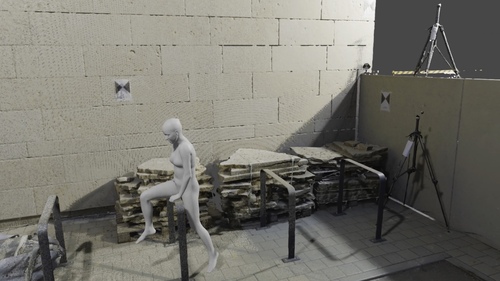
Perceiving Systems Optics and Sensing Laboratory Conference Paper Capturing and Inferring Dense Full-Body Human-Scene Contact Huang, C. P., Yi, H., Höschle, M., Safroshkin, M., Alexiadis, T., Polikovsky, S., Scharstein, D., Black, M. J. In 2022 IEEE/CVF Conference on Computer Vision and Pattern Recognition (CVPR 2022), 13264-13275, IEEE, Piscataway, NJ, IEEE/CVF Conference on Computer Vision and Pattern Recognition (CVPR 2022), June 2022 (Published)
Inferring human-scene contact (HSC) is the first step toward understanding how humans interact with their surroundings. While detecting 2D human-object interaction (HOI) and reconstructing 3D human pose and shape (HPS) have enjoyed significant progress, reasoning about 3D human-scene contact from a single image is still challenging. Existing HSC detection methods consider only a few types of predefined contact, often reduce body and scene to a small number of primitives, and even overlook image evidence. To predict human-scene contact from a single image, we address the limitations above from both data and algorithmic perspectives. We capture a new dataset called RICH for “Real scenes, Interaction, Contact and Humans.” RICH contains multiview outdoor/indoor video sequences at 4K resolution, ground-truth 3D human bodies captured using markerless motion capture, 3D body scans, and high resolution 3D scene scans. A key feature of RICH is that it also contains accurate vertex-level contact labels on the body. Using RICH, we train a network that predicts dense body-scene contacts from a single RGB image. Our key insight is that regions in contact are always occluded so the network needs the ability to explore the whole image for evidence. We use a transformer to learn such non-local relationships and propose a new Body-Scene contact TRansfOrmer (BSTRO). Very few methods explore 3D contact; those that do focus on the feet only, detect foot contact as a post-processing step, or infer contact from body pose without looking at the scene. To our knowledge, BSTRO is the first method to directly estimate 3D body-scene contact from a single image. We demonstrate that BSTRO significantly outperforms the prior art. The code and dataset are available at https://rich.is.tue.mpg.de.
project arXiv BSTRO code video DOI URL BibTeX
Thumb ticker lg screen shot 2022 05 28 at 1.55.51 pm

Perceiving Systems Neural Capture and Synthesis Conference Paper Human-Aware Object Placement for Visual Environment Reconstruction Yi, H., Huang, C. P., Tzionas, D., Kocabas, M., Hassan, M., Tang, S., Thies, J., Black, M. J. In 2022 IEEE/CVF Conference on Computer Vision and Pattern Recognition (CVPR 2022), 3949-3960, IEEE, Piscataway, NJ, IEEE/CVF Conference on Computer Vision and Pattern Recognition (CVPR 2022), June 2022 (Published)
Humans are in constant contact with the world as they move through it and interact with it. This contact is a vital source of information for understanding 3D humans, 3D scenes, and the interactions between them. In fact, we demonstrate that these human-scene interactions (HSIs) can be leveraged to improve the 3D reconstruction of a scene from a monocular RGB video. Our key idea is that, as a person moves through a scene and interacts with it, we accumulate HSIs across multiple input images, and optimize the 3D scene to reconstruct a consistent, physically plausible and functional 3D scene layout. Our optimization-based approach exploits three types of HSI constraints: (1) humans that move in a scene are occluded or occlude objects, thus, defining the depth ordering of the objects, (2) humans move through free space and do not interpenetrate objects, (3) when humans and objects are in contact, the contact surfaces occupy the same place in space. Using these constraints in an optimization formulation across all observations, we significantly improve the 3D scene layout reconstruction. Furthermore, we show that our scene reconstruction can be used to refine the initial 3D human pose and shape (HPS) estimation. We evaluate the 3D scene layout reconstruction and HPS estimation qualitatively and quantitatively using the PROX and PiGraphs datasets. The code and data are available for research purposes at https://mover.is.tue.mpg.de/.
project arXiv DOI URL BibTeX
Thumb ticker lg teaser

Perceiving Systems Conference Paper Occluded Human Mesh Recovery Khirodkar, R., Tripathi, S., Kitani, K. In 2022 IEEE/CVF Conference on Computer Vision and Pattern Recognition (CVPR 2022), 1705-1715, IEEE, Piscataway, NJ, IEEE/CVF Conference on Computer Vision and Pattern Recognition (CVPR 2022), June 2022 (Published)
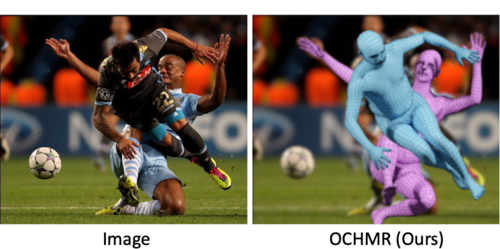
Top-down methods for monocular human mesh recovery have two stages: (1) detect human bounding boxes; (2) treat each bounding box as an independent single-human mesh recovery task. Unfortunately, the single-human assumption does not hold in images with multi-human occlusion and crowding. Consequently, top-down methods have difficulties in recovering accurate 3D human meshes under severe person-person occlusion. To address this, we present Occluded Human Mesh Recovery (OCHMR) - a novel top-down mesh recovery approach that incorporates image spatial context to overcome the limitations of the single-human assumption. The approach is conceptually simple and can be applied to any existing top-down architecture. Along with the input image, we condition the top-down model on spatial context from the image in the form of body-center heatmaps. To reason from the predicted body centermaps, we introduce Contextual Normalization (CoNorm) blocks to adaptively modulate intermediate features of the top-down model. The contextual conditioning helps our model disambiguate between two severely overlapping human bounding-boxes, making it robust to multi-person occlusion. Compared with state-of-the-art methods, OCHMR achieves superior performance on challenging multi-person benchmarks like 3DPW, CrowdPose and OCHuman. Specifically, our proposed contextual reasoning architecture applied to the SPIN model with ResNet-50 backbone results in 75.2 PMPJPE on 3DPW-PC, 23.6 AP on CrowdPose and 37.7 AP on OCHuman datasets, a significant improvement of 6.9 mm, 6.4 AP and 20.8 AP respectively over the baseline. Code and models will be released.
project arXiv DOI BibTeX
Thumb ticker lg teaser ps

Perceiving Systems Conference Paper Putting People in their Place: Monocular Regression of 3D People in Depth Sun, Y., Liu, W., Bao, Q., Fu, Y., Mei, T., Black, M. J. In 2022 IEEE/CVF Conference on Computer Vision and Pattern Recognition (CVPR 2022), 13233-13242, IEEE, Piscataway, NJ, IEEE/CVF Conference on Computer Vision and Pattern Recognition (CVPR 2022), June 2022 (Published)
Given an image with multiple people, our goal is to directly regress the pose and shape of all the people as well as their relative depth. Inferring the depth of a person in an image, however, is fundamentally ambiguous without knowing their height. This is particularly problematic when the scene contains people of very different sizes, e.g. from infants to adults. To solve this, we need several things. First, we develop a novel method to infer the poses and depth of multiple people in a single image. While previous work that estimates multiple people does so by reasoning in the image plane, our method, called BEV, adds an additional imaginary Bird's-Eye-View representation to explicitly reason about depth. BEV reasons simultaneously about body centers in the image and in depth and, by combing these, estimates 3D body position. Unlike prior work, BEV is a single-shot method that is end-to-end differentiable. Second, height varies with age, making it impossible to resolve depth without also estimating the age of people in the image. To do so, we exploit a 3D body model space that lets BEV infer shapes from infants to adults. Third, to train BEV, we need a new dataset. Specifically, we create a "Relative Human" (RH) dataset that includes age labels and relative depth relationships between the people in the images. Extensive experiments on RH and AGORA demonstrate the effectiveness of the model and training scheme. BEV outperforms existing methods on depth reasoning, child shape estimation, and robustness to occlusion. The code and dataset are released for research purposes.
arXiv Project Code Data Sup Mat DOI URL BibTeX
Thumb ticker lg rompteaser

Perceiving Systems Conference Paper Simulation and Control of Deformable Autonomous Airships in Turbulent Wind Price, E., Liu, Y., Black, M. J., Ahmad, A. In Intelligent Autonomous Systems 16, 608-626, Lecture Notes in Networks and Systems, 412, (Editors: Ang Jr, Marcelo H. and Asama, Hajime and Lin, Wei and Foong, Shaohui), Springer, Cham, 16th International Conference on Intelligent Autonomous Systems (IAS-16), June 2022 (Published)
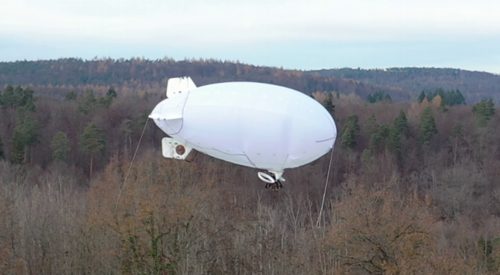
Abstract. Fixed wing and multirotor UAVs are common in the field of robotics. Solutions for simulation and control of these vehicles are ubiquitous. This is not the case for airships, a simulation of which needs to address unique properties, i) dynamic deformation in response to aerodynamic and control forces, ii) high susceptibility to wind and turbulence at low airspeed, iii) high variability in airship designs regarding placement, direction and vectoring of thrusters and control surfaces. We present a flexible framework for modeling, simulation and control of airships, based on the Robot operating system (ROS), simulation environment (Gazebo) and commercial off the shelf (COTS) electronics, both of which are open source. Based on simulated wind and deformation, we predict substantial effects on controllability, verified in real world flight experiments. All our code is shared as open source, for the benefit of the community and to facilitate lighter-than-air vehicle (LTAV) research.
pdf arXiv project/code DOI URL BibTeX
Thumb ticker lg blimp

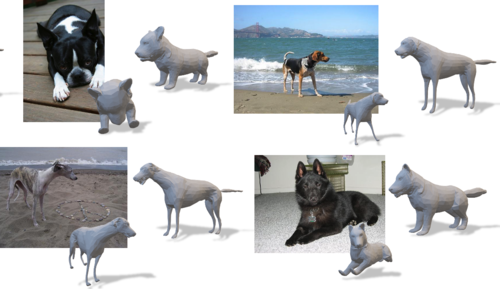
Perceiving Systems Conference Paper BARC: Learning to Regress 3D Dog Shape from Images by Exploiting Breed Information Rueegg, N., Zuffi, S., Schindler, K., Black, M. J. In 2022 IEEE/CVF Conference on Computer Vision and Pattern Recognition (CVPR 2022), 3866-3874, IEEE, Piscataway, NJ, IEEE/CVF Conference on Computer Vision and Pattern Recognition (CVPR 2022), June 2022 (Published)
Our goal is to recover the 3D shape and pose of dogs from a single image. This is a challenging task because dogs exhibit a wide range of shapes and appearances, and are highly articulated. Recent work has proposed to directly regress the SMAL animal model, with additional limb scale parameters, from images. Our method, called BARC (Breed-Augmented Regression using Classification), goes beyond prior work in several important ways. First, we modify the SMAL shape space to be more appropriate for representing dog shape. But, even with a better shape model, the problem of regressing dog shape from an image is still challenging because we lack paired images with 3D ground truth. To compensate for the lack of paired data, we formulate novel losses that exploit information about dog breeds. In particular, we exploit the fact that dogs of the same breed have similar body shapes. We formulate a novel breed similarity loss consisting of two parts: One term encourages the shape of dogs from the same breed to be more similar than dogs of different breeds. The second one, a breed classification loss, helps to produce recognizable breed-specific shapes. Through ablation studies, we find that our breed losses significantly improve shape accuracy over a baseline without them. We also compare BARC qualitatively to WLDO with a perceptual study and find that our approach produces dogs that are significantly more realistic. This work shows that a-priori information about genetic similarity can help to compensate for the lack of 3D training data. This concept may be applicable to other animal species or groups of species.
pdf Sup. Mat. project Code Poster Video Demo DOI URL BibTeX
Thumb ticker lg dogs teaser2 copy 3

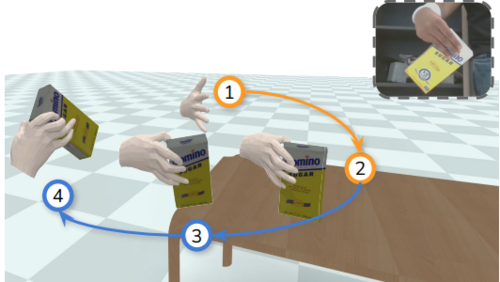
Perceiving Systems Conference Paper D-Grasp: Physically Plausible Dynamic Grasp Synthesis for Hand-Object Interactions Christen, S., Kocabas, M., Aksan, E., Hwangbo, J., Song, J., Hilliges, O. In 2022 IEEE/CVF Conference on Computer Vision and Pattern Recognition (CVPR 2022), 20545-20554, IEEE, Piscataway, NJ, IEEE/CVF Conference on Computer Vision and Pattern Recognition (CVPR 2022), June 2022 (Published)
We introduce the dynamic grasp synthesis task: given an object with a known 6D pose and a grasp reference, our goal is to generate motions that move the object to a target 6D pose. This is challenging, because it requires reasoning about the complex articulation of the human hand and the intricate physical interaction with the object. We propose a novel method that frames this problem in the reinforcement learning framework and leverages a physics simulation, both to learn and to evaluate such dynamic interactions. A hierarchical approach decomposes the task into low-level grasping and high-level motion synthesis. It can be used to generate novel hand sequences that approach, grasp, and move an object to a desired location, while retaining human-likeness. We show that our approach leads to stable grasps and generates a wide range of motions. Furthermore, even imperfect labels can be corrected by our method to generate dynamic interaction sequences.
paper project video code DOI BibTeX
Thumb ticker lg dgrabteaser

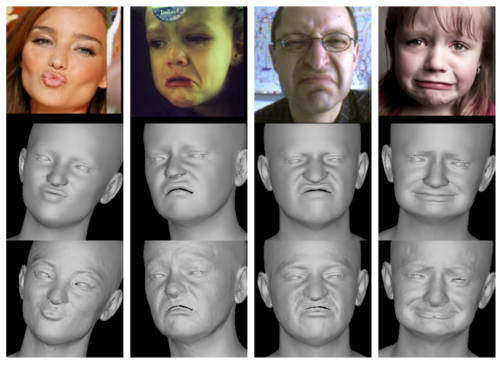
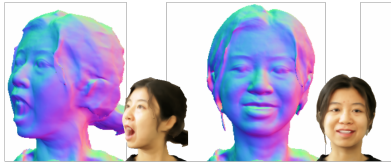
Perceiving Systems Conference Paper EMOCA: Emotion Driven Monocular Face Capture and Animation Daněček, R., Black, M. J., Bolkart, T. In 2022 IEEE/CVF Conference on Computer Vision and Pattern Recognition (CVPR 2022), 20279-20290, IEEE, Piscataway, NJ, IEEE/CVF Conference on Computer Vision and Pattern Recognition (CVPR 2022), June 2022 (Published)
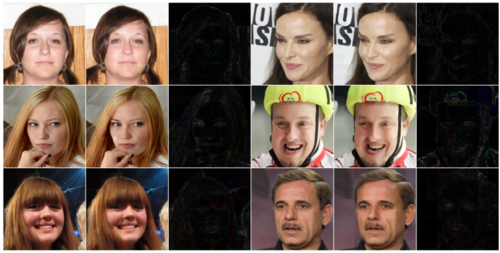
As 3D facial avatars become more widely used for communication, it is critical that they faithfully convey emotion. Unfortunately, the best recent methods that regress parametric 3D face models from monocular images are unable to capture the full spectrum of facial expression, such as subtle or extreme emotions. We find the standard reconstruction metrics used for training (landmark reprojection error, photometric error, and face recognition loss) are insufficient to capture high-fidelity expressions. The result is facial geometries that do not match the emotional content of the input image. We address this with EMOCA (EMOtion Capture and Animation), by introducing a novel deep perceptual emotion consistency loss during training, which helps ensure that the reconstructed 3D expression matches the expression depicted in the input image. While EMOCA achieves 3D reconstruction errors that are on par with the current best methods, it significantly outperforms them in terms of the quality of the reconstructed expression and the perceived emotional content. We also directly regress levels of valence and arousal and classify basic expressions from the estimated 3D face parameters. On the task of in-the-wild emotion recognition, our purely geometric approach is on par with the best image-based methods, highlighting the value of 3D geometry in analyzing human behavior. The model and code are publicly available at https://emoca.is.tue.mpg.de.
code project pdf supplemental DOI URL BibTeX
Thumb ticker lg emoca

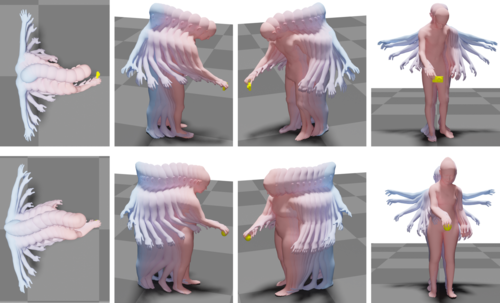
Perceiving Systems Conference Paper GOAL: Generating 4D Whole-Body Motion for Hand-Object Grasping Taheri, O., Choutas, V., Black, M. J., Tzionas, D. In 2022 IEEE/CVF Conference on Computer Vision and Pattern Recognition (CVPR 2022), 13253-13263, IEEE, Piscataway, NJ, IEEE/CVF Conference on Computer Vision and Pattern Recognition (CVPR 2022), June 2022 (Published)
Generating digital humans that move realistically has many applications and is widely studied, but existing methods focus on the major limbs of the body, ignoring the hands and head. Hands have been separately studied but the focus has been on generating realistic static grasps of objects. To synthesize virtual characters that interact with the world, we need to generate full-body motions and realistic hand grasps simultaneously. Both sub-problems are challenging on their own and, together, the state-space of poses is significantly larger, the scales of hand and body motions differ, and the whole-body posture and the hand grasp must agree, satisfy physical constraints, and be plausible. Additionally, the head is involved because the avatar must look at the object to interact with it. For the first time, we address the problem of generating full-body, hand and head motions of an avatar grasping an unknown object. As input, our method, called GOAL, takes a 3D object, its position, and a starting 3D body pose and shape. GOAL outputs a sequence of whole-body poses using two novel networks. First, GNet generates a goal whole-body grasp with a realistic body, head, arm, and hand pose, as well as hand-object contact. Second, MNet generates the motion between the starting and goal pose. This is challenging, as it requires the avatar to walk towards the object with foot-ground contact, orient the head towards it, reach out, and grasp it with a realistic hand pose and hand-object contact. To achieve this the networks exploit a representation that combines SMPL-X body parameters and 3D vertex offsets. We train and evaluate GOAL, both qualitatively and quantitatively, on the GRAB dataset. Results show that GOAL generalizes well to unseen objects, outperforming baselines. A perceptual study shows that GOAL’s generated motions approach the realism of GRAB’s ground truth. GOAL takes a step towards synthesizing realistic full-body object grasping. Our models and code are available for research.
arXiv Sup. Mat Project YouTube Code Models DOI URL BibTeX
Thumb ticker lg teaser copy

Perceiving Systems Conference Paper I M Avatar: Implicit Morphable Head Avatars from Videos Zheng, Y., Fernández Abrevaya, V., Bühler, M. C., Chen, X., Black, M. J., Hilliges, O. In 2022 IEEE/CVF Conference on Computer Vision and Pattern Recognition (CVPR 2022), 13535-13545, IEEE, Piscataway, NJ, IEEE/CVF Conference on Computer Vision and Pattern Recognition (CVPR 2022), June 2022 (Published)
Traditional 3D morphable face models (3DMMs) provide fine-grained control over expression but cannot easily capture geometric and appearance details. Neural volumetric representations approach photorealism but are hard to animate and do not generalize well to unseen expressions. To tackle this problem, we propose IMavatar (Implicit Morphable avatar), a novel method for learning implicit head avatars from monocular videos. Inspired by the fine-grained control mechanisms afforded by conventional 3DMMs, we represent the expression- and pose- related deformations via learned blendshapes and skinning fields. These attributes are pose-independent and can be used to morph the canonical geometry and texture fields given novel expression and pose parameters. We employ ray marching and iterative root-finding to locate the canonical surface intersection for each pixel. A key contribution is our novel analytical gradient formulation that enables end-to-end training of IMavatars from videos. We show quantitatively and qualitatively that our method improves geometry and covers a more complete expression space compared to state-of-the-art methods.
paper video code synth. data DOI URL BibTeX
Thumb ticker lg imavatarteaser

Perceiving Systems Conference Paper ICON: Implicit Clothed humans Obtained from Normals Xiu, Y., Yang, J., Tzionas, D., Black, M. J. In 2022 IEEE/CVF Conference on Computer Vision and Pattern Recognition (CVPR 2022), 13286-13296 , IEEE, Piscataway, NJ, IEEE/CVF Conference on Computer Vision and Pattern Recognition (CVPR 2022), June 2022 (Published)
Current methods for learning realistic and animatable 3D clothed avatars need either posed 3D scans or 2D images with carefully controlled user poses. In contrast, our goal is to learn the avatar from only 2D images of people in unconstrained poses. Given a set of images, our method estimates a detailed 3D surface from each image and then combines these into an animatable avatar. Implicit functions are well suited to the first task, as they can capture details like hair or clothes. Current methods, however, are not robust to varied human poses and often produce 3D surfaces with broken or disembodied limbs, missing details, or non-human shapes. The problem is that these methods use global feature encoders that are sensitive to global pose. To address this, we propose ICON ("Implicit Clothed humans Obtained from Normals"), which uses local features, instead. ICON has two main modules, both of which exploit the SMPL(-X) body model. First, ICON infers detailed clothed-human normals (front/back) conditioned on the SMPL(-X) normals. Second, a visibility-aware implicit surface regressor produces an iso-surface of a human occupancy field. Importantly, at inference time, a feedback loop alternates between refining the SMPL(-X) mesh using the inferred clothed normals and then refining the normals. Given multiple reconstructed frames of a subject in varied poses, we use SCANimate to produce an animatable avatar from them. Evaluation on the AGORA and CAPE datasets shows that ICON outperforms the state of the art in reconstruction, even with heavily limited training data. Additionally, it is much more robust to out-of-distribution samples, e.g., in-the-wild poses/images and out-of-frame cropping. ICON takes a step towards robust 3D clothed human reconstruction from in-the-wild images. This enables creating avatars directly from video with personalized and natural pose-dependent cloth deformation.
Home Code Demo Video arXiv Paper Sup. Mat. Poster DOI URL BibTeX
Thumb ticker lg preview

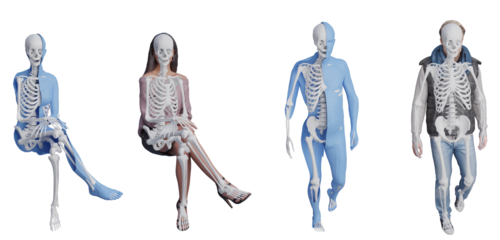
Perceiving Systems Conference Paper OSSO: Obtaining Skeletal Shape from Outside Keller, M., Zuffi, S., Black, M. J., Pujades, S. In 2022 IEEE/CVF Conference on Computer Vision and Pattern Recognition (CVPR 2022), 20460-20469, IEEE, Piscataway, NJ, IEEE/CVF Conference on Computer Vision and Pattern Recognition (CVPR 2022), June 2022 (Published)
We address the problem of inferring the anatomic skeleton of a person, in an arbitrary pose, from the 3D surface of the body; i.e. we predict the inside (bones) from the outside (skin). This has many applications in medicine and biomechanics. Existing state-of-the-art biomechanical skeletons are detailed but do not easily generalize to new subjects. Additionally, computer vision and graphics methods that predict skeletons are typically heuristic, not learned from data, do not leverage the full 3D body surface, and are not validated against ground truth. To our knowledge, our system, called OSSO (Obtaining Skeletal Shape from Outside), is the first to learn the mapping from the 3D body surface to the internal skeleton from real data. We do so using 1000 male and 1000 female dual-energy X-ray absorptiometry (DXA) scans. To these, we fit a parametric 3D body shape model (STAR) to capture the body surface and a novel part-based 3D skeleton model to capture the bones. This provides inside/outside training pairs. We model the statistical variation of full skeletons using PCA in a pose-normalized space. We then train a regressor from body shape parameters to skeleton shape parameters and refine the skeleton to satisfy constraints on physical plausibility. Given an arbitrary 3D body shape and pose, OSSO predicts a realistic skeleton inside. In contrast to previous work, we evaluate the accuracy of the skeleton shape quantitatively on held out DXA scans, outperforming the state-of-the art. We also show 3D skeleton prediction from varied and challenging 3D bodies. The code to infer a skeleton from a body shape is available for research at https://osso.is.tue.mpg.de/, and the dataset of paired outer surface (skin) and skeleton (bone) meshes is available as a Biobank Returned Dataset. This research has been conducted using the UK Biobank Resource.
Project page Paper Sup. Mat. DOI URL BibTeX
Thumb ticker lg renderpeople

Perceiving Systems Autonomous Vision Conference Paper gDNA: Towards Generative Detailed Neural Avatars Chen, X., Jiang, T., Song, J., Yang, J., Black, M. J., Geiger, A., Hilliges, O. In 2022 IEEE/CVF Conference on Computer Vision and Pattern Recognition (CVPR 2022), 204395-20405, IEEE, Piscataway, NJ, IEEE/CVF Conference on Computer Vision and Pattern Recognition (CVPR 2022), June 2022 (Published)
To make 3D human avatars widely available, we must be able to generate a variety of 3D virtual humans with varied identities and shapes in arbitrary poses. This task is challenging due to the diversity of clothed body shapes, their complex articulations, and the resulting rich, yet stochastic geometric detail in clothing. Hence, current methods to represent 3D people do not provide a full generative model of people in clothing. In this paper, we propose a novel method that learns to generate detailed 3D shapes of people in a variety of garments with corresponding skinning weights. Specifically, we devise a multi-subject forward skinning module that is learned from only a few posed, un-rigged scans per subject. To capture the stochastic nature of high-frequency details in garments, we leverage an adversarial loss formulation that encourages the model to capture the underlying statistics. We provide empirical evidence that this leads to realistic generation of local details such as clothing wrinkles. We show that our model is able to generate natural human avatars wearing diverse and detailed clothing. Furthermore, we show that our method can be used on the task of fitting human models to raw scans, outperforming the previous state-of-the-art.
Project page Video Code DOI URL BibTeX
Thumb ticker lg gdna thumbnail

Perceiving Systems Article AirPose: Multi-View Fusion Network for Aerial 3D Human Pose and Shape Estimation Saini, N., Bonetto, E., Price, E., Ahmad, A., Black, M. J. IEEE Robotics and Automation Letters, 7(2):4805-4812, IEEE, April 2022, Also accepted and presented in the 2022 IEEE International Conference on Robotics and Automation (ICRA) (Published)
In this letter, we present a novel markerless 3D human motion capture (MoCap) system for unstructured, outdoor environments that uses a team of autonomous unmanned aerial vehicles (UAVs) with on-board RGB cameras and computation. Existing methods are limited by calibrated cameras and off-line processing. Thus, we present the first method (AirPose) to estimate human pose and shape using images captured by multiple extrinsically uncalibrated flying cameras. AirPose calibrates the cameras relative to the person instead of in a classical way. It uses distributed neural networks running on each UAV that communicate viewpoint-independent information with each other about the person (i.e., their 3D shape and articulated pose). The persons shape and pose are parameterized using the SMPL-X body model, resulting in a compact representation, that minimizes communication between the UAVs. The network is trained using synthetic images of realistic virtual environments, and fine-tuned on a small set of real images. We also introduce an optimization-based post processing method (AirPose+) for offline applications that require higher mocap quality. We make code and data available for research at https://github.com/robot-perception-group/AirPose. Video describing the approach and results is available at https://youtu.be/Ss48ICeqvnQ.
paper code video pdf DOI BibTeX
Thumb ticker lg nitinirlairpose

Perceiving Systems Article Physical activity improves body image of sedentary adults. Exploring the roles of interoception and affective response Srismith, D., Dierkes, K., Zipfel, S., Thiel, A., Sudeck, G., Giel, K. E., Behrens, S. C. Current Psychology, Springer, 2022 (Published)
To reduce the number of sedentary people, an improved understanding of effects of exercise in this specific group is needed. The present project investigates the impact of regular aerobic exercise uptake on body image, and how this effect is associated with differences in interoceptive abilities and affective response to exercise. Participants were 29 sedentary adults who underwent a 12-week aerobic physical activity intervention comprised of 30–36 sessions. Body image was improved with large effect sizes. Correlations were observed between affective response to physical activity and body image improvement, but not with interoceptive abilities. Explorative mediation models suggest a neglectable role of a priori interoceptive abilities. Instead, body image improvement was achieved when positive valence was assigned to interoceptive cues experienced during exercise.
DOI BibTeX
Thumb ticker lg currentpsychology