Publications

DEPARTMENTS

Emperical Interference

Haptic Intelligence

Modern Magnetic Systems

Perceiving Systems

Physical Intelligence

Robotic Materials

Social Foundations of Computation


Research Groups

Autonomous Vision

Autonomous Learning

Bioinspired Autonomous Miniature Robots

Dynamic Locomotion

Embodied Vision

Human Aspects of Machine Learning

Intelligent Control Systems

Learning and Dynamical Systems

Locomotion in Biorobotic and Somatic Systems

Micro, Nano, and Molecular Systems

Movement Generation and Control

Neural Capture and Synthesis

Physics for Inference and Optimization

Organizational Leadership and Diversity

Probabilistic Learning Group


Topics

Robot Learning

Conference Paper

2022

Autonomous Learning

Robotics

AI

Career

Award
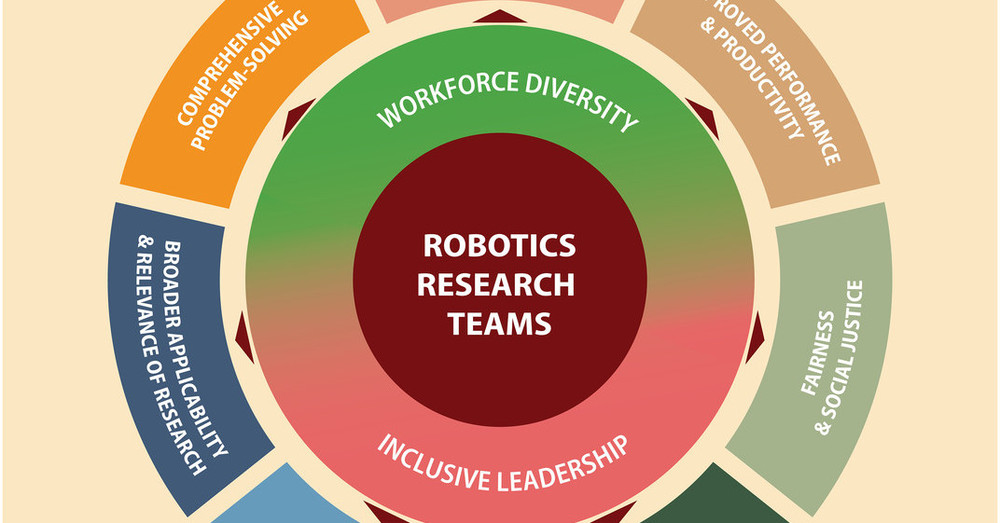

Robotic Materials Organizational Leadership and Diversity Article Accelerating the pace of innovation in robotics by fostering diversity and inclusive leadership Macari, D., Fratzl, A., Keplinger, K., Keplinger, C. Science Robotics, 9, December 2024 (Published)
Diverse and inclusive teams are not merely a moral imperative but also a catalyst for scientific excellence in robotics. Drawing from literature, a comprehensive citation analysis, and expert interviews, we derive seven main benefits of diversity and inclusion and propose a leadership guide for roboticists to reap these benefits.
DOI URL BibTeX

Haptic Intelligence Robotic Materials Article Cutaneous Electrohydraulic (CUTE) Wearable Devices for Pleasant Broad-Bandwidth Haptic Cues Sanchez-Tamayo, N., Yoder, Z., Rothemund, P., Ballardini, G., Keplinger, C., Kuchenbecker, K. J. Advanced Science, 11(48):2402461, December 2024, This article was selected for the inside front cover. https://doi.org/10.1002/advs.202470295 (Published)
By focusing on vibrations, current wearable haptic devices underutilize the skin's perceptual capabilities. Devices that provide richer haptic stimuli, including contact feedback and/or variable pressure, are typically heavy and bulky due to the underlying actuator technology and the low sensitivity of hairy skin, which covers most of the body. This paper presents a system architecture for compact wearable devices that deliver salient and pleasant broad-bandwidth haptic cues: Cutaneous Electrohydraulic (CUTE) devices combine a custom materials design for soft haptic electrohydraulic actuators that feature high stroke, high force, and electrical safety with a comfortable mounting strategy that places the actuator in a non-contact resting position. A prototypical wrist-wearable CUTE device produces rich tactile sensations by making and breaking contact with the skin (2.44 mm actuation stroke), applying high controllable forces (exceeding 2.3 N), and delivering vibrations at a wide range of amplitudes and frequencies (0-200 Hz). A perceptual study with fourteen participants achieved 97.9\% recognition accuracy across six diverse cues and verified their pleasant and expressive feel. This system architecture for wearable devices gives unprecedented control over the haptic cues delivered to the skin, providing an elegant and discreet way to activate the user's sense of touch.
Video DOI BibTeX

Haptic Intelligence Robotic Materials Miscellaneous Active Haptic Feedback for a Virtual Wrist-Anchored User Interface Bartels, J. U., Sanchez-Tamayo, N., Sedlmair, M., Kuchenbecker, K. J. Adjunct Proceedings of the Annual ACM Symposium on User Interface Software and Technology (UIST), (53)1-3, Hands-on demonstration presented at the Annual ACM Symposium on User Interface Software and Technology (UIST), Pittsburgh, USA, October 2024 (Published)
The presented system combines a virtual wrist-anchored user interface (UI) with a new low-profle, wrist-worn device that provides salient and expressive haptic feedback such as contact, pressure and broad-bandwidth vibration. This active feedback is used to add tactile cues to interactions with virtual mid-air UI elements that track the user's wrist; we demonstrate a simple menu-interaction task to showcase the utility of haptics for interactions with virtual buttons and sliders. Moving forward, we intend to use this platform to develop haptic guidelines for body-anchored interfaces and test multiple haptic devices across the body to create engaging interactions.
DOI BibTeX

Robotic Materials Article Hexagonal electrohydraulic modules for rapidly reconfigurable high-speed robots Yoder, Z., Rumley, E., Schmidt, I., Rothemund, P., Keplinger, C. Science Robotics, 9, September 2024 (Published)
Robots made from reconfigurable modular units feature versatility, cost efficiency, and improved sustainability compared with fixed designs. Reconfigurable modules driven by soft actuators provide adaptable actuation, safe interaction, and wide design freedom, but existing soft modules would benefit from high-speed and high-strain actuation, as well as driving methods well-suited to untethered operation. Here, we introduce a class of electrically actuated robotic modules that provide high-speed (a peak contractile strain rate of 4618\% per second, 15.8-hertz bandwidth, and a peak specific power of 122 watts per kilogram), high-strain (49\% contraction) actuation and that use magnets for reversible mechanical and electrical connections between neighboring modules, thereby serving as building blocks for rapidly reconfigurable and highly agile robotic systems. The actuation performance of each hexagonal electrohydraulic (HEXEL) module is enabled by a synergistic combination of soft and rigid components; a hexagonal exoskeleton of rigid plates amplifies the motion produced by soft electrohydraulic actuators and provides a mechanical structure and connection platform for reconfigurable robots composed of many modules. We characterize the actuation performance of individual HEXEL modules, present a model that captures their quasi-static force-stroke behavior, and demonstrate both a high-jumping and a fast pipe-crawling robot. Using embedded magnetic connections, we arranged multiple modules into reconfigurable robots with diverse functionality, including a high-stroke muscle, a multimodal active array, a table-top active platform, and a fast-rolling robot. We further leveraged the magnetic connections for hosting untethered, snap-on driving electronics, together highlighting the promise of HEXEL modules for creating rapidly reconfigurable high-speed robots.
Video PDF DOI URL BibTeX

Robotic Materials Article Electrohydraulic Musculoskeletal Robotic Leg for Agile, Adaptive, yet Energy-Efficient Locomotion Buchner, T. J. K., Fukushima, T., Kazemipour, A., Gravert, S., Prairie, M., Romanescu, P., Arm, P., Zhang, Y., Wang, X., Zhang, S. L., Walter, J., Keplinger, C., Katzschmann, R. K. Nature Communications, 15(1), September 2024 (Published)
Robotic locomotion in unstructured terrain demands an agile, adaptive, and energy-efficient architecture. To traverse such terrains, legged robots use rigid electromagnetic motors and sensorized drivetrains to adapt to the environment actively. These systems struggle to compete with animals that excel through their agile and effortless motion in natural environments. We propose a bio-inspired musculoskeletal leg architecture driven by antagonistic pairs of electrohydraulic artificial muscles. Our leg is mounted on a boom arm and can adaptively hop on varying terrain in an energy-efficient yet agile manner. It can also detect obstacles through capacitive self-sensing. The leg performs powerful and agile gait motions beyond 5 Hz and high jumps up to 40 \% of the leg height. Our leg’s tunable stiffness and inherent adaptability allow it to hop over grass, sand, gravel, pebbles, and large rocks using only open-loop force control. The electrohydraulic leg features a low cost of transport (0.73), and while squatting, it consumes only a fraction of the energy (1.2 \%) compared to its conventional electromagnetic counterpart. Its agile, adaptive, and energy-efficient properties would open a roadmap toward a new class of musculoskeletal robots for versatile locomotion and operation in unstructured natural environments.
Press release Video (overview) Video (technical description) Article in pdf DOI URL BibTeX

Haptic Intelligence Robotic Materials Miscellaneous Three-Dimensional Surface Reconstruction of a Soft System via Distributed Magnetic Sensing Sundaram, V. H., Smith, L., Turin, Z., Rentschler, M. E., Gonzalez Welker, C. Workshop paper (3 pages) presented at the ICRA Workshop on Advancing Wearable Devices and Applications Through Novel Design, Sensing, Actuation, and AI, Yokohama, Japan, May 2024 (Published)
This study presents a new method for reconstructing continuous 3D surface deformations for a soft pneumatic actuation system using embedded magnetic sensors. A finite element analysis (FEA) model was developed to quantify the surface deformation given the magnetometer readings, with a relative error between the experimental and the simulated sensor data of 7.8%. Using the FEA simulation solutions and a basic model-based mapping, our method achieves sub-millimeter accuracy in measuring deformation from sensor data with an absolute error between the experimental and simulated sensor data of 13.5%. These results show promise for real-time adjustments to deformation, crucial in environments like prosthetic and orthotic interfaces with human limbs.
URL BibTeX

Haptic Intelligence Robotic Materials Miscellaneous Cutaneous Electrohydraulic (CUTE) Wearable Devices for Multimodal Haptic Feedback Sanchez-Tamayo, N., Yoder, Z., Ballardini, G., Rothemund, P., Keplinger, C., Kuchenbecker, K. J. Extended abstract (1 page) presented at the IEEE RoboSoft Workshop on Multimodal Soft Robots for Multifunctional Manipulation, Locomotion, and Human-Machine Interaction, San Diego, USA, April 2024 (Published) BibTeX