TMR: Text-to-Motion Retrieval Using Contrastive 3D Human Motion Synthesis
website code paper-arxiv video


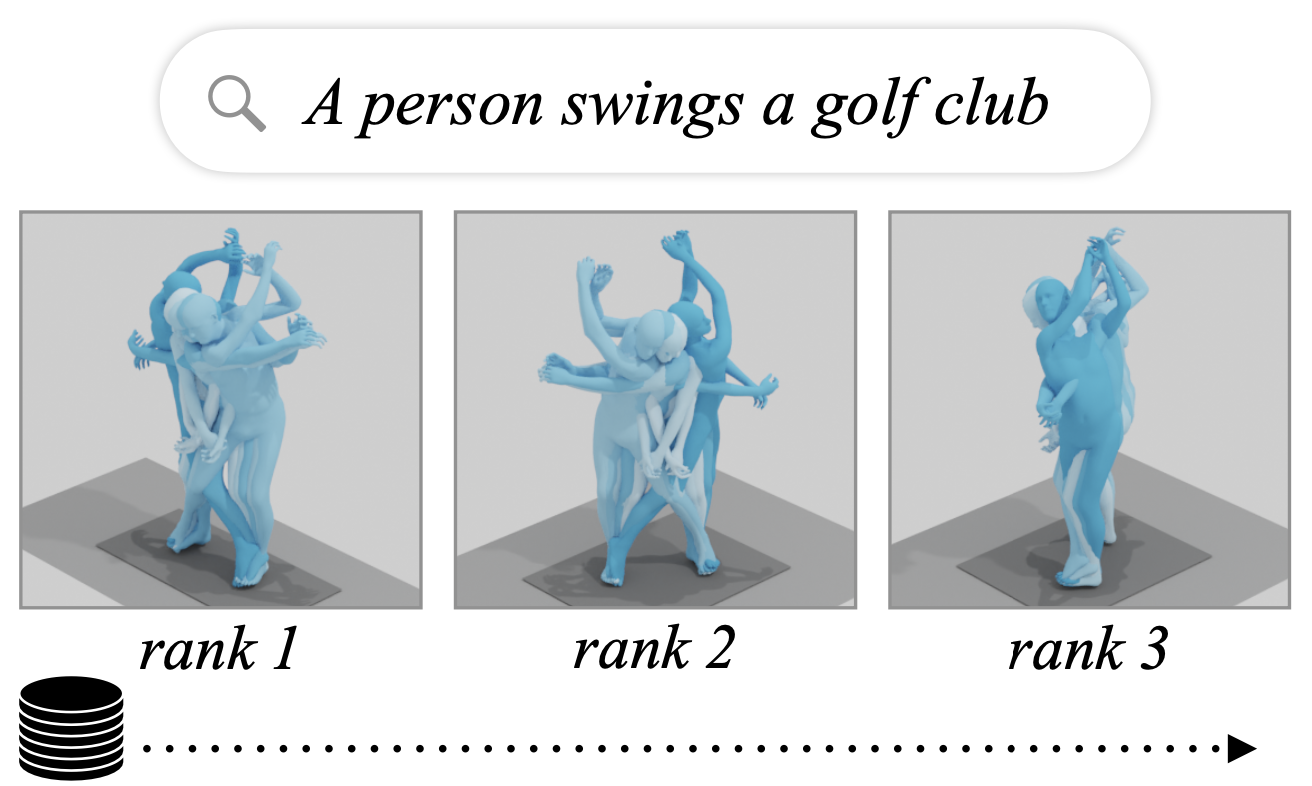
In this paper, we present TMR, a simple yet effective approach for text to 3D human motion retrieval. While previous work has only treated retrieval as a proxy evaluation metric, we tackle it as a standalone task. Our method extends the state-of-the-art text-to-motion synthesis model TEMOS, and incorporates a contrastive loss to better structure the cross-modal latent space. We show that maintaining the motion generation loss, along with the contrastive training, is crucial to obtain good performance. We introduce a benchmark for evaluation and provide an in-depth analysis by reporting results on several protocols. Our extensive experiments on the KIT-ML and HumanML3D datasets show that TMR outperforms the prior work by a significant margin, for example reducing the median rank from 54 to 19. Finally, we showcase the potential of our approach on moment retrieval. Our code and models are publicly available.
| Author(s): | Petrovich, Mathis and Black, Michael J. and Varol, Gül |
| Links: | |
| Book Title: | Proc. International Conference on Computer Vision (ICCV) |
| Pages: | 9488--9497 |
| Year: | 2023 |
| Month: | October |
| BibTeX Type: | Conference Paper (inproceedings) |
| Event Name: | International Conference on Computer Vision 2023 |
| Event Place: | Paris, France |
| State: | Published |
| URL: | https://mathis.petrovich.fr/tmr |
| Electronic Archiving: | grant_archive |
BibTeX
@inproceedings{TMR:2023,
  title = {{TMR}: Text-to-Motion Retrieval Using Contrastive {3D} Human Motion Synthesis},
  booktitle = {Proc. International Conference on Computer Vision (ICCV)},
  abstract = {In this paper, we present TMR, a simple yet effective approach for text to 3D human motion retrieval. While previous work has only treated retrieval as a proxy evaluation metric, we tackle it as a standalone task. Our method extends the state-of-the-art text-to-motion synthesis model TEMOS, and incorporates a contrastive loss to better structure the cross-modal latent space. We show that maintaining the motion generation loss, along with the contrastive training, is crucial to obtain good performance. We introduce a benchmark for evaluation and provide an in-depth analysis by reporting results on several protocols. Our extensive experiments on the KIT-ML and HumanML3D datasets show that TMR outperforms the prior work by a significant margin, for example reducing the median rank from 54 to 19. Finally, we showcase the potential of our approach on moment retrieval. Our code and models are publicly available.},
  pages = {9488--9497},
  month = oct,
  year = {2023},
  author = {Petrovich, Mathis and Black, Michael J. and Varol, G\"{u}l},
  url = {https://mathis.petrovich.fr/tmr},
  month_numeric = {10}
}