From Deformations to Parts: Motion-based Segmentation of 3D Objects
pdf supplemental code poster

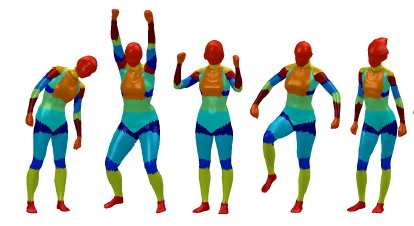
We develop a method for discovering the parts of an articulated object from aligned meshes of the object in various three-dimensional poses. We adapt the distance dependent Chinese restaurant process (ddCRP) to allow nonparametric discovery of a potentially unbounded number of parts, while simultaneously guaranteeing a spatially connected segmentation. To allow analysis of datasets in which object instances have varying 3D shapes, we model part variability across poses via affine transformations. By placing a matrix normal-inverse-Wishart prior on these affine transformations, we develop a ddCRP Gibbs sampler which tractably marginalizes over transformation uncertainty. Analyzing a dataset of humans captured in dozens of poses, we infer parts which provide quantitatively better deformation predictions than conventional clustering methods.
| Author(s): | Ghosh, Soumya and Sudderth, Erik and Loper, Matthew and Black, Michael |
| Links: | |
| Book Title: | Advances in Neural Information Processing Systems 25 (NIPS) |
| Pages: | 2006--2014 |
| Year: | 2012 |
| Editors: | P. Bartlett and F.C.N. Pereira and C.J.C. Burges and L. Bottou and K.Q. Weinberger |
| Publisher: | MIT Press |
| Project(s): |
|
| BibTeX Type: | Conference Paper (inproceedings) |
| URL: | https://proceedings.neurips.cc/paper/2012/file/a1140a3d0df1c81e24ae954d935e8926-Paper.pdf |
| Electronic Archiving: | grant_archive |
BibTeX
@inproceedings{Ghosh:NIPS:2012,
  title = {From Deformations to Parts: Motion-based Segmentation of {3D} Objects },
  booktitle = {Advances in Neural Information Processing Systems 25 (NIPS)},
  abstract = {We develop a method for discovering the parts of an articulated object from aligned meshes of the object in various three-dimensional poses. We adapt the distance dependent Chinese restaurant process (ddCRP) to allow nonparametric discovery of a potentially unbounded number of parts, while simultaneously guaranteeing a spatially connected segmentation. To allow analysis of datasets in which object instances have varying 3D shapes, we model part variability across poses via affine transformations. By placing a matrix normal-inverse-Wishart prior on these affine transformations, we develop a ddCRP Gibbs sampler which tractably marginalizes over transformation uncertainty. Analyzing a dataset of humans captured in dozens of poses, we infer parts which provide quantitatively better deformation predictions than conventional clustering methods.},
  pages = {2006--2014},
  editors = {P. Bartlett and F.C.N. Pereira and C.J.C. Burges and L. Bottou and K.Q. Weinberger},
  publisher = {MIT Press},
  year = {2012},
  author = {Ghosh, Soumya and Sudderth, Erik and Loper, Matthew and Black, Michael},
  url = {https://proceedings.neurips.cc/paper/2012/file/a1140a3d0df1c81e24ae954d935e8926-Paper.pdf}
}