Recovering Intrinsic Images with a Global Sparsity Prior on Reflectance
website + code


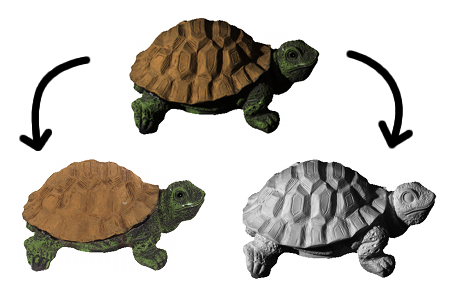
We address the challenging task of decoupling material properties from lighting properties given a single image. In the last two decades virtually all works have concentrated on exploiting edge information to address this problem. We take a different route by introducing a new prior on reflectance, that models reflectance values as being drawn from a sparse set of basis colors. This results in a Random Field model with global, latent variables (basis colors) and pixel-accurate output reflectance values. We show that without edge information high-quality results can be achieved, that are on par with methods exploiting this source of information. Finally, we are able to improve on state-of-the-art results by integrating edge information into our model. We believe that our new approach is an excellent starting point for future developments in this field.
| Author(s): | Peter Gehler and Carsten Rother and Martin Kiefel and Lumin Zhang and Bernhard Schölkopf |
| Links: | |
| Book Title: | Advances in Neural Information Processing Systems 24 |
| Pages: | 765-773 |
| Year: | 2011 |
| Editors: | Shawe-Taylor, John and Zemel, Richard S. and Bartlett, Peter L. and Pereira, Fernando C. N. and Weinberger, Kilian Q. |
| Publisher: | Curran Associates, Inc. |
| Project(s): |
|
| BibTeX Type: | Conference Paper (inproceedings) |
| Address: | Red Hook, NY, USA |
| Event Name: | Twenty-Fifth Annual Conference on Neural Information Processing Systems (NIPS 2011) |
| Event Place: | Granada, Spain |
| Electronic Archiving: | grant_archive |
| Attachments: | |
BibTeX
@inproceedings{gehler11nips,
  title = {Recovering Intrinsic Images with a Global Sparsity Prior on Reflectance},
  booktitle = {Advances in Neural Information Processing Systems 24},
  abstract = {We address the challenging task of decoupling material properties from lighting properties given a single image. In the last two decades virtually all works have concentrated on exploiting edge information to address this problem. We take a different route by introducing a new prior on reflectance, that models reflectance values as being drawn from a sparse set of basis colors. This results in a Random Field model with global, latent variables (basis colors) and pixel-accurate output reflectance values. We show that without edge information high-quality results can be achieved, that are on par with methods exploiting this source of information. Finally, we are able to improve on state-of-the-art results by integrating edge information into our model. We believe that our new approach is an excellent starting point for future developments in this field.},
  pages = {765-773},
  editors = {Shawe-Taylor, John and Zemel, Richard S. and Bartlett, Peter L. and Pereira, Fernando C. N. and Weinberger, Kilian Q.},
  publisher = {Curran Associates, Inc.},
  address = {Red Hook, NY, USA},
  year = {2011},
  author = {Gehler, Peter and Rother, Carsten and Kiefel, Martin and Zhang, Lumin and Sch{\"o}lkopf, Bernhard}
}