Capturing Hand Motion with an RGB-D Sensor, Fusing a Generative Model with Salient Points
pdf Supplementary pdf Supplementary Material Project Page


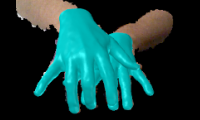
Hand motion capture has been an active research topic in recent years, following the success of full-body pose tracking. Despite similarities, hand tracking proves to be more challenging, characterized by a higher dimensionality, severe occlusions and self-similarity between fingers. For this reason, most approaches rely on strong assumptions, like hands in isolation or expensive multi-camera systems, that limit the practical use. In this work, we propose a framework for hand tracking that can capture the motion of two interacting hands using only a single, inexpensive RGB-D camera. Our approach combines a generative model with collision detection and discriminatively learned salient points. We quantitatively evaluate our approach on 14 new sequences with challenging interactions.
| Author(s): | Dimitrios Tzionas and Abhilash Srikantha and Pablo Aponte and Juergen Gall |
| Links: | |
| Book Title: | German Conference on Pattern Recognition (GCPR) |
| Pages: | 1-13 |
| Year: | 2014 |
| Month: | September |
| Series: | Lecture Notes in Computer Science |
| Publisher: | Springer |
| Project(s): | |
| BibTeX Type: | Conference Paper (inproceedings) |
| DOI: | 10.1007/978-3-319-11752-2_22 |
| Event Name: | GCPR 2014 |
| Electronic Archiving: | grant_archive |
BibTeX
@inproceedings{GCPR_2014_Tzionas_Gall,
  title = {Capturing Hand Motion with an RGB-D Sensor, Fusing a Generative Model with Salient Points},
  booktitle = {German Conference on Pattern Recognition (GCPR)},
  abstract = {Hand motion capture has been an active research topic in recent years, following the success of full-body pose tracking. Despite similarities, hand tracking proves to be more challenging, characterized by a higher dimensionality, severe occlusions and self-similarity between fingers.
  For this reason, most approaches rely on strong assumptions, like hands in isolation or expensive multi-camera systems, that limit the practical use. In this work, we propose a framework for hand tracking that can capture the motion of two interacting hands using only a single, inexpensive RGB-D camera. Our approach combines a generative model with collision detection and discriminatively learned salient points. We quantitatively evaluate our approach on 14 new sequences with challenging interactions. },
  pages = {1-13},
  series = {Lecture Notes in Computer Science},
  publisher = {Springer},
  month = sep,
  year = {2014},
  author = {Tzionas, Dimitrios and Srikantha, Abhilash and Aponte, Pablo and Gall, Juergen},
  doi = {10.1007/978-3-319-11752-2_22},
  month_numeric = {9}
}