Automated Detection of New or Evolving Melanocytic Lesions Using a 3D Body Model
pdf Poster


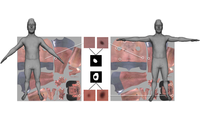
Detection of new or rapidly evolving melanocytic lesions is crucial for early diagnosis and treatment of melanoma.We propose a fully automated pre-screening system for detecting new lesions or changes in existing ones, on the order of 2 - 3mm, over almost the entire body surface. Our solution is based on a multi-camera 3D stereo system. The system captures 3D textured scans of a subject at diff erent times and then brings these scans into correspondence by aligning them with a learned, parametric, non-rigid 3D body model. This means that captured skin textures are in accurate alignment across scans, facilitating the detection of new or changing lesions. The integration of lesion segmentation with a deformable 3D body model is a key contribution that makes our approach robust to changes in illumination and subject pose.
| Author(s): | Federica Bogo and Javier Romero and Enoch Peserico and Michael J. Black |
| Links: | |
| Book Title: | Medical Image Computing and Computer-Assisted Intervention (MICCAI) |
| Volume: | 8673 |
| Pages: | 593--600 |
| Year: | 2014 |
| Month: | September |
| Series: | Lecture Notes in Computer Science |
| Editors: | Golland, Polina and Hata, Nobuhiko and Barillot, Christian and Hornegger, Joachim and Howe, Robert |
| Publisher: | Spring International Publishing |
| Project(s): |
|
| BibTeX Type: | Conference Paper (inproceedings) |
| DOI: | 10.1007/978-3-319-10404-1_74 |
| Event Name: | Medical Image Computing and Computer-Assisted Intervention (MICCAI) |
| Event Place: | Boston, MA, USA |
| Electronic Archiving: | grant_archive |
BibTeX
@inproceedings{bogo:miccai:2014,
title = {Automated Detection of New or Evolving Melanocytic Lesions Using a {3D} Body Model},
booktitle = {Medical Image Computing and Computer-Assisted Intervention (MICCAI)},
abstract = {Detection of new or rapidly evolving melanocytic lesions is crucial for early diagnosis and treatment of melanoma.We propose a fully automated pre-screening system for detecting new lesions or changes in existing ones, on the order of 2 - 3mm, over almost the entire body surface. Our solution is based on a multi-camera 3D stereo system. The system captures 3D textured scans of a subject at diff
erent times and then brings these scans into correspondence by aligning them with a learned, parametric, non-rigid 3D body model. This means that captured skin textures are in accurate alignment across scans, facilitating the detection of new or changing lesions. The integration of lesion segmentation with a deformable 3D body model is a key contribution that makes our approach robust to changes in illumination and subject pose.},
volume = {8673},
pages = {593--600},
series = {Lecture Notes in Computer Science},
editors = {Golland, Polina and Hata, Nobuhiko and Barillot, Christian and Hornegger, Joachim and Howe, Robert},
publisher = {Spring International Publishing},
month = sep,
year = {2014},
author = {Bogo, Federica and Romero, Javier and Peserico, Enoch and Black, Michael J.},
doi = {10.1007/978-3-319-10404-1_74},
month_numeric = {9}
}