TEMOS: Generating Diverse Human Motions from Textual Descriptions
website code paper-arxiv video


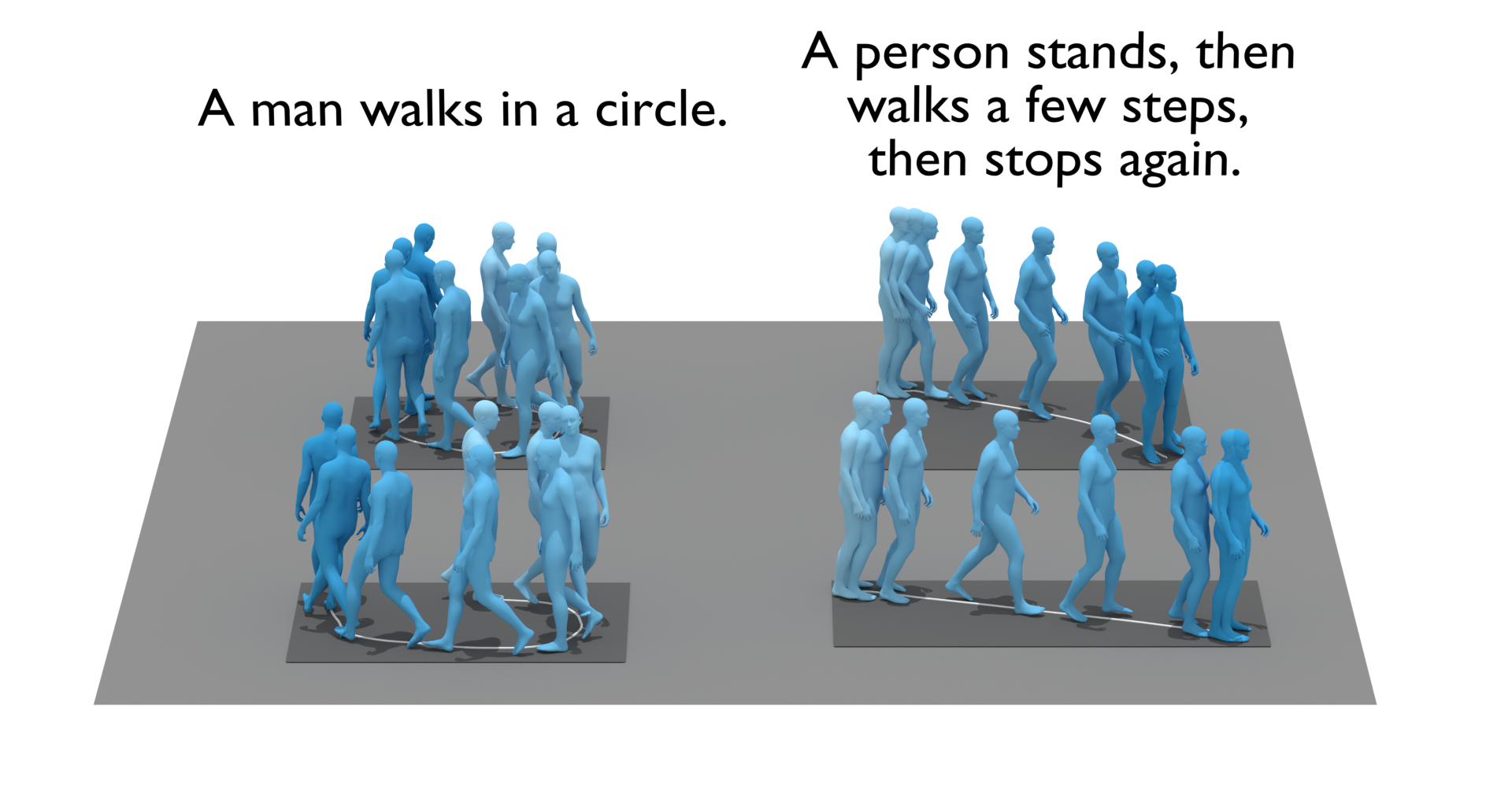
We address the problem of generating diverse 3D human motions from textual descriptions. This challenging task requires joint modeling of both modalities: understanding and extracting useful human-centric information from the text, and then generating plausible and realistic sequences of human poses. In contrast to most previous work which focuses on generating a single, deterministic, motion from a textual description, we design a variational approach that can produce multiple diverse human motions. We propose TEMOS, a text-conditioned generative model leveraging variational autoencoder (VAE) training with human motion data, in combination with a text encoder that produces distribution parameters compatible with the VAE latent space. We show the TEMOS framework can produce both skeleton-based animations as in prior work, as well more expressive SMPL body motions. We evaluate our approach on the KIT Motion-Language benchmark and, despite being relatively straightforward, demonstrate significant improvements over the state of the art. Code and models are available on our webpage.
| Award: | (Oral) |
| Author(s): | Petrovich, Mathis and Black, Michael J. and Varol, Gül |
| Links: | |
| Book Title: | European Conference on Computer Vision (ECCV 2022) |
| Year: | 2022 |
| Month: | October |
| Publisher: | Springer International Publishing |
| Project(s): | |
| BibTeX Type: | Conference Paper (inproceedings) |
| DOI: | 10.1007/978-3-031-20047-2_28 |
| Event Name: | ECCV 2022 |
| Event Place: | Tel Aviv, Israel |
| State: | Published |
| URL: | https://mathis.petrovich.fr/temos |
| Award Paper: | Oral |
| Electronic Archiving: | grant_archive |
| ISBN: | 978-3-031-20046-5 |
BibTeX
@inproceedings{TEMOS:2022,
  title = {{TEMOS}: Generating Diverse Human Motions from Textual Descriptions},
  aword_paper = {Oral},
  booktitle = {European Conference on Computer Vision (ECCV 2022)},
  abstract = {We address the problem of generating diverse 3D human motions from textual descriptions. This challenging task requires joint modeling of both modalities: understanding and extracting useful human-centric information from the text, and then generating plausible and realistic sequences of human poses. In contrast to most previous work which focuses on generating a single, deterministic, motion from a textual description, we design a variational approach that can produce multiple diverse human motions. We propose TEMOS, a text-conditioned generative model leveraging variational autoencoder (VAE) training with human motion data, in combination with a text encoder that produces distribution parameters compatible with the VAE latent space. We show the TEMOS framework can produce both skeleton-based animations as in prior work, as well more expressive SMPL body motions. We evaluate our approach on the KIT Motion-Language benchmark and, despite being relatively straightforward, demonstrate significant improvements over the state of the art. Code and models are available on our webpage.},
  publisher = {Springer International Publishing},
  month = oct,
  year = {2022},
  author = {Petrovich, Mathis and Black, Michael J. and Varol, G\"{u}l},
  doi = {10.1007/978-3-031-20047-2_28},
  url = {https://mathis.petrovich.fr/temos},
  month_numeric = {10}
}