Modern Magnetic Systems Members Publications

Measurement Evaluation - gFORC Interpretation

Members

Modern Magnetic Systems
  • Research Group Leader
no image
Modern Magnetic Systems

Publications

Modern Magnetic Systems Article Tuning the magnetic properties of permalloy-based magnetoplasmonic crystals for sensor applications Murzin, D. V., Belyaev, V. K., Groß, F., Gräfe, J., Rivas, M., Rodionova, V. V. Japanese Journal of Applied Physics, 59(SE):SEEA04, IOP Publishing Ltd, Bristol, England, 2020
Miniature magnetic sensors based on magnetoplasmonic crystals (MPlCs) exhibit high sensitivity and high spatial resolution, which can be obtained by the excitation of surface plasmon polaritons. A field dependence of surface plasmon polaritons' enhanced magneto-optical response strongly correlates with magnetic properties of MPlCs that can be tuned by changing spatial parameters, such as the period and height of diffraction gratings and thicknesses of functional layers. This work compares the magnetic properties of MPlCs based on Ni80Fe20 (permalloy) obtained from local (longitudinal magneto-optical Kerr effect) and bulk (vibrating-sample magnetometry) measurements and demonstrates an ability to control sensors' performance through changing the magnetic properties of the MPlCs. The influence of the substrate's geometry (planar or sinusoidal and trapezoidal diffraction grating profiles) and the thickness of the surface layer is examined.
DOI BibTeX

Modern Magnetic Systems Article Interpreting first-order reversal curves beyond the Preisach model: An experimental permalloy microarray investigation Groß, F., Ilse, S. E., Schütz, G., Gräfe, J., Goering, E. {Physical Review B}, 99(6), American Physical Society, Woodbury, NY, 2019
First-order reversal curves (FORCs) are a powerful tool to separate microscopic coercivities and interactions in a system without the need for lateral resolution. However, measured FORC densities are not always straightforward to interpret, especially if the system is interaction dominated and the Preisach-like interpretation of the FORC density breaks down. This is why FORC is often seen as a magnetic fingerprint instead of a measurement method yielding quantitative information. To understand additional features arising from the interactions in the system, we purposely designed permalloy microstructures which violate the Mayergoyz criteria. These artificial systems allow us to isolate the origin of an additional interaction peak in the FORC density. Modeling the system as a superposition of dipoles allows us to extract interaction strength parameters from this static simulation. Additionally, we suggest a linear relation between integrated interaction peak volume and interaction strength within the system. The presented correlation could be used to investigate the interaction behavior of samples as a function of structural parameters within a series of FORC measurements. This is an important step towards a more quantitative understanding of FORCs which violate the Mayergoyz criteria and away from a fingerprint interpretation.
DOI BibTeX

Modern Magnetic Systems Article gFORC: A graphics processing unit accelerated first-order reversal-curve calculator Groß, F., Martínez-García, J. C., Ilse, S. E., Schütz, G., Goering, E., Rivas, M., Gräfe, J. {Journal of Applied Physics}, 126(16), AIP Publishing, New York, NY, 2019
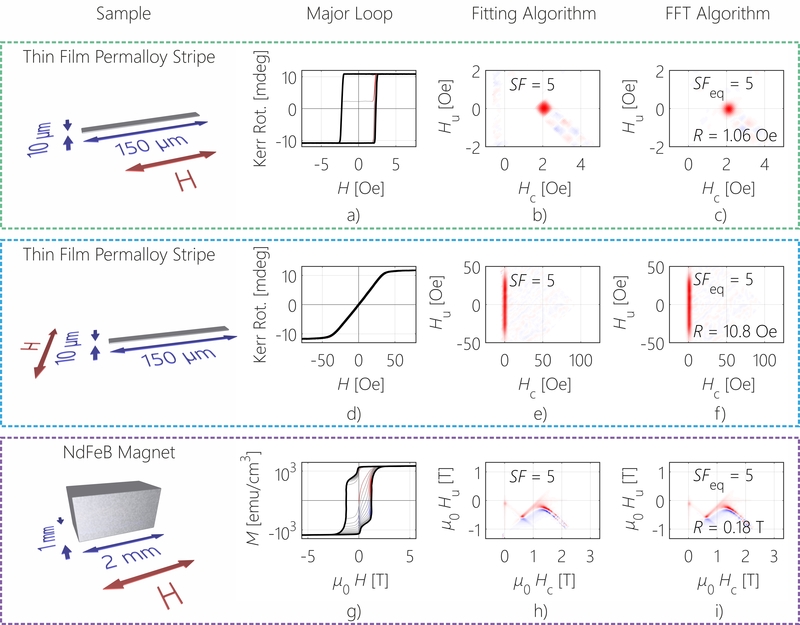
First-order reversal-curves have proven to be an indispensable characterization tool for physics as well as for geology. However, the conventional evaluation algorithm requires a lot of computational effort for a comparable easy task to overcome measurement noise. In this work, we present a new evaluation approach, which exploits the diversity of Fourier space to not only speed up the calculation by a factor of 1000 but also move away from the conventional smoothing factor toward real field resolution. By comparing the baseline resolution of the new and the old algorithm, we are able to deduce an analytical equation that converts the smoothing factor into field resolution, making the old and new algorithm comparable. We find excellent agreement not only for various systems of increasing complexity but also over a large range of smoothing factors. The achieved speedup enables us to calculate a large number of first-order reversal-curve diagrams with increasing smoothing factor allowing for an autocorrelation approach to find a hard criterion for the optimum smoothing factor. This previously computational prohibitive evaluation of first-order reversal-curves solves the problem of over- and undersmoothing by increasing general readability and preventing information destruction.
DOI BibTeX

Modern Magnetic Systems Article Temperature-dependent first-order reversal curve measurements on unusually hard magnetic low-temperature phase of MnBi Muralidhar, S., Gräfe, J., Chen, Y., Etter, M., Gregori, G., Ener, S., Sawatzki, S., Hono, K., Gutfleisch, O., Kronmüller, H., Schütz, G., Goering, E. J. {Physical Review B}, 95(2), American Physical Society, Woodbury, NY, 2017
We have performed first-order reversal curve (FORC) measurements to investigate the irreversible magnetization processes in the low-temperature phase of MnBi. Using temperature-dependent FORC analysis, we are able to provide a clear insight into the effects of microstructural parameters such as grain diameter, shape, and surface composition on the coercivity of nucleation hardened permanent magnet MnBi. FORC diagrams of MnBi show a unique broadening and narrowing of the coercive field distribution with increasing temperature. We were able to microscopically identify the reason for this behavior, based on the shift in the single domain critical diameter from nearly 1 to 2 μm, thereby changing the dependence of coercivity with particle size. This is based on a strong increase in the uniaxial anisotropy constant with increasing temperature. Furthermore, the results also give an additional confirmation that the magnetic hardening in low-temperature phase MnBi occurs due to nucleation mechanisms. In our case, we show that temperature-dependent FORC measurements provide a powerful tool for the microscopic understanding of high-performance permanent magnet systems.
DOI BibTeX

Modern Magnetic Systems Article Combined first-order reversal curve and x-ray microscopy investigation of magnetization reversal mechanisms in hexagonal antidot lattices Gräfe, J., Weigand, M., Stahl, C., Träger, N., Kopp, M., Schütz, G., Goering, E. J., Haering, F., Ziemann, P., Wiedwald, U. {Physical Review B}, 93(1), American Physical Society, Woodbury, NY, 2016
The magnetization reversal in nanoscaled antidot lattices is widely investigated to understand the tunability of the magnetic anisotropy and the coercive field through nanostructuring of thin films. By investigating highly ordered focused ion beam milled antidot lattices with a combination of first-order reversal curves and magnetic x-ray microscopy, we fully elucidate the magnetization reversal along the distinct orientations of a hexagonal antidot lattice. This combination proves especially powerful as all partial steps of this complex magnetization reversal can be identified and subsequently imaged. Through this approach we discovered several additional steps that were neglected in previous studies. Furthermore, by imaging the microscopic magnetization state during each reversal step, we were able to link the coercive and interaction fields determined by the first-order reversal curve method to true microscopic magnetization configurations and determine their origin.
DOI BibTeX

Modern Magnetic Systems Article Geometric control of the magnetization reversal in antidot lattices with perpendicular magnetic anisotropy Gräfe, J., Weigand, M., Träger, N., Schütz, G., Goering, E. J., Skripnik, M., Nowak, U., Haering, F., Ziemann, P., Wiedwald, U. {Physical Review B}, 93(10), American Physical Society, Woodbury, NY, 2016
While the magnetic properties of nanoscaled antidot lattices in in-plane magnetized materials have widely been investigated, much less is known about the microscopic effect of hexagonal antidot lattice patterning on materials with perpendicular magnetic anisotropy. By using a combination of first-order reversal curve measurements, magnetic x-ray microscopy, and micromagnetic simulations we elucidate the microscopic origins of the switching field distributions that arise from the introduction of antidot lattices into out-of-plane magnetized GdFe thin films. Depending on the geometric parameters of the antidot lattice we find two regimes with different magnetization reversal processes. For small antidots, the reversal process is dominated by the exchange interaction and domain wall pinning at the antidots drives up the coercivity of the system. On the other hand, for large antidots the dipolar interaction is dominating which leads to fragmentation of the system into very small domains that can be envisaged as a basis for a bit patterned media.
DOI BibTeX

Modern Magnetic Systems Conference Paper Combined FORC and x-ray microscopy study of magnetisation reversal in antidot lattices Gräfe, J., Haering, F., Stahl, C., Weigand, M., Skripnik, M., Nowak, U., Ziemann, P., Wiedwald, U., Schütz, G., Goering, E. In IEEE International Magnetics Conference (INTERMAG 2015), IEEE, Beijing, China, 2015 DOI BibTeX

Modern Magnetic Systems Article Application of magneto-optical Kerr effect to first-order reversal curve measurements Gräfe, J., Schmidt, M., Audehm, P., Schütz, G., Goering, E. {Review of Scientific Instruments}, 85, American Institute of Physics, Woodbury, N.Y. [etc.], 2014
First-order reversal curves (FORC) are a powerful method for magnetic sample characterization, separating all magnetic states of an investigated system according to their coercivity and internal magnetic interactions. A major drawback of using measurement techniques like VSM or SQUID, typically applied for FORC acquisition, is the long measurement time, limiting the resolution and the number of measurements due to time constraints. Faster techniques like MOKE result in problems regarding measurement stability over the curse of the acquisition of many minor loops, due to drift and non-absolute magnetization values. Here, we present an approach using a specialized field shape providing two anchor points for each minor loop for applying the magneto-optical Kerr effect (MOKE) technique to FORC measurements. This results in a high field resolution while keeping the total acquisition time to only a few minutes. MOKE FORC measurements are exemplarily applied to a simple permalloy film, an exchange-bias system, and a Gd/Fe multilayer system with perpendicular magnetic anisotropy, showcasing the versatility of the method.
DOI BibTeX