Organizational Leadership and Diversity Members Publications

Simulating Leadership Emergence
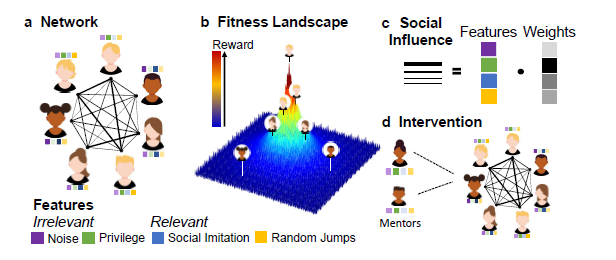
Framework for modeling leadership emergence through agent-based simulations.

Members

Organizational Leadership and Diversity
Research Group Leader
Organizational Leadership and Diversity
  • Doctoral Researcher

Publications

Organizational Leadership and Diversity Conference Paper Constructing and deconstructing bias: modeling privilege and mentorship in agent-based simulations Smith, A., Heuschkel, S., Keplinger, K., Wu, C. Conference on Cognitive Computational Neuroscience, 10.32470/CCN.2023.1257-0, Conference on Cognitive Computational Neuroscience, Oxford, UK, Conference on Cognitive Computational Neuroscience, August 2023 (Published)
Bias exists in how we pick leaders, who we perceive as being influential, and who we interact with, not only in society, but in organizational contexts. Drawing from leadership emergence and social influence theories, we investigate potential interventions that support diverse leaders. Using agent-based simulations, we model a collective search process on a fitness landscape. Agents combine individual and social learning, and are represented as a feature vector blending relevant (e.g., individual learning characteristics) and irrelevant (e.g., race or gender) features. Agents use rational principles of learning to estimate feature weights on the basis of performance predictions, which are used to dynamically define social influence in their network. We show how biases arise based on historic privilege, but can be drastically reduced through the use of an intervention (e.g. mentorship). This work provides important insights into the cognitive mechanisms underlying bias construction and deconstruction, while pointing towards real-world interventions to be tested in future empirical work.
CCN2023 DOI URL BibTeX

Organizational Leadership and Diversity Conference Paper Unlearning the bias: An agent-based simulation for increasing diversere presentation through leadership emergence Smith, A., Heuschkel, S., Keplinger, K., Wu, C. In Proceedings of the 45th Annual Conference of the Cognitive Science Society, https://escholarship.org/uc/item/5mq9v0rm, Sydney, Australia, Proceedings of the 45th Annual Conference of the Cognitive Science Society, July 2023 (Published)
Despite increased interest in creating more diverse and inclusive organizational environments, bias exists in how we choose leaders, who we interact with, and who we consider influential. Drawing from leadership emergence theory, we investigate potential interventions that support diverse leaders. Using agent-based simulations, we model a collective search process on a fitness landscape. Agents combine individual and social learning, and are represented as a feature vector blending relevant (e.g., individual learning characteristics) and irrelevant (e.g., race or gender) features. Agents use rational principles of learning to estimate feature weights on the basis of performance predictions, which are used to dynamically define social influence in their network. We show how biases arise based on historic privilege, but can be drastically reduced through the use of an intervention (e.g. mentorship). This framework allows us to test interventions best suited for unlearning bias in favor of performance-relevant traits.
DOI URL BibTeX