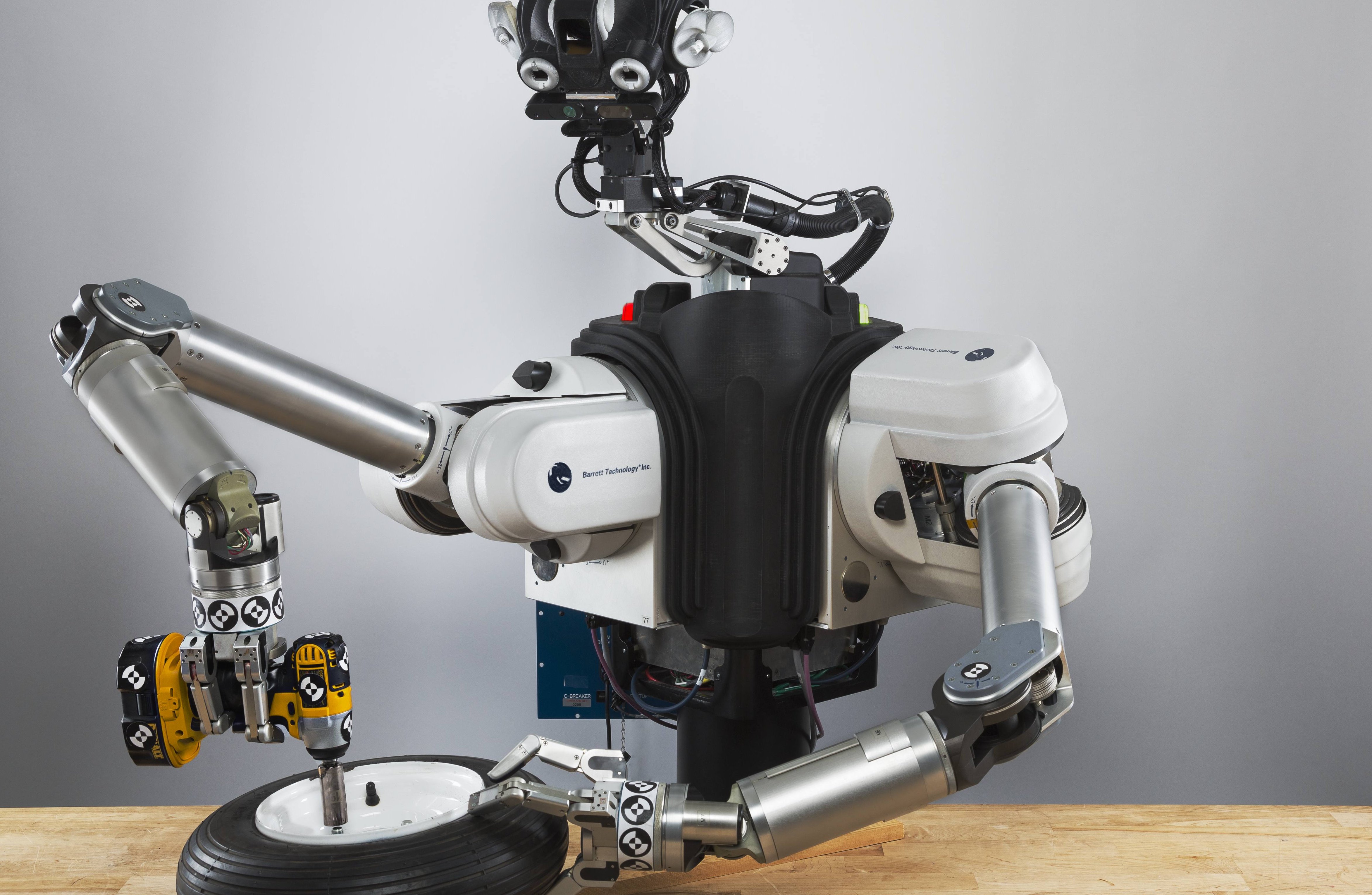
We address the problem of tracking the 6-DoF pose of an object while it is being manipulated by a human or a robot. We use a dynamic Bayesian network to perform inference and compute a posterior distribution over the current object pose. Depending on whether a robot or a human manipulates the object, we employ a process model with or without knowledge of control inputs. Observations are obtained from a range camera. As opposed to previous object tracking methods, we explicitly model self-occlusions and occlusions from the environment, e.g, the human or robotic hand. This leads to a strongly non-linear observation model and additional dependencies in the Bayesian network. We employ a Rao-Blackwellised particle filter to compute an estimate of the object pose at every time step. In a set of experiments, we demonstrate the ability of our method to accurately and robustly track the object pose in real-time while it is being manipulated by a human or a robot.
Learning complex motor skills for real world tasks
is a hard problem in robotic manipulation that often requires
painstaking manual tuning and design by a human expert.
In this work, we present a Reinforcement Learning based
approach to acquiring new motor skills from demonstration.
Our approach allows the robot to learn fine manipulation skills
and significantly improve its success rate and skill level starting
from a possibly coarse demonstration. Our approach aims to
incorporate task domain knowledge, where appropriate, by
working in a space consistent with the constraints of a specific
task. In addition, we also present an approach to using sensor
feedback to learn a predictive model of the task outcome. This
allows our system to learn the proprioceptive sensor feedback
needed to monitor subsequent executions of the task online and
abort execution in the event of predicted failure. We illustrate
our approach using two example tasks executed with the PR2
dual-arm robot: a straight and accurate pool stroke and a box
flipping task using two chopsticks as tools.